
Google’s AutoFDO Kernel Optimization Is Rolling Out Across Android 15, 16, and 17
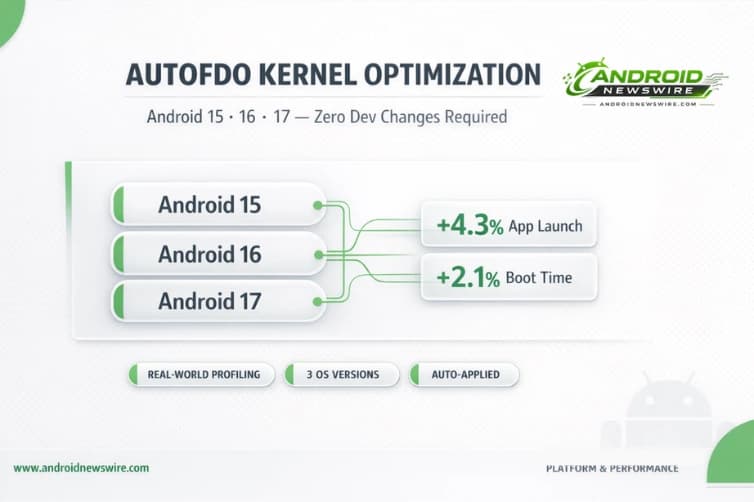
Google has confirmed the rollout of AutoFDO — Automatic Feedback-Directed Optimization — across the Android kernel, and the scope of the deployment is broader than initially reported. The optimization is not being held back for Android 17 alone. It is being applied retroactively across Android 15, 16, and 17 builds, meaning the performance uplift lands on a significantly larger installed base than a single future release would reach. For developers, the headline numbers are a 2.1% improvement in boot times and a 4.3% improvement in app launch speeds — and neither requires a single line of code change.
AutoFDO: What It Is and Why It Works
Feedback-Directed Optimization is a compiler technique that has powered performance-critical infrastructure software for decades. The core idea: instead of compiling code based only on what the source looks like at build time, the compiler uses data about how the code actually executes in the real world — which functions get called most often, which branches are taken, where the CPU spends the most cycles — and uses that knowledge to produce a more efficient binary.
Traditional FDO requires running an instrumented build of the software on real hardware to gather profiling data. For a server application, that is manageable. For an operating system kernel running on hundreds of millions of consumer devices, it is not — an instrumented kernel carries too much overhead to deploy to production devices at scale.
AutoFDO solves this with hardware performance counters. Modern CPUs include built-in, low-overhead sampling hardware that can passively observe execution patterns without an instrumented build. Google collects aggregated hardware profiling data from opted-in Pixel devices during normal use, feeds that data back into the kernel’s compilation pipeline, and produces a kernel binary that has been shaped by real-world Android usage — not lab assumptions. The result is better branch prediction, improved instruction cache utilization, and more efficient CPU pipeline usage across the kernel’s most frequently executed code paths.
The Numbers: 2.1% Faster Boots, 4.3% Faster App Launches
Internal testing on Pixel devices running the AutoFDO-optimized kernel has produced two concrete figures:
~2.1% faster boot times. Android’s boot sequence is one of the most latency-sensitive operations on the platform — the kernel, init, Zygote, SystemServer, and all platform services initialize in a tightly coordinated chain. A 2.1% improvement at the kernel level propagates across that entire sequence. For enterprise device fleets where reboots happen regularly at scale, that compounds meaningfully.
~4.3% faster app launches. This is the metric with the most direct user impact. App launch latency correlates directly with user retention — Google’s own research has established that every additional 100ms of launch delay increases abandonment probability. A 4.3% kernel-level improvement means every app on the platform launches faster — not just apps that have been individually hand-optimized, not just apps targeting Android 17, and not just apps from studios with dedicated performance teams. Every app, automatically, on every affected device.
The mechanism behind the launch improvement is primarily better CPU instruction cache efficiency. The kernel’s process spawning, Binder IPC, and memory management code paths — all on the critical path of app launch — execute with fewer cache misses and fewer branch mispredictions. The CPU spends less time waiting and more time working.
Three Android Versions Affected — Not Just Android 17
The most significant detail in Google’s AutoFDO rollout is its scope. The optimization is being applied across Android 15, Android 16, and Android 17 kernel builds. This is not staged as a future feature arriving with the next major Android release — it is a retroactive performance improvement being pushed into active builds.
What this means in practice:
Android 15 devices — which represent the largest share of the current Pixel installed base — will receive the AutoFDO-optimized kernel without requiring users to wait for an Android 17 upgrade. Pixel devices on Android 15 should see the performance improvement via a system-level kernel update within existing OS builds.
Android 16 devices — currently available to developers through QPR builds — will include AutoFDO-optimized kernels as part of their release build pipeline going forward.
Android 17, targeting June 2026 stable release, will ship with AutoFDO baked into its kernel from day one. New devices launching on Android 17 will have the optimization from their first boot.
For OEM devices from Samsung, OnePlus, Motorola, and others, the timeline depends on when those manufacturers adopt the updated kernel builds into their own Android branches. Since the optimization lives at the AOSP kernel level and is hardware-agnostic, OEM adoption in Android 17-based builds is expected — though the specific profiling data used will reflect Google’s Pixel-derived usage patterns unless OEMs run their own AutoFDO profiling pipelines.
Developer Impact: Two Things to Know
Google’s rollout of AutoFDO is transparent to developers — no API changes, no manifest updates, no targetSdkVersion considerations. But there are two practical implications that developers with active performance monitoring should be aware of.
- Perceived app startup times will improve.
Apps that are already well-optimized for launch will see their launch times improve further as the platform’s kernel-level efficiency improves beneath them. Apps that have launch performance issues will also see improvement, though kernel optimization does not substitute for app-level fixes — heavy main-thread initialization, synchronous disk reads at startup, and blocking Binder calls on the main thread remain worth addressing regardless of platform improvements.
The practical upside is that the rising performance floor benefits your users immediately across Android 15, 16, and 17 without waiting for an app update cycle.
- Performance profiling results will differ from previous builds.
This is the more operationally important point for developers running automated performance benchmarks. If your CI/CD pipeline includes launch time benchmarks, Perfetto traces, or Macrobenchmark runs against specific Android builds, expect those numbers to shift when AutoFDO-optimized kernel builds land on your test devices.
Specifically: benchmark runs on Android 15, 16, or 17 builds with AutoFDO-optimized kernels will show faster results than the same benchmarks on pre-AutoFDO builds on identical hardware. This is not a measurement error or a test flake — it is the optimization working. Update your performance baselines accordingly when you transition test devices to AutoFDO builds, and document the kernel version alongside your benchmark results to maintain meaningful historical comparisons.
If you are using the Android Macrobenchmark library or Jetpack Benchmark for startup time measurement, the raw numbers will improve. This is also a good moment to re-evaluate your performance budgets — if launch times were previously borderline acceptable, the new baseline gives you headroom, but also raises user expectations over time as the broader ecosystem benefits from the same improvement.
Battery Life: The Compounding Benefit
Google has not published a specific battery life improvement figure for AutoFDO, and measuring that accurately across diverse real-world usage patterns is genuinely difficult. But the physics are straightforward: a kernel that completes the same work in fewer CPU cycles means the processor spends more time in low-power states. Over a full day of normal use, the aggregate effect of those marginal efficiency gains at the kernel level compounds into measurable battery savings.
Combined with the Play Store wake lock enforcement that went live March 4 — which targets apps that hold excessive wake locks and drain battery in the background — the platform is tightening up power efficiency from both directions simultaneously: the OS becoming more efficient at the kernel level, and the app ecosystem being held to stricter battery standards at the distribution level.
Where AutoFDO Fits in Android’s Optimization Stack
AutoFDO is the kernel-layer piece of a performance optimization strategy Google has been building across the entire Android stack:
At the app runtime layer, ART (the Android Runtime) has used profile-guided JIT and AOT compilation for years — collecting per-app execution profiles to optimize hot methods automatically after the first few runs of each app.
At the system component layer, core Android libraries and framework code have been compiled with LLVM Profile-Guided Optimization and Link Time Optimization in recent Android releases.
At the app delivery layer, Google Play delivers ART-optimized APK profiles to devices before the app is even launched for the first time, eliminating the “cold start” penalty that previously occurred on new installs.
AutoFDO at the kernel layer completes this stack — every layer from kernel to runtime to app delivery is now being optimized using real-world execution data rather than static analysis alone.
For developers, this means Android 17 in particular will be the most comprehensively profile-optimized version of Android ever shipped. When combined with the hardware-level improvements in the Snapdragon 8 Elite Gen 5 powering the Galaxy S26 and the continued expansion of Play System Updates for modular feature delivery, the platform stack arriving in mid-2026 represents a meaningful step forward in baseline performance for every user and every app.
For a broader view of how Google is using AI and profiling data to reshape Android development tooling, see our coverage of Android Bench — Google’s new benchmark for measuring how accurately AI coding tools handle Android-specific development tasks.
Bottom Line
AutoFDO is unglamorous infrastructure work. It does not ship a feature users will point to in a spec sheet comparison. But its impact — faster launches, faster boots, better battery efficiency, across three Android versions simultaneously — is more tangible for day-to-day device experience than most visible feature additions.
For developers: update your performance baselines, expect your benchmark numbers to shift, and recognize that the platform is doing more of the hard performance optimization work automatically beneath your app layer. For users: your Android device is about to get measurably faster through a software update, without any app updates required.