
AI Smart Glasses Shipments Jump 776% as VR Headsets Collapse – And Google, Samsung, Apple Haven’t Even Launched Yet
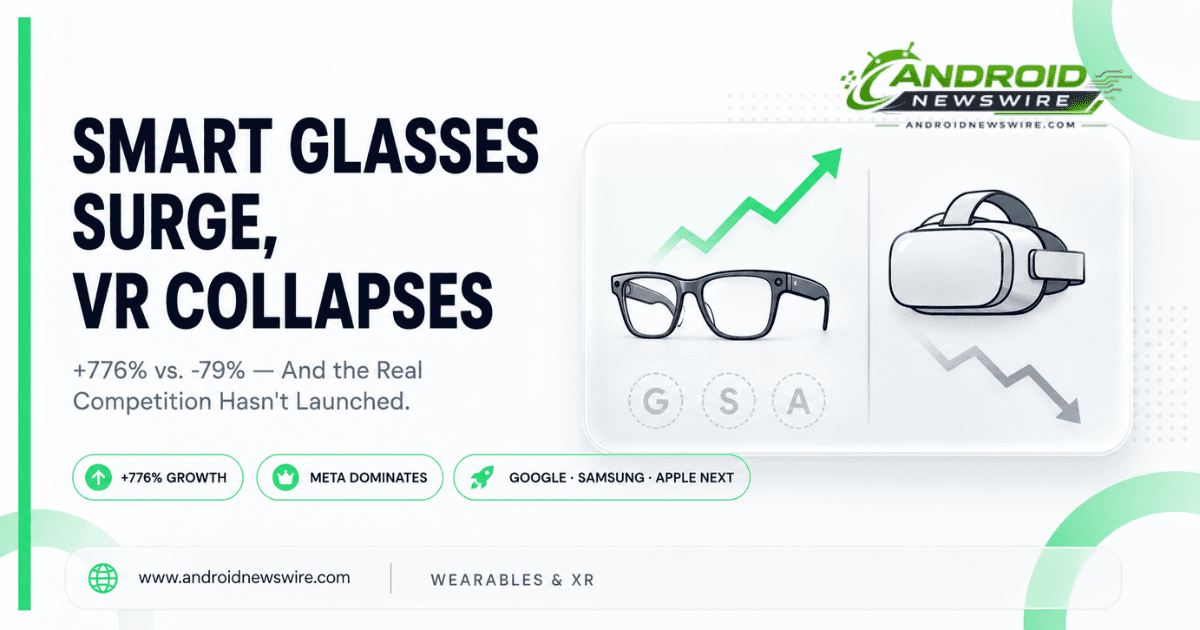
The numbers coming out of the wearable tech industry this quarter tell a genuinely lopsided story. According to research firm Smart Analytics Global, AI smart glasses shipments surged 776% year-over-year in Q2 2026, while VR headset shipments dropped 79% over the same period. Overall smart eyewear shipments grew 89% to reach 4 million units for the quarter. And the part that should genuinely worry anyone invested in the VR category long-term: all of this happened before Google, Samsung, and Apple have even brought their own dedicated smart glasses products to market.
The Numbers Behind the Shift
This isn’t an isolated data point from a single research firm cherry-picking a favorable quarter. Multiple independent analysts are converging on the same directional story, even where their specific figures diverge. Mixed and virtual reality headset shipments are expected to decline 42.8% in 2025, while the rest of the XR market grows 211.2% over the same period. Zooming out to the full category, the XR market shipped 14.5 million devices globally in 2025, a 41.6% increase over 2024 – growth that wasn’t distributed evenly, since smart glasses drove almost all of it while standalone VR and mixed reality headsets actually contracted in the first half of the year.
Perhaps the single most telling number in this entire trend comes from inside Meta’s own business. In 2025, Meta’s smart glasses revenue reached $2.15 billion, exceeding its Quest VR hardware revenue of $660 million for the first time ever. That’s a company whose entire “metaverse” strategy was built around VR headsets a few years ago, now generating more than three times as much revenue from glasses that don’t even include a screen.
Meta Owns This Category – For Now
Right now, this is overwhelmingly Meta’s market to lose. Estimates on exactly how dominant Meta’s position is vary depending on the source – Smart Analytics Global puts Meta’s share of the AI glasses space above 76%, while other research firms have put the figure even higher, in the low-to-mid 80s. Whatever the precise number, every credible estimate agrees on the core fact: Meta is running well clear of the rest of the field.
The product driving that dominance is display-less: simple, audio-and-camera-equipped glasses that add AI capability without adding a screen, weight, or the awkwardness of wearing an obvious piece of technology on your face. EssilorLuxottica, Meta’s manufacturing partner, reported selling more than 7 million AI glasses units across the Ray-Ban Meta and Oakley Meta lines in full-year 2025 alone, and the company’s most recent quarterly results describe AI glasses revenue nearly doubling in the second quarter of 2026 specifically.
Why VR Headsets Are Struggling So Badly
It’s worth being precise about why this shift is happening, rather than treating it as a simple case of one category being trendier than another. Smart glasses ask people to change a habit – putting on something new every day – in a way a phone upgrade never does, yet they’re still succeeding where VR asks for something even more disruptive: dedicating a period of time to being fully visually and physically cut off from your surroundings. That’s a meaningfully higher barrier to daily, casual use than a pair of glasses that looks and functions almost like a normal accessory.
Meta has slowed the pace of new VR headset launches as its Quest 3 and Quest 3S move further into the mature stage of their product lifecycle, while Apple’s Vision Pro has fallen short of initial sales expectations and Samsung’s Galaxy XR headset has yet to gain significant market traction. That’s three of the industry’s biggest players simultaneously showing softening commitment or underwhelming results in the standalone headset category – not exactly a picture of a segment gathering momentum.
The financial toll on Meta specifically has been enormous. Meta’s Reality Labs division has accumulated approximately $92.2 billion in cumulative operating losses through June 30, 2026, including $8.65 billion in losses in just the first six months of 2026 alone, with a further $4.62 billion operating loss recorded in the second quarter of 2026 specifically. Those are staggering numbers for a division whose flagship hardware category is now being outsold, in revenue terms, by a comparatively simple pair of camera-equipped sunglasses from the same company.
The Real Story: Nobody’s Real Competition Has Launched Yet
Here’s the detail that should reframe how anyone in the Android ecosystem reads this data. Every number cited above reflects a market where Meta is effectively running unopposed by any of the companies with the resources and platform reach to genuinely challenge it. Google’s Android XR platform and its hardware partners are expected to introduce new products and raise consumer awareness, creating real opportunities for other brands to challenge Meta’s dominance. Apple has separately signaled its intent to enter the smart glasses market by late 2026, though no product has shipped and no specific launch date has been confirmed.
And Samsung has already made its move this month. Our own coverage of Samsung’s Galaxy Unpacked event detailed the official reveal of Samsung’s Intelligent Eyewear – smart glasses built in partnership with Google, running Android XR with Gemini built in, developed alongside Gentle Monster and Warby Parker, arriving later this fall. That single product launch alone represents the first serious, platform-backed Android challenger entering a category where the incumbent has, until now, faced essentially no comparable competition.
Where Growth Goes From Here
Forecasts diverge on exact figures but agree on direction. IDC projects 13.6 million smart glasses units shipped in 2026, growing to 27.3 million by 2030 – an 18.9% compound annual growth rate – with revenue reaching $5.1 billion in 2026 and $6.4 billion in 2027, before pricing pressure is expected to set in. Average selling prices are expected to fall from roughly $376 today as the category scales and competition intensifies – exactly the kind of price compression that tends to follow once multiple well-funded competitors enter a category previously dominated by one player.
Longer-term projections point in the same direction. The XR near-eye display market’s composition is forecast to shift dramatically, with VR’s market share dropping from 72% in 2026 to just 43% by 2032, while AR’s share climbs from 28% to 57% over the same period.
What This Means for Android and Google’s Ecosystem Specifically
For anyone following Google’s platform strategy, this data lands at a genuinely important moment. Google has spent the better part of this year building out Android XR as the software layer for exactly this category, and Samsung’s Intelligent Eyewear is the first major hardware partner to ship something built on it. If the current growth trajectory holds – and every research firm cited here agrees on the direction even where they disagree on the magnitude – Android XR is positioned to enter a genuinely expanding market at almost the ideal moment: after Meta has proven consumer demand is real and durable, but before any other major platform has meaningfully contested Meta’s lead.
The honest caveat worth including: shipment figures measure units moved into the market, not confirmed sales to end users, and definitely not evidence of sustained daily use once the novelty wears off. Whether Samsung’s Galaxy Glasses, an eventual Google-branded product, or Apple’s rumored entry can actually convert Meta’s current runaway lead into genuine multi-player competition – rather than simply adding volume to a category Meta still dominates – is the real open question this data can’t yet answer.