
Android XR Glasses Are No Longer Prototypes — Two Products Confirmed for 2026 at Google I/O
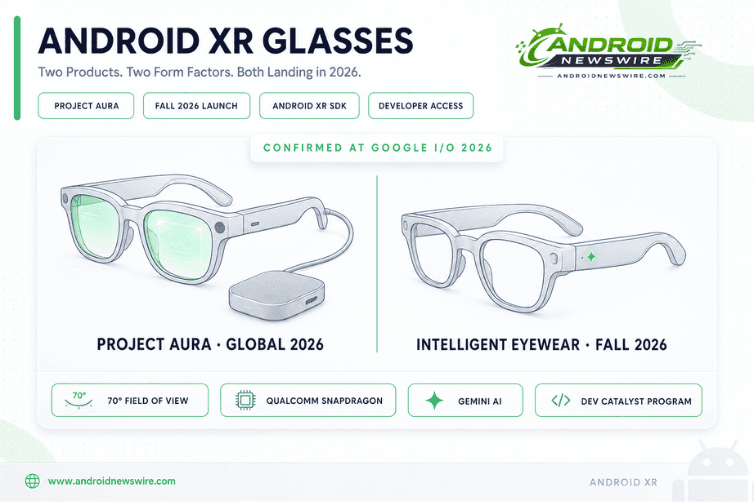
Google I/O 2026 marked the moment Android XR smart glasses transitioned from a research preview into a product category with confirmed launch timelines, real hardware on the show floor, and developer programmes open for applications. Two distinct glasses products were announced — serving different use cases, different price brackets, and different definitions of what “smart glasses” means.
Product 1: XREAL Project Aura — Full AR, Shipping Before Year-End
XREAL has confirmed that its Project Aura glasses will be launching before the end of 2026, with a new programme granting developers early access. XREAL Project Aura was announced a year ago as the first pair of wired Android XR glasses — effectively a lightweight headset compared to something like Galaxy XR, while also allowing for improved passthrough by means of being able to look through the physical display and out to the real world through glass instead of watching a video feed.
Running on the Android XR operating system with Qualcomm Snapdragon hardware, the lightweight glasses feature an optical see-through design with a 70-degree field of view and a split-compute external puck. The device integrates deeply with Gemini AI for automated 3D window layout creation.
The split-compute architecture — glasses doing display and sensor work while the external puck handles the heavy processing — is the design compromise that makes the glasses genuinely lightweight. Rather than packing a full SoC into the frame and accepting the heat and battery weight that comes with it, Project Aura offloads computation to a Qualcomm Snapdragon-powered puck that connects via a cable. The result is a glasses form factor rather than a headset form factor.
The most unique software capability centres on the onboard multimodal Gemini AI integration. When connected to a computer using a native DisplayPort link, the software platform automatically triggers a process called autospatialization. This workflow converts standard flat laptop applications, legacy mobile software, and traditional video assets into floating 3D windows instantly.
The autospatialization capability is the headline productivity use case: connect Project Aura to your laptop via DisplayPort and your flat 2D desktop environment becomes a 3D spatial workspace with floating windows you arrange in your field of view. The Gemini integration allows voice control of that workspace — ask Gemini to bring forward a specific window, launch an app, or summarise on-screen content without touching the keyboard.
Google and XREAL are also working together on a programme that will grant developers early access to Project Aura hardware, with the “Android XR Developer Catalyst Programme” offering opportunities to build on the hardware ahead of the general launch. Applications for the Android XR Developer Catalyst Programme are open now at the Android XR developer portal.
Product 2: Google + Samsung Intelligent Eyewear — Fall 2026, Voice-First
Google and Samsung have officially teased their first pair of Android XR glasses, with the first batch of styles launching in Fall 2026. These glasses are designed to be a companion to your smartphone and as a means to “access help through voice interaction.” This includes navigation assistance, placing orders at restaurants, and summarised notifications for “important texts,” as well as calendar additions and real-time translation — all powered by Gemini.
This is a fundamentally different product from Project Aura. Where XREAL’s glasses are full AR — layering digital content over your physical field of view — the Google/Samsung intelligent eyewear is audio-first. During the Google I/O keynote speech, there was a live demo of Google’s audio glasses showcasing the Gemini capabilities without the need to pull out your phone.
The audio-only approach dramatically simplifies the hardware requirements and the resulting form factor. Glasses that deliver Gemini through speakers and microphones rather than through a display can look exactly like normal eyewear — which is the decisive advantage this category has over full AR devices for mainstream adoption. The promise of a device that does not announce itself as a technology product to everyone in the room is more valuable for everyday use than a superior feature set in a conspicuous form factor.
The Fall 2026 launch timeline puts both Samsung Galaxy Watch 8-aligned hardware and the intelligent eyewear in the same release window — a coordinated Samsung ecosystem announcement that connects wearables to glasses within a single product moment.
The Two-Track Android XR Ecosystem
The simultaneous announcement of two different glasses products — full AR and audio-first — clarifies the Android XR ecosystem strategy that has been building since Google I/O 2025.
Android XR as a platform supports the full spectrum from full spatial computing (Galaxy XR headset) through wired AR glasses (Project Aura) to audio companion devices (Google/Samsung intelligent eyewear). Each tier serves a different use case and a different price sensitivity. Together they represent Google’s answer to the question Apple has been answering with Vision Pro and AirPods simultaneously: spatial computing and audio intelligence are different products for different contexts, and a single platform should serve both.
For developers, the Android XR SDK Developer Preview 4 — released this week as confirmed at The Android Show — now includes APIs for both the display and audio glasses form factors. Jetpack Compose Glimmer for display-based UI and the audio glasses interaction model for voice-first experiences are both part of the same SDK. The Android XR Developer Catalyst Programme is the fastest path to early hardware for building against both.