Google I/O 2026 Starts Tomorrow — Here Is Everything Still to Come After Last Week’s Android Show
Last Tuesday, The Android Show | I/O Edition delivered what Google called the biggest year for Android yet. Gemini Intelligence. Googlebooks. AppFunctions. Contextual Suggestions. The Android 17 consumer reveal. Every Android-forward announcement that used to live inside the I/O keynote now has its own dedicated stage one week earlier.
That means tomorrow’s Google I/O 2026 keynote is a different kind of event from any previous I/O. The Android news has already landed. We aren’t expecting to hear a lot about Android — Google already pulled that off this week with its Android Show I/O Edition — but we do anticipate plenty of Gemini AI updates. We’re sure there will be more to check out.
What remains is arguably more consequential for the long-term direction of the platform: Gemini 4, the developer documentation that turns last week’s announcements into APIs developers can actually ship, Android XR Developer Preview 4, the full Googlebooks SDK story, new Android Studio agentic tooling, and whatever surprises Google has held back from both the Android Show and the weeks of pre-I/O coverage.
Here is everything you need going into tomorrow.
When and How to Watch
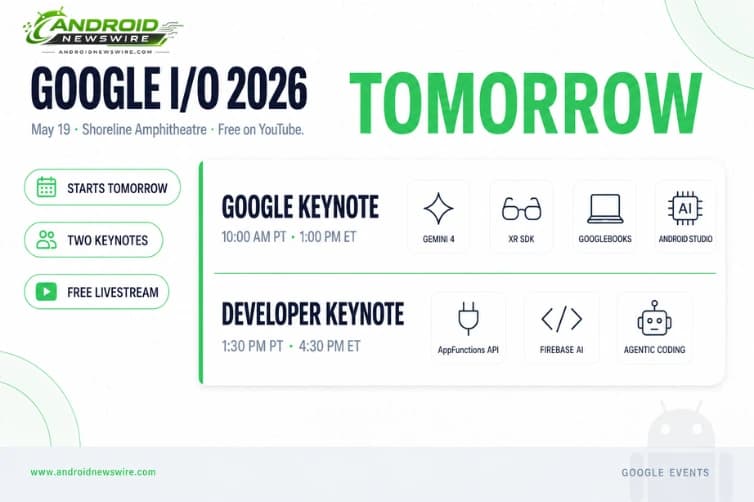
Google I/O 2026 runs May 19–20 at Shoreline Amphitheatre, Mountain View, California.
The main keynote kicks off on Tuesday, May 19, at 1 p.m. ET, followed by multiple developer sessions, workshops, and announcements throughout the event.
| Session | Time (PT) | Time (ET) | Time (BST) | Time (IST) |
|---|---|---|---|---|
| 🎯 Google Keynote | 10:00 AM | 1:00 PM | 6:00 PM | 10:30 PM |
| 👨💻 Developer Keynote | 1:30 PM | 4:30 PM | 9:30 PM | 2:00 AM (May 20) |
All keynotes and sessions are streaming live at io.google, and on Google’s official YouTube channel. No ticket or registration required to watch. Developer sessions will be uploaded to the Google for Developers YouTube channel after the event for on-demand viewing.
Block both keynotes in your calendar. The Google Keynote at 10 AM PT is the platform narrative — Gemini, AI infrastructure, the products story. The Developer Keynote at 1:30 PM PT is where Firebase, Android Studio, APIs, and the toolchain get the detailed treatment. For Android developers, both sessions are essential. The Developer Keynote is where you get the specifics you need to actually ship.
What the Android Show Already Settled
Before getting into what I/O will deliver, it is worth being precise about what is already confirmed so we do not spend tomorrow waiting for things that already arrived.
Android 17 — Platform Stability confirmed, June stable launch on track. App Bubbles, native App Lock, Material 3 Expressive, Desktop Mode, screen recording redesign, Contacts Picker, SMS OTP three-hour delay — all confirmed and covered. The Android 17 consumer reveal happened last Tuesday.
Gemini Intelligence — Announced. Cross-app task automation, Create My Widget via RemoteCompose, Rambler voice cleanup, Personal Intelligence Autofill. Rolling out summer 2026 starting on latest Galaxy and Pixel hardware.
AppFunctions API — Announced and in early access. The no-code automation path and the deeper API integration path both exist. KakaoTalk and 25 other apps are already in the early access programme. Apply now at the Android developer portal.
Googlebooks — Named and confirmed, with Acer, ASUS, Dell, HP, and Lenovo as hardware partners. Magic Pointer demonstrated. But the developer SDK, pricing, launch timeline, and full capability details are I/O’s job.
Contextual Suggestions — Rolling out now on Pixel 10 via Play Services 26.18. On-device AI, data never leaves the phone, fully covered in our dedicated article.
Everything above is settled. What follows is what is still to come.
1. Gemini 4 — The Most Anticipated AI Announcement of the Year
This is the headline that Google I/O 2026 will be remembered for, and it has nothing to do with Android specifically. Google is expected to announce an upgraded version of its advanced Gemini AI, possibly called Gemini 4.0. The update could bring more sophisticated capabilities and deeper integration across the company’s products.
The confirmed session themes point to three capability areas: a context window expansion beyond Gemini 3.1 Ultra’s 2 million tokens; native multimodal capabilities without transcription preprocessing; and three dedicated agentic coding sessions — a direct response to Claude Code and OpenAI Codex.
The competitive context is pointed. OpenAI shipped GPT-5 in early 2026 with significant capability gains. Anthropic’s Claude 4 has been cited by developers as the most capable agentic coding model currently available. Gemini 4 is the direct response to Claude Code and OpenAI Codex. If the context window rumours are accurate — 10 million tokens or more — Gemini 4 would leapfrog the current field in long-context reasoning.
For Android developers, Gemini 4’s capabilities flow directly into every API they just learned about at the Android Show. AppFunctions powered by Gemini 4 rather than Gemini 3.1 Ultra is a materially different developer proposition. Android Studio’s Agent Mode running on Gemini 4 with an expanded context window can handle larger, more complex codebases than it could last month. Gemini Intelligence’s cross-app automation becomes meaningfully more capable when the model behind it can hold more context across longer task chains.
Do not watch the Google Keynote for the Android story. Watch it for the Gemini 4 announcement and what it means for every AI-powered surface you build on.
2. Android XR Developer Preview 4 — Smart Glasses SDK Goes Full
Android XR SDK Developer Preview 4 is arriving next week — meaning this week, at I/O. It adds Jetpack Compose Glimmer to create glanceable interfaces for display glasses, and Jetpack Projected APIs to bridge phone experiences into a user’s field of view.
The XR announcement at The Android Show was consumer-facing: here are the smart glasses, here are the fashion partners, here is what they can do. Google I/O is where that story becomes developer-actionable. Developer Preview 4 is the SDK release that Android XR developers have been waiting for — the one that adds the glasses-specific APIs required to build the kind of contextual, ambient experiences the hardware is designed to deliver.
From foldables, tablets, compatible cars, XR headsets, and new Googlebooks devices, the canvas for Android apps has expanded across screens and form factors. The Developer Keynote’s Adaptive Everywhere theme is the umbrella narrative that unifies phone, tablet, foldable, car, glasses, and Googlebooks as a single platform with a single developer model. Developer Preview 4 is the SDK piece that completes that picture.
For developers evaluating whether to build for Android XR: the launch of Developer Preview 4 at I/O is the moment that early-mover advantage becomes tangible. The glasses are confirmed for 2026. The SDK drops this week. The window to be in the glasses app ecosystem from day one is open right now.
3. AppFunctions Full API Documentation — From Preview to Buildable
At The Android Show, Google announced AppFunctions and opened an early access programme. What was not delivered was full public developer documentation — the reference guide, the code samples, the integration walkthrough, the schema specification for natural language action descriptions.
That documentation lands at I/O. Developers can currently test the APIs locally and apply for the AppFunctions Early Access Program. Google added that developers can choose between “no-code change” app automation or deeper integration through AppFunctions APIs for more control.
The transition from early access to documented, publicly available API is what I/O formalises. After the Developer Keynote, AppFunctions moves from a feature you heard about last Tuesday to an API you can build against with full documentation, schema references, and sample integrations. If you applied for early access, Tuesday afternoon is when you get the full toolkit. If you have not applied yet, Tuesday is when the full developer guide appears on developer.android.com.
4. Googlebooks Developer SDK — How to Build for Android’s New PC Platform
Googlebooks are designed to work closely with the broader Android ecosystem. Several details are still unknown, including final pricing, hardware specifications, processors, battery life, and how much AI processing will happen on-device versus in the cloud.
The Android Show confirmed Googlebooks exist, named the hardware partners, demonstrated Magic Pointer, and showed Create My Widget running on a laptop. What it did not deliver was the developer SDK — the toolchain developers need to target Googlebooks as a distinct form factor with its own capabilities.
Android 17 “Adaptive Everywhere” merges Android, ChromeOS, and XR into a single platform — the biggest Android developer change since Material Design. I/O is where the single app target for phone, tablet, laptop, and XR gets fully documented.
The practical developer question is whether Googlebooks requires a new build target, new manifest declarations, or separate APK configurations — or whether the existing Android adaptive layout system, plus Jetpack Navigation 3’s Scene decorators, is sufficient to produce an acceptable Googlebooks experience from an existing Android app. The Developer Keynote is where that question gets answered.
5. Android Studio — Next Generation Agentic Tooling
Android Studio Panda 3 went stable in April with Agent Skills and granular AI permissions. Panda 4 Release Candidate 1 is already in the pipeline. I/O is typically where Google gives Android Studio’s next direction its most comprehensive presentation.
Three dedicated agentic coding sessions are confirmed at I/O 2026 — a direct response to competitive pressure from Claude Code and OpenAI Codex. With Gemini 4’s expanded capabilities announced at the keynote, the Developer Keynote follows with what those capabilities enable in the IDE: larger context windows for agent-mode code navigation, improved multi-file refactoring reliability, deeper integration between Android Studio’s agent and the AppFunctions API surface, and the Google One AI Pro/Ultra tier integration confirmed in Panda 4 Canary.
For development teams evaluating whether to invest in AI-assisted Android development tooling: the I/O sessions on agentic coding are the most detailed public documentation Google will produce this year on where Android Studio’s AI capabilities are heading. Watch them live or watch them on-demand — they are the sessions most likely to change how your team works.
6. Firebase and Backend AI Infrastructure
Firebase has historically received one of I/O’s larger dedicated segments, and this year the AI integration story is substantial. Google previewed Firebase AI extensions for Gemini-powered backend workflows at the start of 2026. I/O is where those extensions become documented, production-ready features.
The Developer Keynote at 1:30 p.m. PT is where Firebase, Android Studio, and the toolchain story gets pressure-tested with specifics. For full-stack Android developers who build their own backend infrastructure, the Firebase sessions are worth prioritising alongside the Android Developer Keynote.
7. The Wildcard: Pixel Hardware
Hardware is a low-confidence story for I/O. Engadget flags a possible Pixel 11 tease, but notes Google has consistently saved major Pixel and Pixel Watch launches for a dedicated hardware event in August or October, timed well clear of Apple’s September iPhone announcement.
Maybe Google was waiting for the stars to be properly aligned before setting the shop live. Hopefully, it’s on sale at the Google Store once Pichai walks off the stage. The Google Store has had a “coming soon” holding page for a product matching the Pixel 11 Pro description since early May.
Pixel 11 at I/O is possible but not likely as a shipping product — a tease or specification preview is more consistent with Google’s recent pattern. The dedicated Pixel hardware event in August is the more probable venue for a full launch with pricing and pre-order availability. Treat Pixel hardware as a bonus rather than a certainty tomorrow.
The Session to Not Miss
For Android developers, there is one session above all others that warrants live watching: the Android Developer Keynote at 1:30 PM PT on May 19. Not because it will have more surprising news than the Google Keynote — it almost certainly will not — but because it will have more actionable news. The API documentation drops, the SDK samples go live, and the session structure tells you exactly where to start.
Google’s initial I/O 2026 announcement says to expect updates on everything “from Gemini to Android, Chrome, Cloud, and more.” For an Android developer, the “more” is the part worth staying up for. The AppFunctions walkthrough, the Googlebooks build target documentation, the Android XR Developer Preview 4 SDK tour, and the agentic coding demo with Gemini 4 are all in that Developer Keynote.
We will be live on Android News Wire from the first keynote through the last session. Every announcement, every new API, every piece of developer documentation that drops — covered as fast as it happens. Bookmark us, check back tomorrow morning, and we will see you at 10 AM.
Related on Android News Wire: