
Google’s Android Show Teaser Shows a Transparent Android Robot – And the Boss Just Said It’s Not What You Think
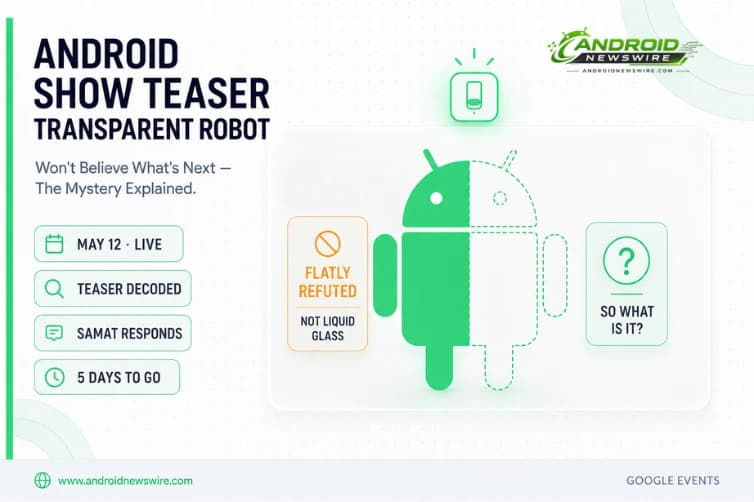
Google released a short teaser video this week for The Android Show | I/O Edition, streaming May 12, and it did something very deliberate: it made the Android robot go transparent. The content of the teaser video has raised some concerns, however. It shows the green droid jumping around and pulling a light switch. It then appears to turn transparent, a visual that’s being used elsewhere in I/O teasers.
The internet’s immediate conclusion was predictable. Apple introduced a sweeping “Liquid Glass” design language across iOS 26 and macOS Tahoe – a frosted, translucent, glass-like aesthetic applied across system UI. Google has been moving in a similar visual direction with Material 3 Expressive’s blur effects throughout Android 17 beta builds. A transparent Android robot in a pre-show teaser felt like the most obvious possible signal that Android was going all-in on the same aesthetic for its May 12 reveal.
Then the head of Android himself stepped in. That has led some to think that Google might be about to implement a “liquid glass” effect like Apple, although that’s been flatly refuted by Sameer Samat, Google’s president of Android.
Samat’s denial is not a hedge or a careful “that’s not the right framing” deflection. It is a flat refutation. And a flat refutation from the president of Android, issued publicly about a visual in his own company’s teaser, is itself a clue about what the teaser is actually pointing toward.
What the Teaser Actually Shows – and What It Might Mean
The visual sequence is specific: the Android robot is animated, energetic, jumping around. It pulls a light switch – a toggle, an activation, a moment of change. Then it becomes transparent. Not frosted glass. Not blurred. Transparent – as in see-through, as in the robot is still there but you can see through it to whatever is behind it.
Taken literally, this is not a description of a visual design language. It is a description of a capability – something that is present but unobtrusive, something that operates in the background, something that is there when you need it and invisible when you don’t.
That description maps almost perfectly onto the vision of Gemini that Google has been articulating all year. Not an assistant you open in an app. Not a feature you invoke deliberately. An intelligence layer that is present throughout the OS – ambient, contextual, transparent in the sense that it works without demanding your attention. When Gemini orders your food through screen automation on Pixel 10, you are not interacting with an AI app – you are interacting with your phone, and the intelligence is invisible beneath the surface. When Gemini continues a conversation on your Nest speaker without you saying “Hey Google” again, the AI is there, transparent, listening without demanding acknowledgment.
A transparent Android robot that operates after pulling a light switch – activating something, changing a state – is a reasonable visual metaphor for exactly that: Gemini as an always-present, transparent intelligence layer rather than a visible assistant interface.
It also connects to the broader platform architecture. Android 17’s “intelligent OS” framing, described by Sameer Samat himself as a transition from an OS that runs AI features to an OS where AI is the operating layer, is about making intelligence invisible rather than making it prominent. The transparency is the point.
“You Won’t Believe What’s Next” – Google’s Strongest Tease Yet
The teaser video’s language escalates significantly beyond what Google has used in previous Android Show promotions. Google has confirmed that The Android Show will air on Tuesday 12 May, giving us the first look at what’s coming for Android. The company hasn’t detailed the changes, but they’re being described as the biggest Android updates ever.
“Won’t believe what’s next” is a materially stronger tease than “biggest year for Android yet” – the phrase that circulated when the show was first confirmed. “Biggest year” is a superlative about volume and significance. “Won’t believe what’s next” is a superlative about surprise – it implies something that does not simply exceed expectations but genuinely catches the audience off guard.
That language, combined with the visual of a transparent robot activating something, and combined with Samat’s explicit denial that the transparency is about Liquid Glass design – suggests Google has something to show on May 12 that has not yet leaked or been anticipated by the community.
The most credible candidate for a genuinely surprising announcement is Project Aluminium. Google’s Android-based desktop OS successor to ChromeOS has been accumulating leaks, but the full picture of what it is, what it looks like, and when it arrives has not been established publicly. A consumer-facing reveal of a Google-branded Android laptop experience – or an announcement that ChromeOS devices will transition to Aluminium OS – would qualify as something many people genuinely would not believe was coming. A transparent robot operating across a wider computing environment than a phone screen would be an apt visual metaphor for an OS that makes Android invisible beneath a desktop interface.
Android XR smart glasses remain the other candidate. The December XR Edition show previewed them as prototypes. “Won’t believe what’s next” could be the transition from prototype to shipping product – a specific price, a specific date, a specific retail partner. That would also represent something surprising rather than merely significant.
What Samat’s Denial Tells Us
When a company executive publicly denies one interpretation of a teaser, they are doing two things simultaneously. They are genuinely correcting a misconception. And they are, intentionally or not, drawing more attention to the teaser – amplifying the question of what it does mean.
Samat’s flat denial that the transparent Android is not Liquid Glass is worth taking at face value on its own terms. Android’s visual direction, as confirmed across every Android 17 beta build, is Material 3 Expressive – not a transparency-first design language but a springier, more dynamic, more depth-aware version of Material You. Android is not copying Apple’s glass aesthetic wholesale. The blur effects in Android 17 are targeted and purposeful. The design language is distinct. On that specific point, Samat’s correction is accurate.
But the denial also narrows the field. If the transparent robot is not about visual design – and the president of Android says it is not – then it is about something else. Something functional. Something architectural. Something that involves the Android robot being present but unseen.
The Android Show streams on May 12 at 10 AM PT. We will find out exactly what the transparent robot means in five days. Given Google’s own language – “won’t believe what’s next” – and the explicit correction from its president, it is reasonable to expect that whatever May 12 reveals will land as something meaningfully unexpected rather than something that confirms predictions already in circulation.
Set your reminder. Stream details, all global start times, and a full breakdown of what to watch for are in our How to Watch guide. We will be covering every announcement live.
Related on Android News Wire: