Google Confirms The Android Show | I/O Edition – May 12, 2026 Is Your First Major Android Reveal of the Year
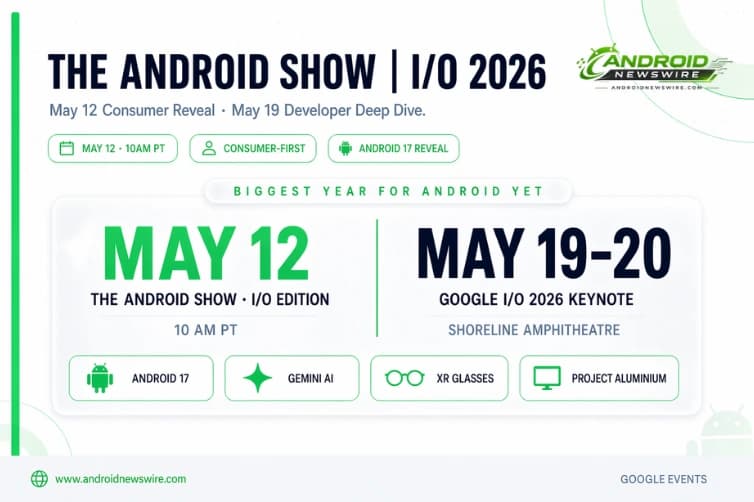
The calendar for the biggest Android event period of 2026 is now locked in. For the second year in a row, Google will be hosting “The Android Show | I/O Edition” before I/O 2026. A week before the May 19–20 developer conference, Google will stream The Android Show on Tuesday, May 12 at 10 a.m. PT.
The event was spotted in a YouTube listing – briefly public before being pulled – and the description Google used to tease it leaves no ambiguity about the ambition behind it: “This is going to be one of the biggest years for Android yet. Tune in to The Android Show | I/O Edition on Tuesday May 12 at 10 AM PT and be the first to take a look at what the future holds.”
That is a significant promise. Android 17 is weeks from its stable launch. Android XR smart glasses have been under development since at least the December 2024 XR Edition show. Project Aluminium – Google’s Android-based desktop OS – has been accumulating leaks for months. Gemini’s integration into the Android platform is accelerating across every device category. The Android Show on May 12 is the first opportunity Google has to land all of these narratives in front of a consumer audience, before the developer-focused I/O keynote takes over a week later.
Why Two Events? The Split Format Explained
In 2025, Google announced Material 3 Expressive, Find Hub, and the Gemini expansion to Android Auto, Wear OS, and Google TV. The majority of OS announcements came a week earlier at The Android Show, with Android XR appearing during the I/O keynote itself. Google is repeating that format for 2026. Expect consumer-facing announcements at The Android Show, with developer updates happening at I/O.
The two-event structure is a deliberate editorial choice that solves a real problem: Google I/O has become so dense with AI, cloud, and platform announcements that Android – despite being the world’s most widely used operating system – risks being crowded off its own stage. By launching The Android Show | I/O Edition before I/O, Google appears to be creating a focused Android-first event that can highlight new Android experiences without competing against AI announcements.
The split also serves different audiences efficiently. The Android Show is a consumer broadcast – designed to excite existing Android users about what is coming to their phones, tablets, smart home devices, and eventually cars. Google I/O is a developer conference – designed to give engineers the API details, SDK documentation, and technical depth they need to build against the new platform. The content that belongs in each format is genuinely different, and trying to serve both audiences in a single keynote produces a show that is too technical for consumers and too shallow for developers.
Last year’s format worked well enough that Google is not experimenting – it is repeating. That is the clearest signal that The Android Show has found its role as the consumer-first entry point to Google’s annual announcement arc.
What to Expect on May 12: The Consumer Announcement Preview
Google has not published a formal agenda for The Android Show | I/O Edition. But between the session list for I/O 2026 published in April, the Android 17 beta cycle timeline, and the product areas Google has been telegraphing for months, the probable content is not difficult to map.
Android 17 consumer feature reveal. Android 17 is targeting a June 2026 stable launch, and The Android Show arrives right at the point where Google typically transitions from “developer testing” messaging to “here is what this means for your phone” messaging for mainstream users. Android 17 has already reached late beta development stages, making May an ideal time for feature breakdowns. Expect the consumer-facing version of the Android 17 story: Material 3 Expressive animations, native App Lock, Desktop Mode, Live Updates for lock screen, and Gemini Magic Actions – all explained in terms of the user experience they deliver rather than the API surface they expose.
Gemini platform expansion. For Gemini, the focus at The Android Show 2026 is likely to be on how it expands across devices rather than just adding new standalone features. Google is expected to show tighter system-level integration within Android, where Gemini can handle tasks across apps more seamlessly. The Gemini screen automation capability that launched on Pixel 10 and Galaxy S26 in March is the leading edge of this story. The Android Show is where Google gets to present the broader vision – Gemini as an ambient AI layer across phone, tablet, watch, glasses, and home – to a mainstream audience for the first time.
Android XR smart glasses. Google first showed its display-based AI smart glasses at “The Android Show: XR Edition” on December 8 last year, confirming partnerships with Warby Parker and Gentle Monster. The prototype included a subtle in-lens display that could show contextual details such as navigation directions and live translation captions. Google has earlier indicated that these smart glasses are expected to launch sometime in 2026. Google may preview these glasses at the event. A May 12 appearance – seven weeks before the anticipated Android 17 stable launch – would be the right moment to transition the glasses from a prototype preview into a near-launch product reveal.
Project Aluminium / Android desktop OS. Google is kicking off I/O 2026 with The Android Show and maybe some answers about ‘Project Aluminium.’ The Android-based desktop OS that has been accumulating leaks throughout early 2026 – replacing ChromeOS with a unified Android desktop platform – is one of the most significant potential announcements of the year. If Google is ready to talk about it publicly, The Android Show is the appropriate venue for a consumer-first introduction before the developer API details appear at I/O.
Possible hardware. The Android Show has historically been a software event, but Google’s product calendar is densely packed in spring 2026. A Pixel 10a launch announcement – or at minimum a first look – before I/O would not be unprecedented. Google has used The Android Show format in the past to introduce hardware alongside software narratives.
The Context: Android 17 Platform Stability Has Been Reached
The Android Show announcement arrives on the same day as another significant milestone: Android 17 has now reached platform stability, so new features will arrive later with QPR1 updates instead of the base release.
Platform Stability is the formal declaration that Android 17’s API surface is locked – no further changes to public APIs before the stable launch. For developers, it means the compatibility testing window is open and the surface they are testing against is final. For The Android Show, it means Google can talk about Android 17’s features without the caveat that they might change – everything presented on May 12 will ship in the stable June release.
Also releasing this week: Android 17 QPR1 Beta 1, carrying build number CP31.260403.005.A1, the April 2026 security patch, and Google Play Services version 26.11.36. The QPR1 Beta dropping before Android 17 even ships stable is unusual by historical standards – “to see the first Android 17 QPR1 Beta already seems a bit odd.” But it is consistent with the accelerated release cadence Google has been operating on all year. Android 17 QPR1 Beta 1 mainly focuses on bug fixes, including improvements to the Terminal app and wireless printing issues.
The four specific fixes in QPR1 Beta 1 cover a Default Print Service crash under low ink conditions, a Terminal app ANR error that was causing devices to become unresponsive, VoIP audio distortion caused by hardware audio processing interference, and a direct audio output failure on AIDL audio HAL devices for streams longer than five seconds. These are not glamorous problems, but real ones – distorted VoIP calls, frozen apps, and broken print jobs. The QPR1 Beta program is also noteworthy for its breadth: the update covers a wide range of Google Pixel hardware from 2021 all the way through to the current lineup, which is a genuinely good sign for software longevity.
The Developer Calendar: Three Weeks, Three Events
The concentration of Android activity in the next three weeks is extraordinary even by Google’s standards. For developers tracking the Android 17 cycle, here is the compressed timeline now in view:
April 22, 2026: Android 17 QPR1 Beta 1 released. Platform Stability confirmed. API surface is locked.
May 12, 2026: The Android Show | I/O Edition, 10 a.m. PT. Consumer-facing Android 17 feature reveals, Gemini platform expansion, likely XR glasses and Project Aluminium updates.
May 19–20, 2026: Google I/O keynote, Shoreline Amphitheatre, Mountain View. Developer-facing Android 17 deep dives – the 45-minute Android session covering Adaptive Everywhere, large-screen mandatory compliance details, Jetpack Compose advances, and the full Gemini agentic platform story. Firebase, AI tools, and platform API sessions running across both days.
June 2026 (expected): Android 17 stable launch on Pixel devices. Play Store mandatory API 36 targeting takes effect. All confirmed Android 17 features land on users’ devices.
For development teams managing Android 17 compatibility timelines, the May 12 show matters even though it is primarily consumer-facing. Google uses The Android Show to set public expectations for what Android’s next version delivers – and those expectations directly inform the App Store quality standards and feature promotion opportunities that app teams will be evaluated against from June onward.
How to Watch
The Android Show | I/O Edition will stream live on YouTube on Tuesday, May 12, 2026 at 10 a.m. PT / 1 p.m. ET / 6 p.m. BST / 10:30 p.m. IST. The stream link will be published on the Android YouTube channel and the Android Developers YouTube channel ahead of the event. Given the brief appearance and removal of the teaser video, expect a formal announcement with a public link in the coming days.
Google I/O 2026 follows on May 19–20 at the Shoreline Amphitheatre in Mountain View, California, with the keynote streaming globally via the Google I/O website and YouTube.
We will be covering both events live on Android News Wire – the Android Show on May 12 and Google I/O beginning May 19. Stay tuned.
Related on Android News Wire:
- Android 17 “Cinnamon Bun”: Every Confirmed Feature & Release Date
- Android 17 Beta Cycle Is Accelerating – Developer Survival Guide
- Android 17 Is Making Adaptive Layouts Mandatory – The Developer Compliance Guide
- Top Android Stories: April 2026 Week 3 Roundup
- Google Is Moving Android From Your Car’s Dashboard Into Its Brain – AAOS SDV