
Android 17’s Beta Cycle Is Moving Faster Than You Think — A Developer’s Survival Guide
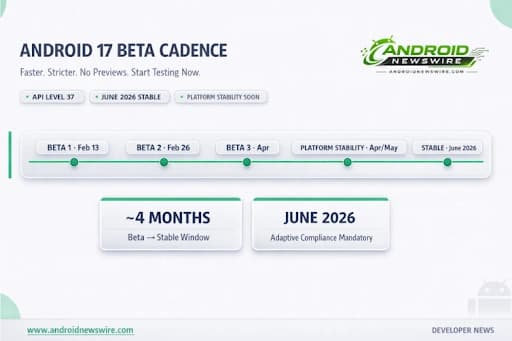
Google has fundamentally changed how it ships Android. The comfortable, predictable rhythm of one major release per year with a long Developer Preview runway before it — that model is gone. Android 17 is already in active beta. Platform Stability is weeks away. The stable June 2026 target is firm. And the pipeline from Android 16 QPR3 to the first Android 17 beta handoff is narrower than any previous generation. If you are a developer still planning to “start Android 17 testing later,” later has already arrived. Here is everything you need to know about the new cadence, what is already confirmed in Android 17 builds, and exactly what you should be doing right now.
The Cadence Has Changed — Here Is What That Actually Means
The shift started with Android 16. Google publicly announced a move to a dual-release annual cadence: a first stable release targeting Q2 of each year, with a second QPR (Quarterly Platform Release) targeting Q4. Android 17 is the second generation operating under this model, and the pace has not slowed.
Compare the timelines directly. Under the old model, a typical Android release cycle looked like this: Developer Preview 1 in February, four more Developer Previews through April, Beta 1 in May, Beta 2 in June, Beta 3 in July, Platform Stability in August, final release in September or October. That gave developers roughly eight months of advance visibility from first preview to stable release, with Platform Stability — the point at which APIs are finalized — arriving about six to seven weeks before the stable launch.
Under the new model, Android 17’s timeline compresses this significantly. Beta 1 arrived on February 13, 2026. Beta 2 followed on February 26 — just thirteen days later. The stable release is targeting June 2026. That is approximately four months from first beta to stable launch, with Platform Stability expected to arrive in April or early May. Developers have roughly half the runway they had under the old cadence, and the Developer Preview phase — which previously served as a low-stakes early signal — has been eliminated entirely, replaced by the continuous Canary channel.
The practical consequence is that the window between “Google announces a new Android feature” and “users have it on stable devices” has compressed significantly. For developers, that same compression applies to the window between “API changes are announced” and “apps need to comply with them.”
Where the Android 17 Beta Cycle Stands Right Now
Android 17 — codenamed Cinnamon Bun, API level 37 — has two beta builds in the hands of developers as of late March 2026. The trajectory toward Platform Stability is clear.
Beta 1 (February 13, 2026): Introduced the first stable API surface for Android 17, including the new Contacts Picker API, the EyeDropper tool, app bubbling improvements on large screens, and the initial Material 3 Expressive system animations. Available for Pixel 6 through Pixel 10 series, Pixel Fold, and Pixel Tablet, plus the Android Emulator.
Beta 2 (February 26, 2026): Expanded the feature set with additional large-screen improvements, refined the bubble bar on foldable form factors, stabilized the new EyeDropper color picker integration, and brought further refinements to the adaptive app compliance enforcement mechanisms. Motorola joined the beta program with this release — the Moto Edge 2025 and Moto G57 becoming the first non-Pixel OEM hardware in the Android 17 beta cycle, as we covered in our Android 17 Beta Motorola article.
What comes next: Beta 3 is expected in April, with Platform Stability — the point at which all public APIs and behaviors are finalized and will not change before the stable release — arriving shortly after. Once Platform Stability is declared, the API surface is locked. Any app-side changes you need to make to handle Android 17 API changes must be completed before your app ships to users on the stable release in June.
The Canary channel continues rolling between beta milestones with incremental builds. Panda 3 Canary in Android Studio already includes AI crash analysis, Compose screenshot testing, and LeakCanary integration in the Profiler — tooling that reflects the kind of development workflow that Android 17’s faster cadence demands.
What Android 17 Already Shows: Multi-Device, Privacy, and Connectivity
Even at Beta 2, Android 17 has revealed a coherent platform direction across three areas that directly affect how apps need to be built.
Multi-Device and Large-Screen: Mandatory, Not Optional
The most consequential change in Android 17 for the broadest range of developers is the mandatory adaptive app compliance requirement. Apps that do not meet Google’s large-screen and resizability criteria will face Play Store distribution restrictions beginning with the Android 17 stable release in June 2026. There is no opt-out API, no grace period extension, and no legacy exception path.
What “adaptive app compliance” requires in practice: your app must support arbitrary window sizes and aspect ratios without crashing or breaking its layout. It must not lock orientation in ways that make it unusable on tablets and foldables. It must handle multi-window and split-screen modes gracefully. The Activity embedding and WindowSizeClass APIs from Jetpack WindowManager are the recommended implementation path.
Android 17 Beta builds show desktop windowing improvements that extend this requirement further. The 90:10 split-screen ratio confirmed for Android 17 — allowing one app to occupy 90% of the screen while a second occupies 10% — creates new layout edge cases that apps need to handle. The new desktop windowing experience on Pixel Tablet, which shipped with Android 16 QPR3, previews the kind of multi-window behavior that Android 17 will generalize across the platform.
The large-screen push in Android 17 is also directly connected to the Chrome 146 bookmarks bar landing on Android tablets — which we covered in our March 2026 Week 3 roundup — and to the broader ChromeOS convergence strategy Google is executing across the platform. Large-screen Android is the convergence target. Android 17 is the release that makes compliance with that target mandatory.
Privacy APIs: Identity Without Exposure
Android 17 introduces two new privacy-preserving APIs that reflect a direction Google has been moving toward for several releases: giving apps the data they need to function without granting them ongoing access to sensitive resources.
The Contacts Picker API provides apps with a one-time, user-selected snapshot of specific contacts rather than ongoing read access to the full contacts database. Apps that currently request the READ_CONTACTS permission to support contact selection flows should evaluate whether the new Contacts Picker covers their use case — because on Android 17, the Contacts Picker is the expected path for apps that do not have a genuine ongoing contacts management need.
The EyeDropper API allows apps to sample colors from anywhere on screen without requiring screenshot or accessibility permissions. For design tools, creative apps, and color-sensitive applications, this is a meaningful capability addition that eliminates a previous awkward workaround involving accessibility service abuse or screenshot capture.
Both APIs fit the broader Android 17 privacy direction: shift sensitive capability access from “grant once, use always” toward “grant at the moment of use, for the specific purpose stated.” The Credential Manager API — now the mandatory replacement for deprecated AccountManager flows — follows the same principle. If your app uses any authentication flow that touches AccountManager, complete the migration to Credential Manager before Android 17 ships.
Connectivity and System APIs
Android 17 expands the companion device pairing framework with two new device profiles that carry real permission implications for apps in the health and fitness space.
The Medical companion device profile grants companion apps for medical devices — continuous glucose monitors, blood pressure monitors, ECG devices — prioritized background processing permissions that allow them to maintain reliable connections and data streams without being subject to the standard background activity restrictions that other apps face. If your app manages a medical companion device, registering the Medical profile in Android 17 is the path to guaranteed background reliability.
The Fitness Tracker companion device profile provides a parallel path for sports and fitness wearable companion apps, streamlining how these apps declare their function to the system and granting appropriate background access for data synchronization. Combined with the Health Connect API — which Google has been expanding as the unified health data layer across Android — this positions Android 17 as a significantly more capable platform for health and fitness developers who are willing to adopt the new APIs.
On the media side, VVC / H.266 hardware decode support arrives in the Android 17 media stack for devices with compatible hardware, and the CTA-2075 Loudness Management API enables apps to normalize audio playback levels dynamically. Both additions are additive rather than breaking — apps that do not adopt them are unaffected, but media apps that do adopt them gain meaningful quality improvements on Android 17 devices.
The Stabilization Window Is Shorter — Here Is What That Requires
Under the old Android release cadence, Platform Stability arriving in August gave developers a three-to-four week window before the September stable release to finalize compatibility work, run internal QA, and push App Store updates. Under the new June stable target, Platform Stability in April or early May gives developers a similar three-to-four week window — but that window starts and ends roughly four months earlier in the calendar year.
This matters for planning because it compresses against Q1 development cycles that are typically focused on shipping new features rather than compatibility maintenance. Teams that plan their Android compatibility testing work for “summer” will miss the Android 17 window entirely. The compatibility work needs to happen in Q1 and early Q2 of 2026 — now.
Three concrete actions that need to happen before Platform Stability:
Action 1: Flash Beta 2 on a test Pixel and run your full automated test suite today. Not next sprint. Not next month. Today. Beta 2 is already live and already contains the API changes that will ship in the stable release. Every week you wait is a week less of test cycle time before Platform Stability locks the API surface.
Action 2: Audit every permission your app requests against Android 17’s stricter model. The Contacts permission, the nearby device discovery permissions, the background location access model — all of these have changed or are changing in Android 17. Run your permission usage through the Android Studio lint rules for API 37 targeting to surface any calls that are being deprecated or restricted.
Action 3: Test your app’s layout across every WindowSizeClass breakpoint. The Android Emulator supports all relevant screen size configurations. Set up a test matrix that covers compact, medium, and expanded width and height classes, and add the 90:10 split configuration that Android 17 introduces. If your layout breaks in any of these configurations, you have a Play Store distribution risk starting in June.
Canary Is the New Developer Preview — Are You On It?
The elimination of the Developer Preview program — replaced by the continuous Canary release channel — is the aspect of Google’s new cadence that has received the least developer attention but carries the most long-term behavioral change. Under the old model, a Developer Preview release was a discrete event: a specific build, a specific changelog, a specific moment to evaluate new APIs. The Canary channel is a continuous stream.
The practical implication is that early API signal is now available continuously rather than episodically. New APIs, behavior changes, and platform modifications land in Canary builds throughout the year rather than being batched into four or five preview releases. Developers who monitor the Canary channel — or subscribe to the Android Developers Blog and the API diff tooling — have earlier warning of upcoming changes than was possible under the old model. Developers who wait for explicit Preview announcements get less notice.
Android Studio Panda 3 Canary, already available, includes AI crash analysis that can identify crashes in Canary builds against Android 17’s platform changes — a direct workflow adaptation to the faster cadence. If you are not running Android Studio Canary alongside your production Android Studio installation for platform monitoring purposes, now is the time to set that up. As covered in our Android Studio Panda 2 article, the agentic development tooling in Panda 2 stable can also accelerate compatibility remediation work — letting AI agents handle boilerplate migration tasks while your team focuses on testing.
The Developer Timeline for Android 17: Every Milestone That Matters
Now (March 2026): Beta 2 is live. Begin compatibility testing immediately. Identify any API 37 targeting issues in your app. Review the mandatory adaptive compliance checklist.
April 2026: Beta 3 expected. Platform Stability likely to be declared in late April or early May. This is the last point at which API surface changes can arrive before the stable release. Any API adoption decisions must be made before this milestone.
May 2026 (Google I/O): Google I/O is expected in May. This is where the full Android 17 feature set, final API surface, and associated tooling will receive their most comprehensive public documentation. Budget time in your schedule to attend sessions or review the published content — Google I/O 2026 will be the definitive reference for Android 17 development.
June 2026: Android 17 stable release for Pixel devices. Mandatory adaptive app compliance takes effect for new apps and updates submitted to the Play Store. Play Store billing policy changes take effect for US, UK, and EEA developers. AutoFDO optimization is fully integrated across Android 15, 16, and 17 builds — your performance benchmarks will shift.
Post-June 2026: OEM rollouts of Android 17 begin. The installed base of Android 17 devices grows rapidly through Q3 2026. Apps that have not completed API 37 compatibility work will begin encountering distribution restrictions in markets where enforcement is active.
The Bottom Line for 2026
Android 17’s accelerated beta cycle is not a problem to manage around — it is the new normal to plan within. Google has made a deliberate choice to ship Android faster, test in public earlier, and enforce compliance more strictly. The developer community that thrives in this environment will be the one that has treated the beta channel as a standard part of the development workflow rather than an optional advanced activity.
The platform itself is doing significant work to make the transition easier: AutoFDO kernel optimization improving performance automatically, creating accountability for AI coding tools that generate Android code, and Android Studio Panda 2’s agentic capabilities accelerating migration work. The tooling exists to move faster. The platform is moving faster. The only remaining variable is whether your team’s testing and adoption process is keeping pace.
June 2026 is twelve weeks away. Platform Stability is approximately five weeks away. The time to start is now.
Related on Android News Wire: