Google Is Moving Android From Your Car’s Dashboard Into Its Brain
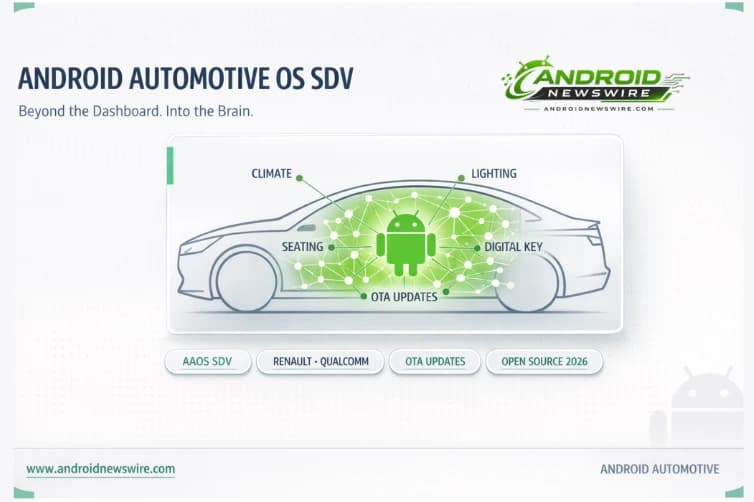
Google has just made its most ambitious move in automotive software. On March 26, 2026, the company announced Android Automotive OS for Software Defined Vehicles — AAOS SDV — a platform that extends Android’s presence in cars far beyond the infotainment touchscreen and into the non-safety core computing systems that govern how a modern vehicle actually operates. Climate control, lighting, seating, remote cabin conditioning, digital key management, personalized driver profiles, proactive maintenance alerts — all of it, running on Android, delivered and updated over the air, with open-source availability planned for later this year. This is not an infotainment upgrade. It is Google making a direct play to become the default operating system for the software-defined vehicle era.
From Dashboard Screen to Vehicle Brain
Modern cars are quickly becoming computers on wheels. From pre-heating your car in the morning to using your smartphone as a car key, many of today’s vehicle functions are controlled by software. These Software-Defined Vehicles allow for rapid innovation, bringing new features over-the-air much faster.
Until now, Android Automotive’s role in those vehicles was well-defined and limited: the infotainment screen. The touchscreen where you control navigation, music, climate settings, and connected apps. A capable implementation that has grown impressively — Volvo, Renault, Ford, GM, Honda, Mazda, Hyundai, and BMW are among the manufacturers already deploying Android Automotive OS with Google Automotive Services — but still fundamentally a screen-level integration. The vehicle’s underlying software architecture remained the domain of the automaker and its supplier network.
AAOS SDV changes that. Google today announced Android Automotive OS for Software Defined Vehicles to extend “beyond the car’s screen,” providing an open infrastructure for the non-safety parts of vehicles — allowing for in-car voice assistants that can control more vehicle functions, as well as proactive maintenance reminders. Over-the-air updates can deliver more of these features over time.
Non-driving functions like climate control, lighting, and seating adjustment would fall under Android’s control. The system would move beyond basic infotainment to create a unified ecosystem for features like remote cabin conditioning, digital key management, and personalized driver profiles.
Matt Crowley, Android Automotive’s group product manager, described the vision directly: the in-car experience will feel “much more cohesive and the latest features will reach your driveway faster.” From a truly integrated voice experience to proactive maintenance reminders, the car will become “a true extension of your digital life.”
The Problem AAOS SDV Is Designed to Solve
To understand why this announcement matters, it helps to understand the state of automotive software today. Moving to software-defined vehicles doesn’t come without challenges. Different manufacturers have developed different software architectures, integrating software modules from dozens of different suppliers. This fragmented approach means carmakers have to spend time on building infrastructure rather than what truly differentiates them in a fast-moving market.
Most automakers currently cobble together software from dozens of different suppliers, creating a patchwork of mismatched modules that don’t play nicely together. Every new vehicle model requires re-integrating those modules from scratch. Every software update has to navigate a maze of supplier dependencies, certification requirements, and architecture mismatches. The result is vehicles where software updates are slow, features are inconsistent across model years, and the underlying code base is effectively frozen between major platform refreshes.
In this model, vehicle functions are developed as “topology-agnostic services,” meaning they are reusable across different vehicle models and architectures. This allows for granular, service-level updates with built-in dependency handling. If a carmaker wants to improve the logic of the climate control system or add a new lighting signature, they can deploy a targeted over-the-air update to that specific service without needing to reflash the entire vehicle’s operating system.
For the consumer, the practical implication is significant: a car that continues to improve after purchase, with meaningful feature additions delivered over the air rather than requiring a dealer visit or a new model purchase. For automakers, the implication is equally significant: by providing “foundational code and a common language for their software,” Google says automakers will be free to design unique experiences for their customers without rebuilding infrastructure from scratch for each model line.
A “Headless” Android Deep in the Vehicle Architecture
The technical architecture of AAOS SDV is distinct from the consumer-facing Android Automotive that runs the dashboard. The platform is designed as a compact, performant, and scalable software foundation based on a “headless” Android native stack. Unlike the consumer-facing version of Android seen on tablets or in-dash displays, this version operates out of sight, extending deep into the vehicle’s electrical and electronic architecture.
The platform is designed to power a wide array of vehicle controllers, tackling core compute, body controls, and instrument cluster domains. This means that instead of having dozens of isolated electronic control units from different suppliers — each running unique, incompatible software — automakers can utilize a unified Android-based operating system. This stack incorporates low-level automotive frameworks for communications, diagnostics, and software updates.
The “headless” nature is critical to understanding what is and is not changing. This is not Android with a touchscreen interface appearing on additional vehicle displays. It is Android running invisibly in the vehicle’s computing fabric — governing inter-system communication, enabling service-level OTA updates, and providing the common platform layer that eliminates the supplier fragmentation problem. The driver never sees it directly; they experience its effects through a more cohesive, more responsive, more frequently updated vehicle.
Open Source: The Strategic Playbook
At Android, Google believes that open platforms can help to increase innovation and reduce complexity. By championing open platforms, the company empowers the industry to define what tomorrow’s cars will offer. The AAOS SDV platform is being open-sourced later this year.
This is the same strategic move that made Android the dominant mobile operating system globally. It is the same playbook Google used with Android smartphones, which now power roughly 70% of mobile devices worldwide. Open-sourcing the platform lowers the barrier to adoption for every automaker — no licensing cost for the platform itself, freedom to customize on top of the shared foundation, and the ability to contribute improvements back to the shared codebase.
To prepare for the open source release later this year, Google is proactively working with leading industry carmakers, suppliers, silicon platforms, and software vendors to ensure that the AAOS SDV platform is well supported. The open-source release is not a distant roadmap item — it is the scheduled next step in a deployment that is already in active production with real automaker partners.
Partners Already Building on AAOS SDV
Google’s announcement is not a concept or a beta program. Two major partnerships are already in production deployment.
Renault Group: Renault is currently leveraging the Android Automotive OS SDV platform for its upcoming Renault Trafic e-Tech, with production set to begin in late 2026. The Renault Trafic e-Tech validates the platform’s ability to accelerate development and enable a new generation of software-defined commercial vehicles. The Trafic e-Tech is a commercial van — not a consumer passenger car — which makes it an important real-world stress test of the platform’s durability, update reliability, and deployment scale requirements.
Qualcomm: Qualcomm is scaling the Android Automotive OS SDV platform through a strategic partnership. At CES 2026, Qualcomm introduced Snapdragon vSoC on Google Cloud and announced a scaling collaboration to deliver a turnkey, pre-integrated AAOS SDV stack on Snapdragon Digital Chassis platforms. The Snapdragon vSoC on Google Cloud capability allows developers to run the exact same software in the cloud that will eventually run on the physical Qualcomm chips inside the car — a development and validation workflow that dramatically compresses automotive software testing cycles.
Together, these partnerships cover the two dimensions that matter most for automotive platform adoption: a production vehicle deployment (Renault) and a hardware integration path that other OEMs can follow without bespoke silicon work (Qualcomm Snapdragon Digital Chassis).
What Changes for Drivers, Automakers, and Developers
For drivers: These in-car experiences will feel much more cohesive and the latest features will reach your driveway faster. Voice control that understands and executes vehicle functions — not just media and navigation — becomes possible when the voice layer and the vehicle systems layer share the same platform. Maintenance reminders become proactive because the software governing vehicle subsystems can surface diagnostics through the same unified layer. Personalized driver profiles — seat position, climate preferences, display configurations — can be stored, synchronized, and automatically applied across vehicles on the same platform.
For automakers: The value proposition is a direct exchange: give up infrastructure differentiation (which provides no competitive advantage) in return for dramatically reduced software development cost and faster time-to-market for meaningful features. Development cycles for proprietary systems are long and expensive. Maintaining and updating these systems is equally resource-intensive. AAOS allows automakers to offload much of this burden to Google, freeing them to focus on core competencies like vehicle design, manufacturing, and safety.
For Android developers: AAOS SDV represents a long-term platform opportunity. As the vehicle’s non-safety computing systems converge on a shared Android foundation, the developer model that exists for Android phones and tablets — standardized APIs, common runtime, shared tooling — becomes applicable to the automotive domain. Apps and services built on Android can eventually target vehicle contexts alongside phone and tablet contexts, using familiar tools and distribution mechanisms.
The Questions the Announcement Raises
AAOS SDV’s ambition also generates legitimate questions that Google’s announcement does not fully answer.
Data and privacy: Google’s business model revolves around collecting user data and serving targeted advertising. While the company has positioned Android Automotive as an “open infrastructure” play, automakers and regulators will scrutinize exactly what data flows back to Google’s servers and how it’s used. A platform that governs climate control, seating, and driver profiles has access to a rich behavioral signal stream. How that data is handled, what Google retains, and what automakers can contractually restrict will be a defining question for OEM adoption in privacy-sensitive markets including Europe.
Safety boundaries: Google has been explicit that AAOS SDV governs the non-safety portions of vehicle software. The distinction between safety-critical systems (braking, steering, ADAS) and non-safety systems (climate, lighting, seating) is clear in principle. Maintaining it cleanly in a unified software architecture as the platform matures will require ongoing regulatory attention and rigorous isolation guarantees.
Competitive dynamics: Tesla’s competitive advantage has always stemmed from controlling its entire software stack. Google’s timing is strategic — the automotive industry is in the midst of a massive transformation, with electrification and autonomous driving features pushing software to the forefront. AAOS SDV gives traditional automakers a credible path to software-defined vehicle capabilities without building a Tesla-scale software organization from scratch. Whether that is sufficient to close the competitive gap with Tesla — or with Chinese EV manufacturers who have similarly tight software-hardware integration — remains to be seen.
The Bigger Android Picture
AAOS SDV arrives at a moment when Android’s platform ambitions have never been more expansive. Android 17 is targeting a June 2026 stable release with mandatory large-screen adaptive compliance and a new “intelligent OS” positioning that puts Gemini at the architectural center of the platform. The Gemini screen automation feature now live on Pixel 10 is the consumer face of the same AI-native platform direction. Android XR is extending the platform into mixed-reality headsets and smart glasses.
AAOS SDV extends that same platform into the vehicle. The long-term vision is an Android that follows you coherently across phone, tablet, desktop, watch, glasses, TV, and car — a unified OS layer for every computing context in your life, with Gemini as the intelligence layer connecting them. That vision is still years from full realization. But the Renault Trafic e-Tech entering production in late 2026 is a concrete, real-world step toward it.