Google and Epic End Their Fight – Third-Party App Stores Launch Inside Google Play July 22
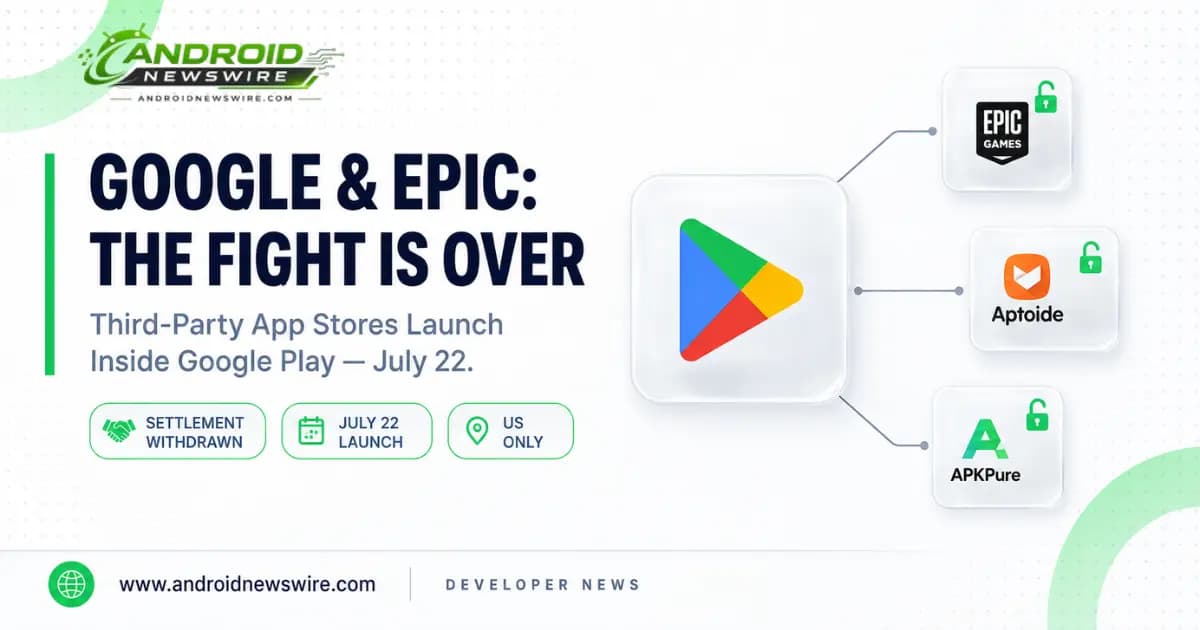
The longest-running fight in Android’s app economy is finally over, and the resolution is more consequential than a settlement would have been. Google and Epic Games have jointly withdrawn their proposed settlement agreement, which means Google is now bound by the original court order it had spent months trying to soften. Starting July 22, 2026, US Android users will be able to download rival app stores directly inside the Google Play Store – no sideloading required – and those third-party stores will arrive pre-stocked with Google Play’s own app catalog unless individual developers opt out.
How We Got Here
The dispute traces back to a 2020 ruling that found Google held an illegal monopoly over Android app distribution, which produced a permanent injunction from Judge James Donato in October 2024 ordering Google to open the Play Store to competing marketplaces. Google didn’t want that outcome. Late last year, Google and Epic proposed a settlement instead – one that would have replaced the court’s sweeping structural requirements with a narrower set of concessions, arriving in the same period as an $800 million business partnership between the two companies.
That settlement is now dead. Epic Games and Google have jointly withdrawn their previously proposed settlement, which means Google must now abide by the original October 2024 US court injunction. A Google spokesperson framed the decision as a move to eliminate ecosystem uncertainty: “We’ve agreed with Epic to withdraw our motion to modify the US Court’s injunction rather than prolonging this process which creates uncertainty for the ecosystem. This allows us to focus on executing our recently announced global business model evolution to deliver greater app store choice, lower prices, and more opportunities for developers and users. We remain committed to maintaining Android’s industry-leading security and fostering a competitive ecosystem where every app store and developer has the freedom to compete.”
What Actually Chanegs on July 22
Starting July 22, 2026, Google will carry rival third-party app stores directly within the US Play Store, opening its app catalog to them through a new enrollment program. This is the detail worth sitting with: rather than requiring users to hunt down an APK and sideload a competing storefront, people will be able to find and install alternative Android app stores the same way they install any other app – through Google Play itself.
Once installed, users will be able to launch those third-party stores on their device and browse the catalogs inside them. And those catalogs won’t start empty. US app and game listings will automatically become available to these third-party stores unless developers explicitly choose to opt out, under what Google calls the Play Catalog Access Program. Developers who don’t opt out will have their apps and games distributed on these alternative stores under the same terms as the Play Store itself.
Google has published details on exactly what gets shared. Starting July 22, 2026, developers’ US apps and games listings – including app names and icons – become available to enrolled third-party stores by default.
The Rules Third-Party Stores Have to Follow
This isn’t an open floodgate with no conditions attached. Google has built in requirements that any competing store must meet before it gets access to the Play catalog:
- Third-party operators must pay an annual $5,000 fee to cover security and policy reviews.
- Stores must keep malware below 1 percent of total install attempts.
- Participating stores must operate solely within the United States and enforce clear, non-discriminatory safety policies.
- There’s a separate $5,000 onboarding fee on top of the annual charge, according to reporting on the program’s fee structure.
That combination – a real monetary barrier plus an ongoing malware ceiling – signals Google isn’t simply complying with the letter of the injunction while quietly making participation impractical. It’s a structured program with real gatekeeping, but it’s gatekeeping around security and abuse rather than around who’s allowed to compete.
This Is a US-Only Change, For Now
It’s worth being precise about scope here, because the geographic limits matter. This change is US-only – outside the United States, third-party app stores will still need to be sideloaded rather than installed directly through Google Play. In parallel, Google is separately moving ahead with its Registered App Stores program for markets outside the US, which is a different mechanism with its own rules, not the in-Play-Store hosting arrangement launching domestically on July 22.
Why the Settlement Actually Fell Apart
The proposed settlement wasn’t rejected outright by a judge – Google and Epic pulled it themselves. The practical reason traces back to a fundamental disagreement over the injunction’s core mechanic. Tim Sweeney, Epic’s CEO, had pushed for “injunctive relief to allow fair competition,” and the two sides had most recently been jointly fighting the judge’s specific plan for Google to carry third-party app stores inside the Play Store itself, rather than requiring sideloading. That fight over how competing stores should reach users – hosted inside Play versus sideloaded outside it – appears to be exactly the mechanic both companies ultimately agreed to accept rather than continue litigating.
Fresh Regulatory Pressure Adds Context
The timing isn’t happening in isolation. The change also arrives as Google faces new regulatory scrutiny, with Swiss authorities opening an antitrust probe into Android’s search choice screen. Whatever the direct connection, the broader pattern is unmistakable: Google is under simultaneous pressure on multiple fronts over how much control it exercises over Android’s distribution layer, and the Epic outcome is the most concrete resolution of that pressure to land so far.
What This Means If You’re a Developer
For Android developers, the immediate decision point is the opt-out choice inside the Play Catalog Access Program. Leaving your app enrolled means broader distribution reach with essentially zero extra work – your existing listing gets mirrored into any compliant third-party store a user chooses to install. Opting out keeps your app exclusive to Google Play, which may matter if you have specific reasons to control where your app is distributed or how it’s priced across storefronts.
For competing app store operators, the math is now concrete: a $5,000 onboarding cost, a $5,000 annual fee, a sub-1%-malware bar to clear, and a US-only launch window starting July 22. That’s a real but not prohibitive cost of entry – cheap enough that established players (and well-funded new entrants) can clear it, but not so cheap that it invites low-effort clone stores at scale.
The Bigger Picture
Whichever way this shakes out over the next few months, July 22 marks the first time Android users in the US will be able to get a genuinely competing app marketplace through the same frictionless install flow they already use for every other app – no enabling unknown sources, no hunting for an APK, no sideloading warning screens. Six years after Epic pulled Fortnite from the Play Store to force this exact fight, Android’s app distribution model is about to look meaningfully different, at least within US borders.