Google Play’s Android 16 Target API Deadline Is Three Weeks Away – Here’s What Developers Need to Know
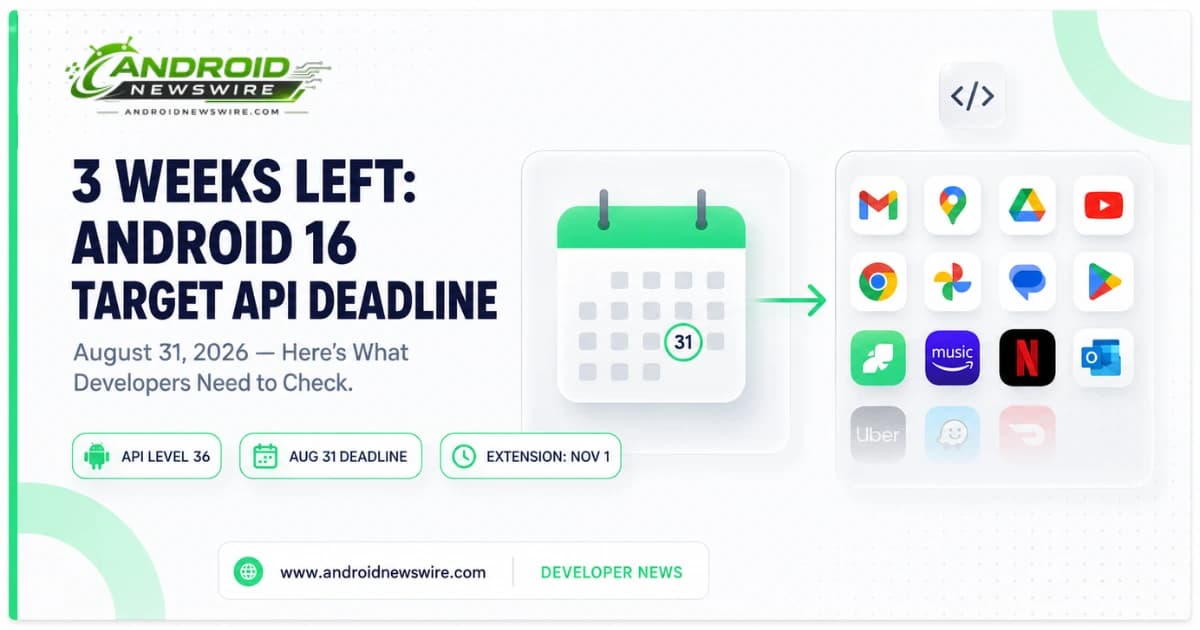
Every August, Google Play quietly raises the bar for what counts as an acceptable app, and this year’s version of that annual ritual lands on August 31, 2026 – just three weeks out. Starting that date, every new app and every app update submitted to Google Play must target Android 16 (API level 36). Existing apps that haven’t already made the jump face a real, if invisible, consequence: they stop showing up in Play Store search results for anyone running a newer version of Android than what the app currently targets.
What Actually Happens If You Miss It
This is the detail that trips up developers who assume “deadline” means their app gets pulled or rejected outright. That’s not quite how it works, and the actual mechanism is arguably worse from a growth standpoint, precisely because nothing visibly breaks.
If your app is still targeting an older API level once the deadline passes, it doesn’t disappear from the Play Store entirely. It remains available to existing users and to anyone browsing on a device running an Android version at or below what your app currently targets. What it loses is visibility to new users on devices running a newer Android OS version than your app’s target level – meaning your app quietly stops appearing in search and discovery for a growing slice of the Android install base, with zero error message, zero crash report, and zero obvious signal that anything has changed. For a developer relying on organic Play Store discovery to acquire new users, that’s a slow, silent leak in the acquisition funnel rather than a dramatic cutoff.
The specific thresholds:
- New apps and app updates submitted on or after August 31, 2026 must target Android 16 (API level 36) or higher.
- Existing apps already on the Play Store need to target at least Android 15 (API level 35) to remain discoverable by new users on devices running a newer OS.
- Wear OS and Android Automotive OS apps are exempt from this specific deadline, running on their own separate timeline.
There’s a Grace Period, But It’s Not Automatic
If your team genuinely can’t hit August 31, Google does provide a safety valve – but it requires action, not just waiting it out. Developers who need more time can request an extension until November 1, 2026 to continue distributing to all Google Play users while they finish the update. That extension isn’t automatically granted just because you haven’t updated yet; it’s a formal request submitted through an extension form that becomes available later this year directly inside the Play Developer Console. If you know you’re going to miss the deadline, the smart move is filing that extension request as soon as the form is live, rather than assuming you’ll quietly slip past the requirement unnoticed.
Why Google Keeps Doing This Every Year
It’s worth understanding the actual purpose behind this recurring policy, because it’s easy to read it as pure bureaucratic overhead. Google raises the target API level requirement annually specifically to push the broader app ecosystem toward adopting each release’s security protections, privacy features, performance improvements, and new platform capabilities more quickly than voluntary adoption alone would achieve. An app still targeting a three- or four-year-old API level misses out on runtime protections and behavioral improvements that have shipped since – and from Google’s perspective, an ecosystem full of apps lagging years behind current Android security models is a real platform-wide risk, not just an individual developer’s technical debt problem.
This year’s push carries extra weight given the direction Android’s platform APIs have been heading. At Google I/O 2026, the company introduced its framing of Android shifting from a traditional operating system into what it’s calling an “intelligence system” – the same language Android President Sameer Samat has repeated in developer discussions since, describing agentic features like AppFunctions, Rambler, and Gemini Intelligence hooks that let apps expose functions directly to Gemini. Many of these newer capabilities are tied to more recent API levels. Staying several versions behind doesn’t just risk Play Store visibility – it increasingly means missing access to the exact platform hooks that plug an app into Android’s emerging AI-driven feature set.
What to Actually Check Before August 31
For any team that hasn’t already gone through this process, a proper readiness pass covers more ground than just bumping a single number in a build config file. Based on what’s tripped up other developers going through this exact migration recently, the areas worth specifically testing are:
- Runtime permissions – Android 16 introduces behavioral changes here that can silently alter how and when your app requests access to sensitive data.
- The photo picker migration – apps using older media-access patterns may need to adopt the modern photo picker flow to avoid permission friction.
- Back-gesture handling – predictive back gesture behavior has continued evolving across recent Android versions and is a common source of unexpected navigation bugs after a target bump.
- Third-party SDKs – payment processors, ad networks, analytics tools, push notification providers, and crash reporting libraries are frequent points of failure; outdated versions of any of these can behave unpredictably once your app’s target level changes underneath them.
- Full regression testing on a real Android 16 device or emulator – not just a build-succeeds check, since a target API bump can expose UI and permission issues that only surface at runtime, not at compile time.
The Bottom Line
Three weeks is enough time to handle this properly if you start now, and genuinely tight if you wait until the last week of August. Because this specific consequence – quietly losing visibility to new users rather than an outright takedown – doesn’t announce itself, it’s the kind of deadline that’s easy to underestimate until search traffic and new installs start trending down for reasons that aren’t immediately obvious. If your app hasn’t been rebuilt against a current SDK since early 2025 or before, this is the week to put a proper Android 16 compatibility pass on the calendar, well ahead of August 31.