
Google Just Made Its Smart Home Lineup Noticeably More Expensive — Here’s Exactly How Much
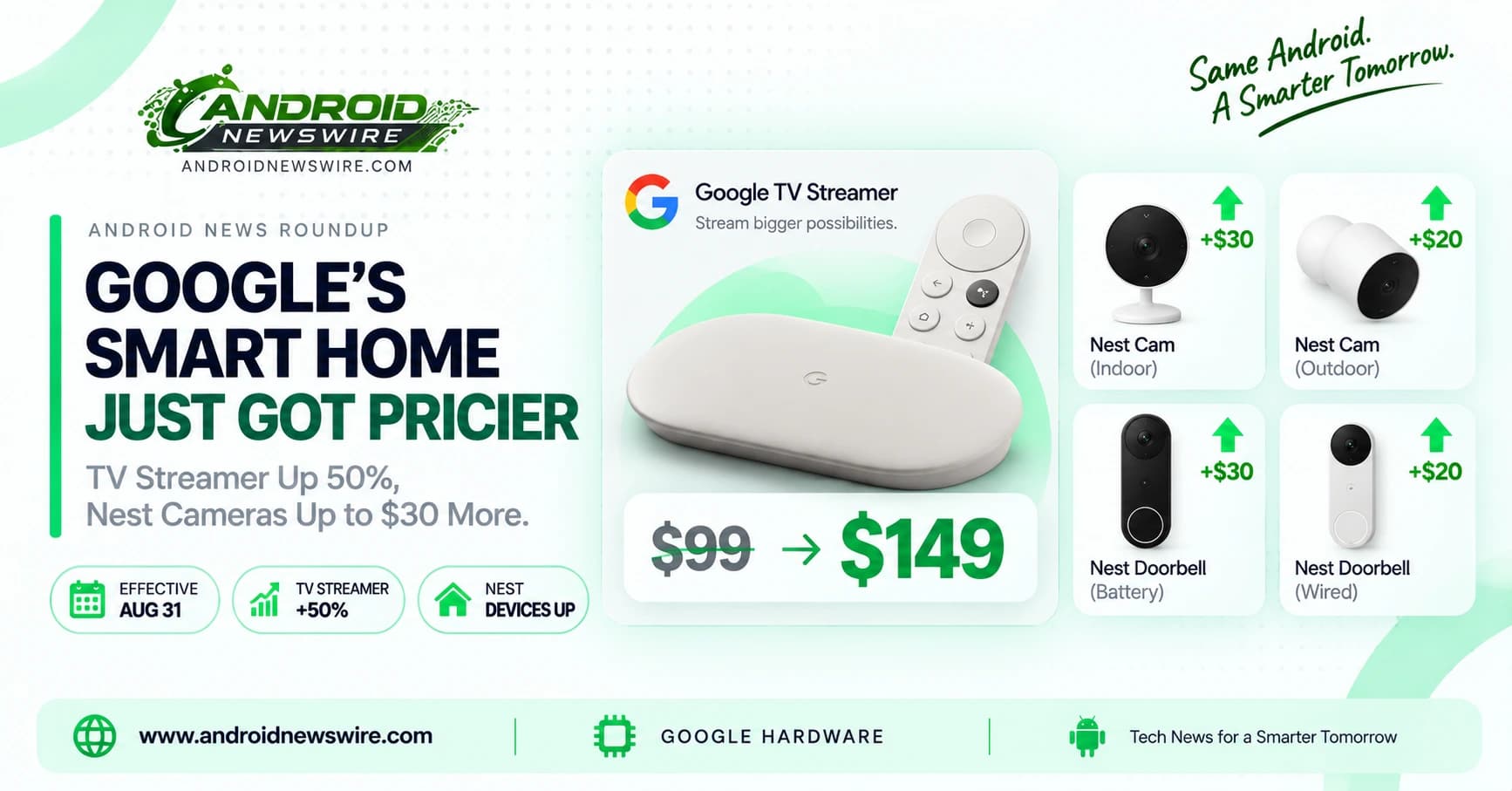
If you’ve been putting off buying a Google TV Streamer or a new Nest camera, that hesitation just got considerably more expensive. Without any advance announcement, Google quietly raised prices across nearly its entire US streaming and home security hardware lineup on August 31, hitting the Google TV Streamer with a genuinely dramatic increase and pushing nearly every current Nest camera and doorbell higher as well.
The Big One: The Google TV Streamer Jumps 50%
The single most striking number in this round of price changes belongs to Google’s own streaming box. The Google TV Streamer, which launched in 2024 at $99.99 as the direct successor to Chromecast with Google TV, has now jumped to $149.99 at both the Google Store and Best Buy — a 50% increase on a device that’s barely two years old. That’s not a modest adjustment; it’s the kind of price jump that meaningfully changes where the device sits competitively against rivals like Apple TV 4K, Roku, and Amazon’s Fire TV lineup.
The Full Nest Lineup Price Breakdown
Every current Nest camera and doorbell Google sells picked up an increase as part of the same rollout, ranging from $20 to $30 more depending on the specific model — roughly an 11% increase across most of the affected hardware:
- Nest Cam (outdoor or indoor, battery): now $199.99, up from $179.99
- Nest Cam Outdoor (wired, 2nd gen): now $199.99, up from $149.99
- Nest Cam Indoor (wired, 3rd gen): now $129.99, up from $99.99
- Nest Doorbell (wired, 3rd gen): now $199.99, up from $179.99
- Nest Doorbell (battery): now $199.99, up from $179.99
Notably, all five of Google’s current camera and doorbell models were affected — this wasn’t a selective price adjustment on one or two products, but a broad markup across the entire currently available Nest security lineup.
What Didn’t Get More Expensive
A handful of products were specifically left untouched in this round, and the pattern is worth noting. The Nest Cam with Floodlight bundle remains at its original $279.99 price — likely because its higher existing margin already absorbs individual component cost pressures better than the standalone camera models. Core climate and hub devices, including Nest Thermostats, the Nest Hub (2nd gen), and the recently launched Google Home Speaker, also avoided this particular wave of increases, at least for now.
Google’s Own Explanation
Google gave a direct, consistent statement to 9to5Google explaining the change: “Due to rising component costs, we are adjusting the U.S. pricing of select Google Nest cameras, doorbells and Google TV streamer 4K, effective August 31. We remain committed to providing our customers with industry-leading smart home security and continuous feature updates.”
That’s a notably candid explanation as far as corporate pricing statements go — Google isn’t dressing this up as new features or improved hardware justifying the higher cost. It’s a straightforward acknowledgment that the underlying components going into these devices now cost more to source than they did when the original prices were set.
Where the Real Culprit Lives: The Google TV Streamer’s Own Hardware
There’s a specific technical detail worth including here that helps explain why the TV Streamer specifically got hit so much harder than the Nest cameras: under the hood, the device packs 4GB of RAM and 32GB of storage — exactly the category of components at the center of the memory pricing crisis that’s been driving cost increases across the entire Android and consumer electronics industry throughout 2026. A device built around a meaningful chunk of RAM is going to feel that specific cost pressure more acutely than a camera or doorbell, whose bill of materials leans more heavily on image sensors and other components outside the current memory shortage.
This Fits an Unmistakable Pattern
If this price increase feels familiar, that’s because it is — this is now one of many entries in a running story we’ve tracked across nearly every corner of the Android hardware ecosystem throughout 2026. Google has already confirmed broader Pixel lineup price increases tied to the same RAM supply crisis, Samsung raised its own advanced chipmaking prices, Amazon’s own smart home devices got more expensive for identical reasons, and even Google’s upcoming Googlebook laptop platform is reportedly wrestling with the same memory cost pressures as it finalizes pricing ahead of its September 15 reveal.
What makes this particular round notable isn’t that a price increase happened — at this point in 2026, that’s become almost the expected default across the industry — it’s the scale of the TV Streamer’s specific jump. A straight 50% increase on a single product, rather than the more typical 10-15% adjustments we’ve seen elsewhere this year, is a meaningfully sharper move than most of the comparable price changes we’ve covered this summer.
What This Means If You’re Shopping Right Now
If you’ve been considering either device, there’s a real, time-sensitive opportunity worth acting on quickly. Because Google rolled this change out without advance warning, inventory at third-party retailers hasn’t fully caught up — as of this reporting, Amazon in particular was still listing the Google TV Streamer at its original $99.99 price, even though Google’s own store and Best Buy had already moved to $149.99. That gap won’t last; retailers typically sync their pricing to match a manufacturer’s updated MSRP within days to a few weeks as old stock sells through or gets repriced. If either device is on your list, checking third-party retailers immediately — rather than assuming the new pricing is already universal — could genuinely save you real money before those older listings get updated.
Related on Android News Wire:
- Google Officially Confirms Pixel 11 Price Hike, Cites “Severe” RAM Crisis
- Samsung’s August 2026 Security Patch Hits Galaxy S26 With 56 Fixes
- Googlebook’s Big Reveal Is Set for September 15