
March 2026 Android Security Bulletin: 129 Vulnerabilities Patched — The Largest Single-Month Fix in Eight Years
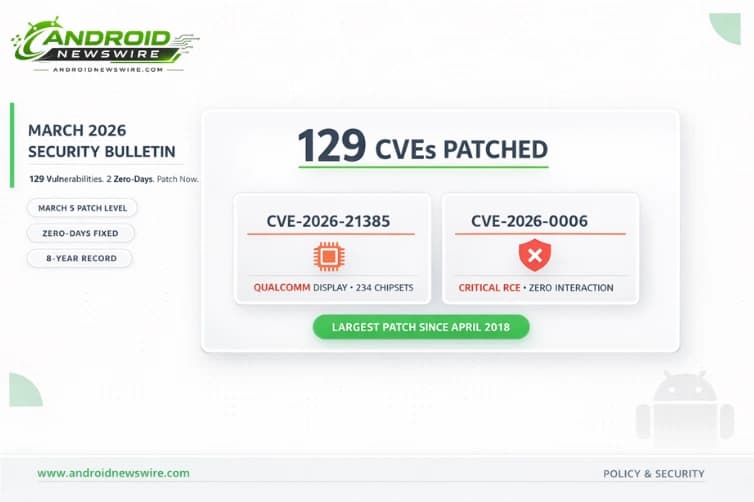
The March 2026 Android Security Bulletin is not a routine monthly patch. With 129 vulnerabilities fixed across two patch levels, it is the largest single-month Android security update since April 2018 — and it includes two CVEs being actively exploited in the wild. One targets Qualcomm display hardware across 234 chipsets. The other is a critical System-component remote code execution flaw that requires no user interaction and no elevated privileges to trigger. If your Pixel device has not yet installed the March update, stop reading and install it now. Then come back for the full developer-focused breakdown.
The Numbers: Why This Month Is Different
Google’s March 2026 Android Security Bulletin contains 129 vulnerability fixes and carries two security patch levels: 2026-03-01 and 2026-03-05. The 129 defects represent the largest single-month Android patch count since April 2018.
To put that in context: a typical monthly Android Security Bulletin addresses somewhere between 40 and 70 CVEs. Months above 90 are notable. 129 is a categorically different scale — nearly double the usual volume — and the presence of two actively exploited vulnerabilities within that count makes this more than a routine hygiene update. It is a genuine security event.
The two patch levels — 2026-03-01 and 2026-03-05 — indicate a structured rollout. Devices showing the March 1 patch level have received the platform and framework fixes. Devices showing the March 5 level have additionally received the kernel, driver, and vendor component fixes that typically require deeper hardware-specific validation. For full protection against both zero-days detailed below, the March 5 patch level is required.
Zero-Day One: CVE-2026-21385 — Qualcomm Display Memory Corruption
The bulletin flags a Qualcomm display memory-corruption issue — CVE-2026-21385 — that affects 234 chipsets.
The breadth of the affected chipset list is the most immediately alarming aspect of this vulnerability. Qualcomm’s display subsystem components are pervasive across the Android ecosystem — from budget devices running older Snapdragon 4-series hardware to flagships running the current Snapdragon 8 Elite generation. A memory corruption vulnerability in that component, actively exploited in the wild, represents a meaningful attack surface across a very large installed base.
Memory corruption vulnerabilities in display subsystems are particularly significant because they can be triggered through rendering operations — parsing images, displaying certain content types, or processing graphics buffers — without requiring a traditional user-initiated action. The attack vector depends on the specific exploitation technique being used in the wild, which Google has not publicly disclosed to prevent wider exploitation while the patch rolls out.
For developers: if your app handles custom image rendering, processes user-supplied image buffers, or interacts with low-level graphics components, this vulnerability is worth understanding as context for why the March 5 patch level is particularly important for Qualcomm-powered test devices.
Zero-Day Two: CVE-2026-0006 — Critical System RCE, No Interaction Required
A critical System-component remote code execution issue — CVE-2026-0006 — requires no user interaction and no additional execution privileges.
Thiis the classification that the Android security team reserves for the most severe category of vulnerabilities. “No user interaction” means exploitation does not require the target to click a link, open a file, install an app, or take any other action. “No additional execution privileges” means it does not require the attacker to have already compromised the device in some way. The combination describes a vulnerability that, under the right conditions, can be triggered remotely without the user’s knowledge or participation.
The component affected is within the System layer — the core Android framework that mediates between apps and the kernel. A successful exploit in this layer can potentially grant an attacker access to system-level capabilities, including data accessible to other apps, sensor streams, and communication channels.
Google does not publicly disclose active exploitation details until a significant percentage of the installed base has received the patch. The active exploitation classification means Google’s Threat Analysis Group or external researchers have observed this CVE being used in real attacks before the patch was available.
For security-focused developers: this CVE reinforces the case for ensuring your app implements defense-in-depth even when operating on a theoretically trusted Android system. Apps that handle sensitive data — financial information, health records, authentication credentials — should not assume the platform layer beneath them is always uncompromised.
What 129 Patches Cover: The Full Vulnerability Surface
Beyond the two zero-days, the remaining 127 CVEs in the March 2026 bulletin cover a wide range of severity levels and components. Understanding the distribution matters for assessing risk across different device tiers.
Framework vulnerabilities affect the Android application framework — the layer that mediates between apps and the platform. Vulnerabilities here can allow privilege escalation (an app gaining more permissions than it was granted), information disclosure (leaking data between apps or to unauthenticated callers), and in some cases denial of service. Apps that interact heavily with system services — accessibility services, notification listeners, input method editors — are more exposed to framework-level vulnerabilities.
System vulnerabilities affect the core OS layer below the framework, including system services, inter-process communication mechanisms, and core Android daemons. These vulnerabilities tend to carry higher severity ratings because successful exploitation can affect the entire device rather than a single app’s context.
Kernel vulnerabilities affect the Linux kernel at the base of Android’s software stack. These are typically the most technically difficult to exploit but carry the highest potential impact — a successful kernel exploit can bypass all higher-level security boundaries. The March 5 patch level primarily addresses kernel and driver vulnerabilities.
Vendor and hardware component vulnerabilities — including the Qualcomm display issue flagged above — affect device-specific hardware drivers and firmware. These require the deepest level of OEM-specific validation, which is why they are gated behind the second patch level date and why their rollout to non-Pixel Android devices depends entirely on OEM update timelines.
Platform Security Is Getting Stricter: What Developers Need to Know
The March 2026 bulletin does not exist in isolation. It is part of a multi-year trend toward increasingly aggressive platform-level security enforcement that has direct implications for how apps need to be built and maintained. Three areas stand out for immediate developer attention.
Permissions enforcement is tightening. Each major Android release has narrowed the circumstances under which apps can hold sensitive permissions without explicit per-use justification. Android 16 introduced additional restrictions on background access to certain permission groups — particularly location, microphone, and camera — and the March patch brings platform-level fixes that strengthen the enforcement mechanisms behind those restrictions. Apps that request permissions more broadly than their actual use cases justify are increasingly likely to encounter enforcement-level restrictions rather than just Play Store policy flags.
Background activity restrictions are expanding. The platform’s controls over what apps can do when not in the foreground have become substantially stricter across Android 14, 15, and 16. The March patch reinforces the enforcement of background process limits, wake lock restrictions — which the Play Store began actively enforcing on March 4, 2026, as we covered in our March 2026 Week 1 developer roundup — and background launch restrictions. Apps that have relied on legacy background patterns need to audit their behavior against Android 16’s BackgroundActivityStartRestrictions and the updated WorkManager guidance.
SDK targeting requirements carry security implications. Apps targeting older SDK levels are progressively losing access to API surfaces that have been restricted or removed on security grounds. The migration toward API 37 compliance for Android 17 — mandatory for Play Store distribution from June 2026 — brings a new set of security-relevant API changes that apps must accommodate. Key areas for review include the new Contacts Picker API (which removes ongoing contacts read permissions in favor of one-time snapshot access), the updated permission model for nearby device discovery, and stricter limits on what data apps can access about other installed packages.
The Trend Line: Security Is Now Platform-Enforced, Not App-Optional
The March 2026 bulletin — 129 CVEs, two actively exploited zero-days, record patch volume — is a data point in a longer trend that developers need to internalize. Android security is no longer primarily a matter of developer best practices or optional compliance recommendations. It is increasingly enforced at the platform layer, through API restrictions, permission enforcement changes, background activity limits, and Play Store distribution requirements that apply regardless of developer intent.
This trend has several practical implications:
The security work that used to be optional — implementing scoped storage properly, using the Credential Manager API instead of custom credential flows, adopting the Health Connect API for health data rather than direct sensor access — is now table-stakes. Apps that have deferred this work are increasingly encountering enforcement rather than recommendations.
The gap between targeting the current SDK and targeting an older one is widening in security terms. Each API level brings new security-relevant restrictions. An app targeting API 33 on a device running Android 16 is operating with a significant number of security restrictions unenforced against it — but that protection gap is also a liability, because those older API surfaces have often been deprioritized for security review.
Platform security improvements like the AutoFDO kernel optimization — which we covered in detail in our Android AutoFDO article — and the modular Play Services update model mean that many security improvements now arrive outside of full OS updates. Security is increasingly continuous rather than episodic, which means developers’ security assumptions about the platform beneath their apps need to be updated continuously rather than only at major version boundaries.
The March 2026 bulletin, in its record scale, is a reminder that the threat landscape Android operates in is genuine and active. Two zero-days being exploited in the wild — one affecting 234 Qualcomm chipsets — are not theoretical risks. They are real attack vectors that real users were exposed to before this patch. The platform’s response is to patch aggressively, enforce strictly, and require developers to participate in that security posture through API compliance. The expectation on developers is to meet the platform where it is going, not where it has been.
How to Verify Your March 2026 Patch Level
On Pixel and other Android devices: Settings → About phone → Android version → Android security update. You want to see 2026-03-05 for the full March bulletin protection, including the Qualcomm display zero-day fix.
If your device shows 2026-03-01, the framework and system fixes are applied but the vendor component fixes — including CVE-2026-21385 — are not yet installed. Check for a pending update.
If your device shows a February date or earlier, install the March update immediately. This is not a routine hygiene update — it addresses two vulnerabilities being actively exploited in the wild.