
Moto G Stylus 2026: Active Pen, $499 Price – The Affordable Galaxy Ultra Rival?
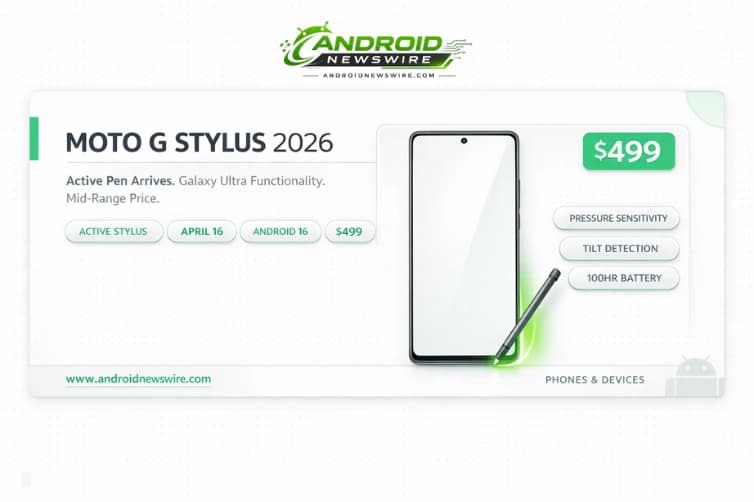
Motorola’s Moto G Stylus 2026 Finally Gets a Real Active Pen – And It’s Only $499
For years, the Moto G Stylus has been the only mainstream Android phone with a built-in stylus that wasn’t made by Samsung. For just as long, that stylus has been the device’s most obvious limitation – a passive capacitive pen that could point and tap but couldn’t do the precision writing, pressure sensitivity, or tilt detection that made the Galaxy Note’s S Pen genuinely transformative for productivity. That changes with the Moto G Stylus 2026. Motorola has replaced the passive pen with a proper active stylus – pressure sensitivity, tilt detection, a floating shortcut menu, and AI-powered features built around it – and kept the device at $499. That is $800 less than a Galaxy S26 Ultra. Here is everything you need to know.
The Headline Change: Passive Pen to Active Pen
For years, the Moto G Stylus has offered a built-in stylus pen, but it has always been a passive pen with no particularly special tricks. That changes with the Moto G Stylus 2026, which now comes with an active pen not too unlike the S Pen on Samsung phones like the Galaxy S26 Ultra. This means that, unlike previous models, the new pen supports features like pressure sensitivity and tilt detection.
The distinction between passive and active stylus technology is fundamental and worth understanding clearly. A passive pen is essentially a precision finger – it mimics a touch input with better accuracy. It cannot vary line weight, cannot detect angle, and cannot communicate any state information to the device beyond its position. An active stylus contains its own electronics, communicates bidirectionally with the display, and can transmit pressure level, tilt angle, and button state in real time. That is the difference between a pointer and a drawing instrument.
With the Moto G Stylus 2026 switching to an active pen, users get not only more precise input, but also the ability for the pen to recognize tilt and pressure in supported apps. It should feel much more like writing on real paper.
For notes, sketches, handwritten annotations, creative work, and any task where the quality of the stylus input matters, this is a generation-level upgrade from every previous Moto G Stylus model.
Active Pen Specs: 100-Hour Battery, IP68/69, 15-Minute Charge
The new pen lasts about 100 hours per charge, and can fully charge in just 15 minutes when you slide it back into the Moto G Stylus 2026. It’s also tough, with a combined IP68/IP69 rating for water and dust resistance.
The 15-minute full recharge from the phone’s built-in silo is the practical detail that makes the active pen actually usable as a daily tool rather than a novelty that requires careful battery management. Samsung S Pen users have historically not had to think about charging their stylus at all – the S Pen does not have its own battery, deriving power from the display when in use. Motorola’s approach requires a separate charge, but 100 hours of standby and 15-minute recharge from the silo makes that an entirely manageable consideration.
The IP68/IP69 dual certification on the pen itself – matching the phone body – means users do not have to worry about rain, sweat, or accidental submersion affecting the stylus separately from the device. This is a detail that matters for the kinds of real-world use cases Motorola is targeting: field notes, outdoor sketching, note-taking in less-than-ideal environments.
AI Features Built Around the Stylus
The 2026 model does not just add an active pen – it builds a software ecosystem around it through Motorola’s Moto AI and Google Gemini integration.
The new active stylus introduces several AI-assisted features in the Notes app. Sketch to Image uses AI to convert basic drawings into standard visual formats. Handwriting Calculator solves handwritten mathematical equations without requiring a separate application.
The pen also introduces several system-wide shortcuts accessible via the pen’s built-in button. Quick Clip allows users to highlight and send text directly to Notes. Drag & Drop lets users move content between apps. Hover to Magnify previews content before tapping. Circle to Search activates Google’s visual search from anywhere on screen.
The Circle to Search integration deserves particular attention – it brings the same AI-powered visual search capability that has been a flagship differentiator on Pixel and Galaxy devices into a $499 mid-range phone through stylus gesture. Combined with Google Gemini being built into the OS for daily assistance, the Moto G Stylus 2026’s AI feature set is meaningfully closer to flagship territory than any previous model in the lineup.
The phone ships with Android 16 out of the box with Google Gemini built into the operating system for assistance with daily tasks, writing, and planning. Google Photos includes AI-powered editing tools. Motorola’s Hello UX allows for personalization of colors, fonts, and gesture controls.
Full Specs: What You Get for $499
Beyond the pen, the Moto G Stylus 2026 puts together a pretty solid Android phone for its $499 price point. It runs Android 16 out of the box with a Snapdragon 6 Gen 3 chipset, 8GB of RAM, 128GB or 256GB of UFS 3.1 storage, a microSD card slot, a 6.7-inch AMOLED display at 120Hz, a 5,200mAh battery with 68W wired charging and 15W wireless, NFC, a 3.5mm headphone jack, and IP68/69 dust and water resistance.
The display is a 6.7-inch 1.5K 10-bit pOLED panel running at 120Hz with up to 5,000 nits of peak brightness and Corning Gorilla Glass 3 protection. Water Touch technology ensures the screen remains responsive even with wet hands.
In the camera department, there’s a 50MP Sony Lytia 700C main sensor with OIS, a 13MP ultrawide shooter, and a 32MP front camera for selfies. All lenses support 4K video recording.
The phone weighs 192g with an 8.3mm thickness and meets SGS-certified military-grade toughness standards, rated to withstand drops of nearly five feet and temperature extremes from -4°F to 140°F. It comes in Coal Smoke and Lavender Mist colorways, both part of Motorola’s ongoing Pantone partnership.
The Snapdragon 6 Gen 3 chipset – a mid-range 4nm processor – is both the most defensible and most debated spec in this lineup. It delivers solid day-to-day performance, capable gaming, and efficient power management at $499. It is not the chip you would choose for sustained heavy workloads or the highest-end gaming titles. For the device’s target use case – productivity, note-taking, creative work, everyday communication – it is entirely appropriate.
The Price: $499 vs $1,299 – The Real Comparison
The Moto G Stylus 2026 is $499.99 in the US – $100 more than the 2025 model. Quick Clip, Drag & Drop, Hover to Magnify, and Circle to Search are the key features enabled by the new pen, and although the Moto G Stylus 2026 still can’t quite compare to the Galaxy S26 Ultra in this department, the gap in convenience and functionality is clearly a lot smaller than the S25 Ultra’s advantage over the Moto G Stylus 2025.
Tha t sentence captures the real story of this device with precision. The Moto G Stylus 2026 is not a Galaxy S26 Ultra replacement – the S26 Ultra’s S Pen is more capable, its display more refined, its camera system more powerful, its chip more performant, and its software ecosystem more mature. At $1,299, it should be all of those things.
But the question for most of the market is not “which is better in a direct comparison?” It is “how much stylus productivity value can I get for $499 instead of $1,299?” And on that question, the Moto G Stylus 2026’s answer is meaningfully better than its predecessors could ever have offered. Pressure sensitivity and tilt detection for handwriting. Circle to Search. Sketch to Image. Handwriting Calculator. Active pen shortcuts. A floating menu off the pen button. These are not consolation features – they are the core productive value proposition of the stylus form factor, delivered in a device that costs less than half of the Galaxy S26 base model.
For first-time stylus buyers, students, note-takers, artists working on a budget, and professionals who need an active pen on a device they can expense without a conversation – the Moto G Stylus 2026 is the most compelling answer this segment has ever had.
Launch Bundles: Significant Value at Both Storage Tiers
Motorola is sweetening the launch with accessory bundles that genuinely offset the $100 price increase from last year’s model.
The 128GB option will be bundled with a four-pack of Moto Tags at launch, while the 256GB model will come with a Moto Watch, a Moto Tag, and Moto Buds Loop wireless earbuds.
The 256GB bundle in particular is worth evaluating against its retail value: a Moto Watch, a set of wireless earbuds, and a tracking tag represent meaningful monetary value alongside the extra 128GB of storage. For buyers who were planning to purchase Bluetooth earbuds anyway – which describes most smartphone buyers – the 256GB bundle is likely the better value even at its higher price point.
Availability: April 16, Broadly Distributed
The Moto G Stylus 2026 will be available at Amazon, Best Buy, and Motorola.com on April 16 for $499.99. It will also reach Google Fi on the same day, with subsequent availability planned for Spectrum Mobile, Cricket Wireless, AT&T, Xfinity Mobile, and Optimum Mobile. In Canada, it will be available exclusively from Motorola.ca on April 16.
The April 16 date – one week from now – makes this one of the most imminent major Android launches on the calendar. Motorola’s broad carrier distribution across both national and regional carriers means the Moto G Stylus 2026 will reach a significantly wider audience than previous models, which were sometimes more limited in carrier availability.
The Bigger Picture: Stylus Tech Is Going Mainstream
The Moto G Stylus 2026’s active pen launch is a signal worth reading beyond the device itself. For years, meaningful stylus input on a smartphone has been effectively Samsung’s exclusive domain – the S Pen on the Galaxy Note and Galaxy S Ultra series has had no real competition at the hardware level. The Moto G Stylus lineup offered a passive alternative that kept the category alive in the mid-range, but never meaningfully challenged the S Pen’s technical capabilities.
The 2026 model changes that. By bringing pressure sensitivity, tilt detection, active pen shortcuts, and AI features to a $499 device, Motorola has demonstrated that the hardware and software requirements for a capable active stylus experience are no longer exclusively flagship territory. The Snapdragon 6 Gen 3’s AI processing is sufficient to run the Sketch to Image and Handwriting Calculator features. A mid-range AMOLED panel at 1.5K resolution is sufficient to make fine stylus input practical and enjoyable. The economic model works.
That democratization matters for Android as a platform. Samsung’s S Pen has historically been one of the strongest arguments for choosing Samsung hardware specifically – a capability that could not be replicated by any competitor at any price point below the Ultra tier. The Moto G Stylus 2026 does not eliminate that argument, but it genuinely weakens it for a significant portion of the market that does not need the full Galaxy S26 Ultra feature set.
For users shopping in the $400–$600 mid-range who want an active stylus – whether for handwriting, drawing, annotations, or productivity – the consideration set just expanded meaningfully. That is good for the Android ecosystem, good for competition, and good for buyers who deserve more choices than just “pay $1,299 or settle for a passive pen.”