
Motorola Razr Ultra 2026: $1,500 For Last Year’s Phone – 5 Better Alternatives
Motorola’s Razr Ultra was one of the best flip-phone foldables you could buy in 2025. Excellent displays, flagship-tier performance, a premium build, and a design that genuinely turned heads. So when the Razr Ultra 2026 arrived with a $200 price increase to $1,500, the expectation was a meaningfully better phone. What buyers actually got was, with almost no exaggeration, the same phone – same chip, same cameras, same displays, same charging speeds, same dimensions, same weight, same IP rating. A slightly bigger battery, a mildly brighter inner display, and new colour options. That is not a new phone. That is a new SKU. Before you spend $1,500 on last year’s device at this year’s prices, here are five alternatives worth serious consideration.
What You Are Actually Getting With the Razr Ultra 2026
The case against the Razr Ultra 2026 does not require any spin – the spec comparison is self-explanatory.
Compared to the 2025 Ultra, the Razr Ultra 2026 is practically the same phone. It is also $200 more expensive despite virtually zero notable upgrades or improvements. Both phones share the same display sizes for external and internal screens, and the display technology, resolution, and refresh rates are all the same. The camera systems are identical between the two phones, as are the charging speeds, storage, RAM, IP rating, and even the dimensions and weight. The Razr Ultra 2026 even uses the same Snapdragon 8 Elite chip as the Razr Ultra 2025.
The Razr Ultra 2026 is not 100% the same as its predecessor. Its battery is slightly bigger – 5,000mAh up from 4,700mAh – the inner display gets a little brighter, and it comes in new colours. But that is it.
A 300mAh battery increase and a marginal brightness bump do not justify a $200 premium over the previous generation. And importantly, the Razr Ultra 2026 ships with the Snapdragon 8 Elite rather than the Snapdragon 8 Elite Gen 5 that powers the Samsung Galaxy S26 Ultra released in the same market window. That generational chip gap becomes directly relevant when comparing the Razr Ultra 2026 to its actual competitive alternatives.
With that context established – here are the five phones you should seriously consider first.
1. Motorola Razr Ultra 2025 – The Obvious Answer
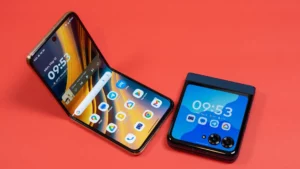
If you are looking for a flagship Android flip-phone, the Razr Ultra 2026 certainly fits the bill. But so does the Razr Ultra 2025. Buying last year’s version of a flagship smartphone is often a smart way to save money and still get a great experience, but in the case of the Razr Ultra 2025 and 2026, there is really no good reason to buy the new model – because for all intents and purposes, these two phones are the same.
The best part of this situation is how cheap the Razr Ultra 2025 has become. You can buy a Razr Ultra 2025 from Motorola’s website for just $800 – and that includes a free pair of Motorola earbuds plus a free storage upgrade to the 1TB model, which does not even exist for the 2026 Ultra. Unless you really want to spend $700 more for that bigger battery, just buy the 2025 Razr Ultra and pretend the new version does not exist.
$800 versus $1,500. Same Snapdragon 8 Elite. Same cameras. Same displays. Free 1TB storage upgrade. Free earbuds. The 2025 model is the single most compelling reason not to buy the 2026 model, and Motorola’s own pricing makes the case unavoidable.
Best for: Anyone who had the Razr Ultra 2026 on their shopping list and values their money.
2. Motorola Razr 2025 – The Smart First-Foldable Entry Point
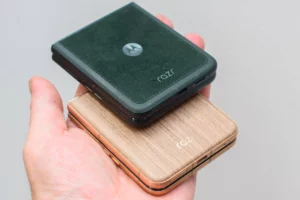
If you are new to the world of foldables and looking to finally join the party, the Razr Ultra 2026 might be a tempting choice. But rather than drop $1,500 on your first folding phone, the Motorola Razr 2025 is a much smarter starting point.
Compared to the Razr Ultra 2026, the Razr 2025 has some obvious drawbacks. Its MediaTek processor is not as capable, its camera system is not as impressive, its displays are slightly smaller, and its charging speeds are a bit slower. However, for someone testing the waters with a flip-phone foldable for the first time, none of that really matters. The Razr 2025 has a great hinge mechanism, the same IP rating as the Razr Ultra 2026, and offers basically the exact same folding functionality as its more expensive sibling.
More importantly, the Razr 2025 retails for $700 but can be found for as little as $550 – almost $1,000 less than the new Razr Ultra. If you are not completely sure a flip phone is right for you but want to try one, this is a much better way to go.
The logic here is sound. The defining characteristic of a flip foldable – the hinge mechanism, the dual-display experience, the pocketability of the folded form factor – is present in the Razr 2025 at $550. If you discover you love the flip foldable lifestyle, you can upgrade to a true flagship next cycle. If you find the form factor is not for you, you have risked $550 rather than $1,500.
Best for: First-time flip foldable buyers, anyone uncertain about the form factor, budget-conscious shoppers who want to experience folding phones without flagship commitment.
3. Motorola Razr Fold 2026 – More Phone For $400 More
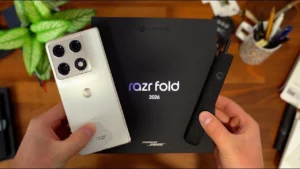
This is the most counterintuitive recommendation on the list, but hear it out. The Razr Fold is Motorola’s first book-style foldable, and its design is much more versatile than the Razr Ultra’s – giving you a 6.6-inch screen on the outside and a large 8.1-inch display when the phone is unfolded. The Razr Ultra has portability on its side, but the Fold is essentially a phone and tablet in one.
The Razr Fold also has a periscope telephoto camera – something the Ultra lacks – a much larger battery, faster charging, and four extra years of major software updates. And compared to the $1,500 Razr Ultra 2026, the Razr Fold is just $400 more expensive at $1,900. If you are already preparing to spend so much on a folding Motorola phone, you get a lot more bang for your buck with the Razr Fold. Plus, it is actually a brand new device rather than a repackaged phone from last year.
The “pay $400 more for a dramatically better device” argument only makes sense if you are already committed to spending $1,500. But for anyone who has already made peace with four-figure spending on a folding phone, the Razr Fold’s value proposition is significantly stronger than the Razr Ultra 2026’s. An 8.1-inch 2K inner display, a periscope telephoto the Ultra does not have, a larger battery, faster charging, stylus support, and four additional years of software updates – that is a meaningfully different product.
Best for: Committed foldable enthusiasts who want Motorola’s ecosystem and genuinely new hardware rather than a repackaged prior year device.
4. Samsung Galaxy S26 Ultra – The Superior Flagship For $200 Less
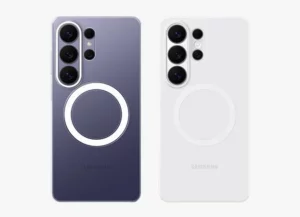
The Samsung Galaxy S26 Ultra may not have a foldable design, but it offers a whole lot more horsepower and technical capabilities for less money. Instead of the outdated Snapdragon 8 Elite chip powering the 2026 Razr Ultra, the S26 Ultra features the latest Snapdragon 8 Elite Gen 5. Samsung’s phone has a much more powerful 200MP primary camera, plus two telephoto cameras. The S26 Ultra comes with a built-in stylus, a more durable IP68-rated design, and the unique Privacy Display that can keep prying eyes off your phone.
When it delivers so much more phone for a retail price that is $200 less than the new Razr Ultra, Samsung’s phone is undoubtedly the more practical choice.
The chip generation gap is worth emphasising. The Snapdragon 8 Elite Gen 5 in the S26 Ultra is the current generation flagship SoC. The Snapdragon 8 Elite in the Razr Ultra 2026 is the same chip that launched in 2024. Paying $1,500 for last-generation silicon when the current-generation chip is available for $1,299 – in a phone with a dramatically better camera system, a built-in S Pen, and Samsung’s Privacy Display – is a difficult proposition to defend.
If the flip foldable form factor is a non-negotiable requirement, the S26 Ultra obviously cannot substitute. But for buyers whose primary motivation is flagship capability rather than the flip factor, the S26 Ultra is the more rational $1,500 spend by a significant margin.
Best for: Users who want the best-specced Android flagship in 2026 and are open to a conventional slate form factor.
5. Google Pixel 10 Pro – The Better All-Rounder For $500 Less
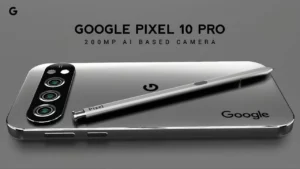
The Pixel 10 Pro is available for $500 less than the Razr Ultra 2026 – and is objectively better in so many ways. Cameras are a major advantage for the Pixel. Motorola’s setup on the Razr Ultra 2026 is not terrible, but the Pixel 10 Pro is the better cameraphone between the two. Not only do you benefit from a dedicated telephoto lens, but Google’s image processing and overall camera experience are more reliable.
The Pixel 10 Pro also benefits from Google’s excellent Pixel-exclusive software features, plus seven years of guaranteed Android updates – significantly better than the three years of support you get on the Razr.
Seven years of updates against three. That gap matters more than any single spec comparison. A $999 phone that receives software updates and security patches through 2032 has a significantly longer practical lifespan than a $1,500 phone whose support window closes in 2029. Amortised across that difference, the Pixel 10 Pro’s per-year cost of ownership is dramatically lower.
Add the Pixel’s camera reputation – Google’s computational photography and image processing remain among the best on any Android device – Gemini integration, Pixel-exclusive features from each Android update, and the Tensor G5’s AI processing capabilities, and the Pixel 10 Pro is an extremely competitive choice at $999 against a $1,500 flip phone that is genuinely not a new product.
Best for: Camera-focused users, software-first buyers, and anyone who wants seven years of guaranteed updates and Pixel-exclusive feature access.
So Who Should Actually Buy the Razr Ultra 2026?
After examining five compelling alternatives at prices ranging from $550 to $1,900, it is worth being honest about who the Razr Ultra 2026 actually serves.
The honest answer is: almost nobody. Existing Razr Ultra 2025 owners should not upgrade – they already have the same phone. First-time flip foldable buyers should start with the Razr 2025 and discover whether they love the form factor before committing to $1,500. Buyers who want the best Motorola folding experience should stretch $400 further to the Razr Fold and get genuinely new hardware. And buyers who want the best Android flagship should spend $200 less on the Galaxy S26 Ultra or $500 less on the Pixel 10 Pro.
The Razr Ultra 2026’s $200 price increase over an identical predecessor is not just a disappointing product decision – it is a pricing strategy that cannot survive contact with a rational alternatives comparison. Motorola makes excellent phones. The Razr Ultra 2025 was and remains excellent. The 2026 version is an exercise in testing whether brand loyalty can substitute for product differentiation.
It cannot.
Quick Comparison: At A Glance
| Phone | Price | Key Advantage |
| Razr Ultra 2025 | ~$800 | Same phone, $700 less, free earbuds + 1TB |
| Razr 2025 | ~$550 | Best flip foldable entry point |
| Razr Fold 2026 | $1,900 | Genuinely new – 8.1″ display, periscope, 7yr updates |
| Galaxy S26 Ultra | $1,299 | Snapdragon 8 Elite Gen 5, 200MP, S Pen, $200 less |
| Pixel 10 Pro | $999 | Best cameras, 7yr updates, $500 less |
Related on Android News Wire: