
Google Overhauls Play Store Economics: Lower Fees, Billing Freedom & Third-Party App Stores Are Now Reality
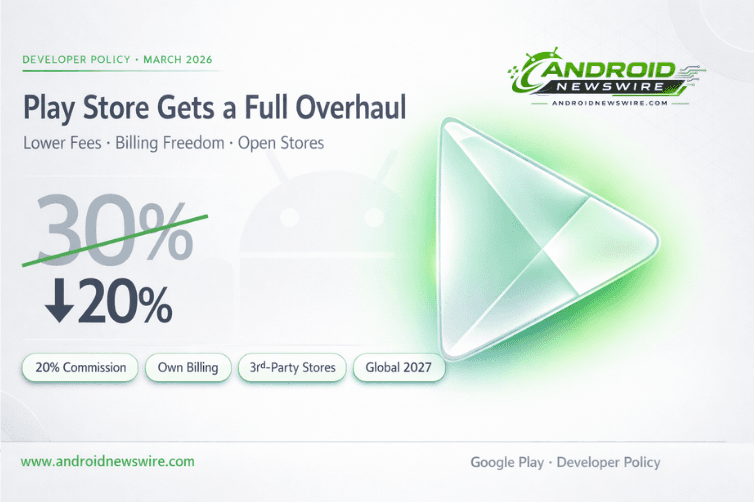
The Android app economy just changed. In what industry observers are calling the most consequential structural shift to the Google Play Store since its launch, Google has announced a sweeping overhaul of how apps are sold, how payments are processed, and how alternative app stores operate on Android devices. The long-standing 30% commission is effectively dead for most developers, third-party billing is now officially permitted, and a new formalized program makes alternative app stores easier to install than ever before.
This is not a minor policy tweak. It is a top-to-bottom rethink of the commercial and distribution architecture that has governed the Android app economy for over a decade — and every developer with an app on Android needs to understand what is changing and why it matters.
The Context: Why Google Is Making These Changes Now
To understand the scale of what Google has announced, it helps to understand the pressure that produced it. For years, Google’s 30% commission on in-app purchases and subscriptions drew fierce criticism from developers large and small. It was the same rate that Apple charged on iOS, and together the two platforms were accused of operating a comfortable duopoly that extracted an outsized share of developer revenue with limited competitive justification.
The backlash eventually turned legal. Epic Games, maker of Fortnite, took direct action in 2020 by implementing its own in-app payment system inside its Android app — bypassing Google Play Billing entirely. Google removed Fortnite from the Play Store, Epic sued, and the resulting antitrust battle wound through the courts for years. Regulators in the European Union, South Korea, India, and the United States simultaneously piled on with investigations, legislation, and rulings that collectively made the old 30% model untenable.
The Play Store overhaul announced this week is the culmination of all that pressure arriving simultaneously. Google has framed it as a proactive move toward openness — and in fairness, the substance of the changes is real. But the timing makes clear that this is as much regulatory reality as it is strategic generosity.
The settlement with Epic Games, which we covered in full detail here, was the final trigger that brought these changes into official policy.
Change #1 — The 30% Commission Is Gone. Here Is the New Structure.
The headline number is 20%. But the full picture is more nuanced than that, and developers should understand every layer of the new fee model before recalculating their revenue projections.
The New Service Fee Tiers:
Google is now separating what it previously bundled into a single commission rate into two distinct components: a service fee for being on the platform, and a billing processing fee for using Google’s payment infrastructure.
- Standard service fee: 20% on in-app purchases for new app installs
- Recurring subscription service fee: 10% — a dramatic reduction from the previous 15% after year one
- Google Play Billing add-on: +5% if developers choose to process payments through Google’s own billing system, applied in the US, UK, and European Economic Area
This means a developer who routes payments through their own processor pays 20% total. A developer who uses Google Play Billing pays 25% combined. Both represent meaningful improvements over the previous standard rate.
The Developer Program Discounts:
Google is simultaneously launching two new developer incentive programs — the Apps Experience Program and the revamped Google Play Games Level Up Program — that unlock an even lower rate.
Developers who qualify for and participate in either program will pay just 15% on transactions from new app installs, compared to the standard 20%. Existing app install transactions remain at 20% for program participants.
These programs are designed to reward developers who build high-quality, Android-optimized experiences — and the 5% commission reduction for qualifying apps is a meaningful incentive to invest in platform optimization.
Regional Rollout Timeline:
The new fee structure does not activate everywhere at once. Developers with international audiences need to track this schedule carefully:
| Region | Effective Date |
|---|---|
| United States, UK, EEA | June 30, 2026 |
| Australia | September 30, 2026 |
| South Korea & Japan | December 31, 2026 |
| Global | September 30, 2027 |
If your app generates significant revenue across multiple markets, the gap between regional activation dates means you will be operating under two different fee structures for stretches of 2026 and 2027. Factor this into your financial planning now rather than at year-end.
Change #2 — Developers Can Now Use Their Own Billing Systems
This is the change that Epic Games spent years fighting for, and it is now official Google policy.
Previously, apps distributed through the Google Play Store were required to use Google Play Billing for any in-app purchases. There were narrow exceptions for specific categories — certain reader apps, for instance — but for the vast majority of developers, the mandate was absolute and the 30% rate was unavoidable.
Under the new policy, developers have two legitimate paths forward. They can integrate their own payment processor directly inside their app alongside the Google Play Billing option, giving users a choice at the point of purchase. Alternatively, they can redirect users to an external website to complete the transaction entirely outside the app environment.
Both options are now explicitly permitted and officially supported within Google’s updated developer guidelines — no workarounds, no grey area, no risk of removal for policy violation.
The practical implications are significant. Subscription-based apps, digital content platforms, gaming companies with high transaction volumes, and any developer whose margin analysis has historically been constrained by mandatory Play Billing now have genuine optionality. The 5% saving on the billing component may seem small in isolation, but at scale it compounds into material revenue.
This development builds on the broader policy framework we analyzed in our complete breakdown of Google Play’s billing flexibility and app store program changes — required reading for any developer evaluating their options under the new rules.
Change #3 — The Registered App Stores Program Makes Alternative Distribution Official
Of all the changes in this overhaul, the Registered App Stores program may prove to be the most structurally significant over the long term.
Android has always technically permitted users to install apps from sources other than the Play Store — a practice known as sideloading. But in practice, the experience was designed in a way that strongly discouraged it. Installing a third-party app store involved multiple aggressive security warnings, manual permission toggles buried in settings, and a general atmosphere of technical intimidation that kept mainstream users well away from the process.
The Registered App Stores program changes this. Third-party app stores that apply to the program and meet Google’s quality and safety standards will be given a streamlined installation flow on Android devices — one that removes the most friction-heavy steps and replaces the scaremongering warning screens with a cleaner, more normalized experience.
This does not mean anything goes. Registered stores must satisfy Google’s requirements, and stores that choose not to apply retain the same sideloading experience they have always had. But for legitimate, established alternative marketplaces — think the Epic Games Store for Android, Samsung Galaxy Store, Amazon Appstore, F-Droid, or new entrants — the path to reaching mainstream Android users just became substantially clearer.
The program is launching outside the United States first, reflecting the regulatory environments that pushed hardest for this kind of change. US activation will follow once the Epic Games settlement receives final court approval.
This directly addresses something the Android open-source and privacy community has campaigned for loudly. Earlier this year, a coalition of over 40 organizations including Proton, AdGuard, the Tor Project, and the EFF demanded that Google preserve Android’s open distribution model. The Registered App Stores program does not resolve every concern raised in that open letter — the mandatory developer identity verification policy remains a separate flashpoint — but it does formalize alternative distribution in a way the coalition has long argued was necessary.
What the Epic Games Resolution Means for the Wider Ecosystem
The settlement with Epic is more than a legal footnote. It establishes a precedent for how Google responds to sustained developer and regulatory pressure — and the answer, evidently, is with structural reform rather than prolonged resistance.
Epic’s CEO Tim Sweeney described the outcome as Android evolving into “a true open platform with competition among stores” — language that, if taken seriously, signals a fundamentally different Android distribution landscape is taking shape. The Epic Games Store for Android is now being built with the backing of a formal Registered App Store designation, giving it the streamlined install experience needed to attract mainstream users rather than just enthusiasts willing to navigate sideloading.
For other game developers and large app publishers, the emergence of a credible alternative storefront operated by one of the industry’s most recognizable gaming brands creates new distribution and revenue-sharing possibilities that did not exist six months ago.
What This Means for Developers: A Practical Action Plan
With the June 30, 2026 effective date now confirmed for the US, UK, and EEA markets, developers have a defined window to prepare. Here is a structured plan:
Immediately:
- Pull your last 12 months of transaction data from Play Console and run it against the new 20% and 15% (program) rates to model your new revenue baseline
- Identify your subscription renewal volume specifically — the drop from 15% to 10% on recurring subscriptions may be your largest single gain
Within 30 days:
- Evaluate third-party payment processor integration — compare integration cost against the 5% billing fee saving at your transaction volume
- Research eligibility criteria for the Apps Experience Program and Play Games Level Up Program
Before June 30, 2026:
- Update your privacy policy and checkout flows if you plan to offer external payment links
- Review the official Android Developers Blog announcement for final program terms and API guidance
- Consider whether the Registered App Stores program creates a distribution opportunity for your product category
Ongoing:
- Monitor the regional rollout timeline if you serve Australian, Korean, or Japanese markets
- Track the Epic Games Store for Android development as a potential additional distribution channel
For a broader view of the developer tooling and platform changes happening in parallel, our top Android developer stories roundup for March 2026 covers Android Studio Panda 2, Android Bench, the Android 17 beta progress, and every other major development this week that affects how Android apps are built, distributed, and monetized.
The Bigger Picture: Android’s Commercial Model Is Being Reset
Step back from the individual changes and the pattern is clear. Google is systematically dismantling the moat that made the Play Store’s 30% rate defensible — mandatory billing, hostile sideloading UX, and the absence of legitimate alternative stores. Each of those walls is now coming down in a controlled, structured way.
The result is an Android ecosystem that looks meaningfully different from the one that existed even 12 months ago. Developers have more leverage. Alternative stores have a path to mainstream viability. Users have more choice. And Google retains its position as the primary platform operator — but on terms that are harder to characterize as anticompetitive.
For developers who have built their businesses on Android, this is a moment to reassess assumptions, revisit revenue models, and engage seriously with distribution options that were not viable before. The Android app economy is being reset. The developers who move quickly to understand the new rules will be the ones best positioned to benefit from them.