Googlebook Pre-Orders Are Live — Here’s Everything Confirmed, From Pricing to the New OS Name
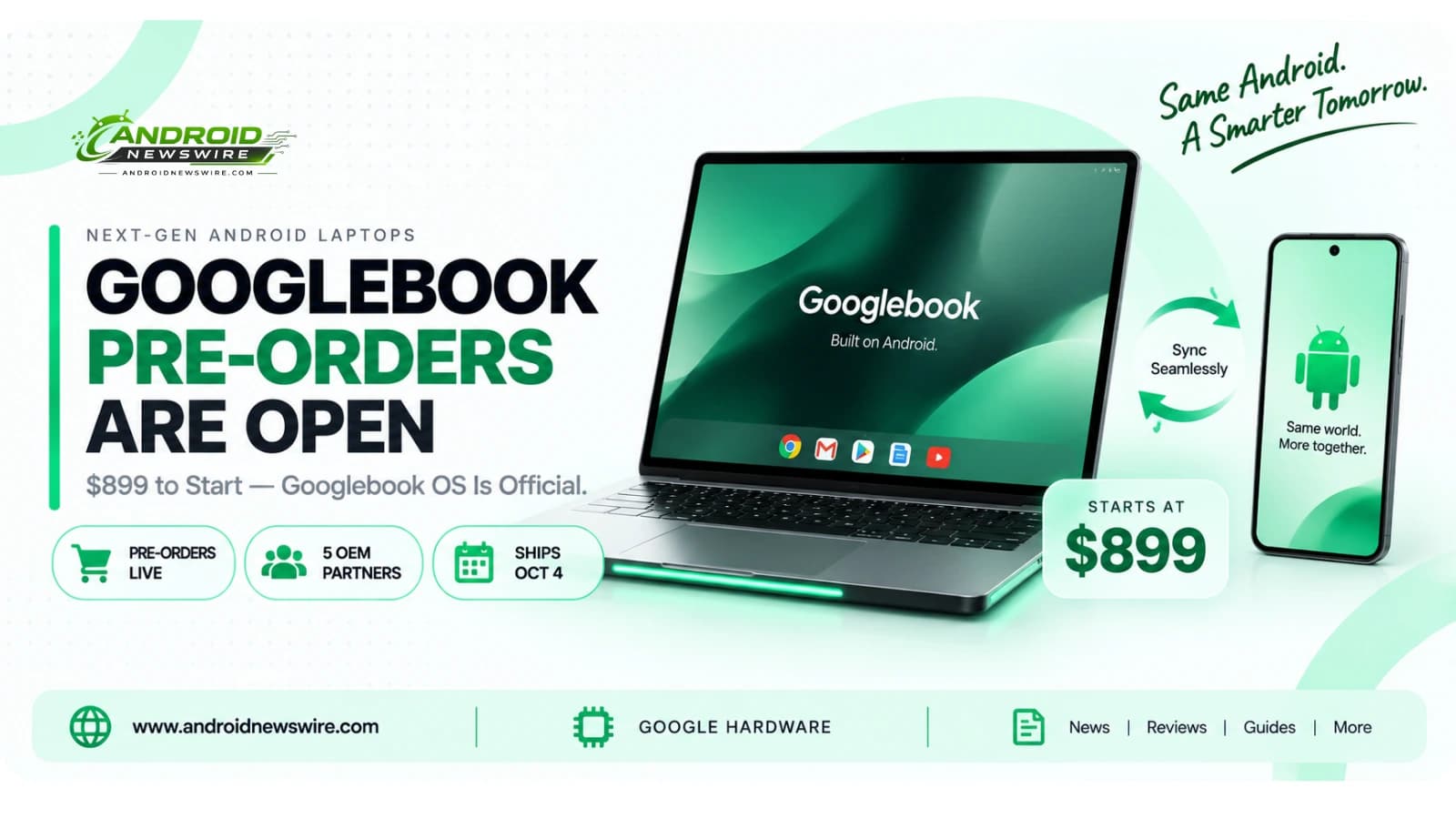
The wait is officially over. Google has opened pre-orders for Googlebook, its new category of Gemini-powered laptops, following the September 15 media reveal in New York we previewed in detail. Pre-orders went live September 21 at 9 a.m. ET, with devices from all five confirmed hardware partners — Acer, ASUS, Dell, HP, and Lenovo — now available to reserve at the Google Store, Best Buy, and select other retailers, ahead of a October 4 on-shelf date in the US.
The Software Finally Has a Real Name: Googlebook OS
One of the biggest open questions heading into the reveal was what Google would actually call the operating system that had spent months circulating under its internal codename, “Aluminium.” That question is now answered: the platform is officially Googlebook OS. It runs the full desktop version of Chrome, extensions included, alongside Play Store Android apps — many specifically adapted for larger screens, mouse, and keyboard input — meaning it’s genuinely a merger of ChromeOS’s desktop browsing strengths and Android’s native app ecosystem, rather than either platform simply running inside the other.
Pricing: $899 to Start, Climbing to $1,299
Here’s the actual pricing breakdown, now confirmed rather than rumored. The headline $899 price applies specifically to Acer’s entry-level model — it’s the only device in the initial five-manufacturer lineup that hits that exact price point. Every other manufacturer’s offering climbs to $1,299. That’s worth being precise about, since “starting at $899” technically describes the lineup’s floor, not what most buyers should expect to actually pay across the five available options.
On form factor: Acer’s 14-inch model is also the only convertible in this initial wave, while the other four manufacturers — ASUS, Dell, HP, and Lenovo — are shipping standard clamshell laptops ranging from 13 to 15.3 inches.
Real Hardware, Not Just a Software Story
Google’s own announcement leans heavily into build quality: 2.8K OLED touchscreen displays, up to 14 hours of battery life, haptic glass trackpads, and backlit keyboards across the lineup. This is Google’s first serious return to premium laptop hardware since the Pixelbook Go in 2019 — and the positioning is deliberately different. Where the Pixelbook Go ran ChromeOS and targeted a mid-market audience, Googlebook is explicitly aimed higher, treating the underlying AI model — not the operating system itself — as the actual selling point.
The Real Differentiator: Deep Android Phone Sync
The feature Google is leaning on hardest in its own marketing is genuine, practical continuity with an Android phone you already own. Sign in on a Googlebook, and your phone’s settings, saved passwords, Wi-Fi networks, and messages carry over automatically, protected by end-to-end encryption. A feature called Continue On lets you pick up directly on the laptop exactly where you left off on your phone — the specific kind of cross-device continuity Apple has held as a meaningful advantage between iPhone and Mac for years, which Google is now attempting to match natively rather than through a third-party workaround.
Gemini Front and Center: Magic Pointer and More
True to Google’s framing that AI is the actual product here rather than a bolted-on feature, Googlebook ships with several Gemini-powered tools baked directly into the desktop experience:
- Magic Pointer — first previewed at Google’s I/O 2026 event, this lets you bring Gemini directly to whatever you’re looking at on screen simply by wiggling your cursor, then assign it a task or ask for help with exactly what’s in view.
- Rambler — the same speech-cleanup feature that debuted as one of the Pixel 11’s headline additions, now available on the desktop, automatically cutting filler words and false starts from dictated text.
- Create My Widget — an AI tool that generates a custom desktop widget displaying whatever specific information you want tracked, built on the fly rather than chosen from a fixed template library.
What’s Actually in the Box: Subscriptions Included
Every Googlebook ships with real subscription value bundled in at no extra cost: 12 months of Google AI Pro, including 5TB of cloud storage and Gemini’s advanced capabilities, plus YouTube Premium included as well. For creative work, Google specifically names Adobe Photoshop, Adobe Lightroom, and CapCut as native tools available on the platform, alongside Netflix and HBO Max for streaming with offline viewing support. Every device also includes a free year of GeForce NOW for cloud gaming — a notable inclusion for a laptop category not primarily marketed around gaming performance.
Release Timeline and Where It’s Launching
Devices reach US shelves on October 4, with Canada, the UK, Ireland, France, Germany, and Australia following on October 5. Worth flagging for anyone outside that list: India is not part of the initial launch markets, despite being one of Google’s largest Android user bases globally — a notable omission that may reflect the platform’s premium price positioning against a market where budget and mid-range devices dominate far more heavily than in the US or Western Europe.
Why This Launch Matters Beyond the Spec Sheet
Googlebook’s real significance isn’t any single feature — it’s the strategic bet underneath the whole platform. Google is positioning this as a direct answer to Microsoft’s Copilot Plus PC push and Apple’s on-device AI story, treating the AI model itself as the primary reason to choose a laptop, rather than the operating system or hardware specs alone. That’s a meaningfully different pitch than “a slightly better Chromebook,” and it’s consistent with the broader “operating system to intelligence system” framing Android chief Sameer Samat has repeated throughout 2026 — Googlebook is that philosophy’s most literal expression yet, arriving as actual purchasable hardware rather than a stage demo or roadmap slide.
Whether Googlebook OS genuinely delivers on tight Android integration in daily use, and whether the AI-first pitch resonates against two extremely well-established competitors in Microsoft and Apple, are questions that will only get real answers once devices start reaching reviewers and early buyers after the October 4 launch. But with pricing, hardware partners, release dates, and the platform’s actual name all now locked in, Googlebook has moved decisively from concept to real, purchasable product.