
Google Quietly Gave the Pixel 9a Screen-Off Fingerprint Unlock — And Said Nothing About It
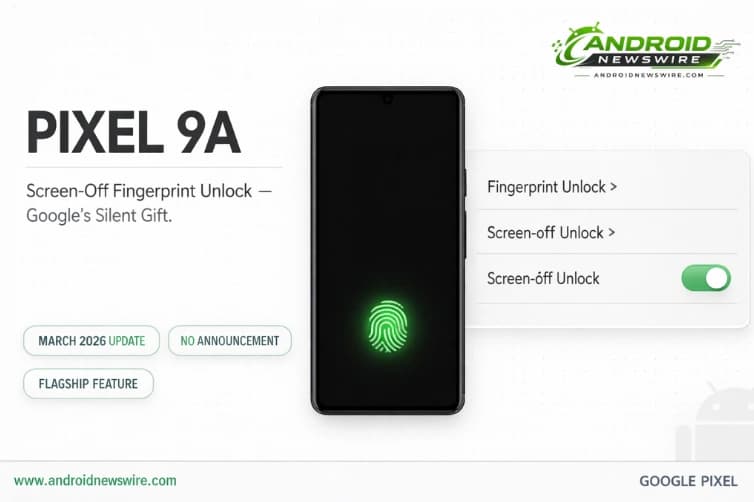
No changelog entry. No feature spotlight. No blog post. Google appears to have slipped one of its most convenient biometric features — screen-off fingerprint scanning — into the Pixel 9a with the March 2026 update, and said absolutely nothing about it. Users on Reddit spotted the change over the weekend, and reports are confirming it works. Here is what the feature does, how to find it, what devices are affected, and why the March update’s broader track record means you should check your own device carefully before celebrating.
What Screen-Off Fingerprint Unlock Actually Does
The screen-off fingerprint feature was first reported late in 2024 as Android 16’s second Developer Preview rolled out. Users are already used to the usual runaround: wake your phone, hold your thumb or finger to the scanner, and you’re in. With screen-off fingerprint unlock, you wouldn’t have to wake your display first. Users can hold their thumb against their screen and watch their phone unlock. Fox News
In practice this means picking up your phone from a table, placing your registered finger on the display sensor in the rough location of the fingerprint icon, and having the device unlock and go straight to the home screen — all without pressing the power button or tapping the display first. It is a small change in the unlock flow that becomes genuinely noticeable in daily use, particularly for users who pick up and put down their phone dozens of times a day.
The feature is also toggleable, meaning you don’t need to have it on if the usual method doesn’t bother you. Fox News It is an opt-in convenience addition, not a forced change to how fingerprint unlock works.
How Pixel 9a Users Discovered It
Over the weekend, users on the Pixel phones subreddit noticed that a new fingerprint option arrived with the March update. The original poster reports that their Pixel 9a received a “When using Fingerprint Unlock” option in the respective settings menu. This sub-section now houses the Screen-off Fingerprint Unlock toggle. According to the user, the feature “works great on my Pixel 9a.” A few more reports were added to the Reddit thread, with others confirming the feature has arrived on their Pixel 9a as well. Fox News
Google has made no public mention of this addition — it does not appear in the March 2026 patch notes, was not called out in the Pixel Drop announcement, and has not been highlighted in any official communication. The discovery was entirely community-driven, surfacing on Reddit over the weekend and quickly confirmed by multiple users.
To find the setting: go to Settings → Security & Privacy → Device Unlock → Fingerprint Unlock, where a new “When using Fingerprint Unlock” sub-section now appears containing the Screen-off Fingerprint Unlock toggle.
Catching Up to the Pixel 9 and Pixel 10
With this, Pixel 9a users catch up to Google’s flagships — the Pixel 9 and Pixel 10 series — with a feature that lets users unlock their phones without waking their display. At the time of the feature’s initial introduction in Android 16’s Developer Preview, it was limited to the Pixel 9 series for testing. Fox News
The Pixel 9a sits in Google’s mid-range tier — a device positioned to deliver a strong Pixel experience at a more accessible price point. The arrival of screen-off fingerprint unlock on the 9a is a meaningful value-add that narrows the experiential gap between it and Google’s more expensive hardware. Users who chose the 9a for price reasons rather than specs will now have access to a quality-of-life feature that was previously only available on devices costing significantly more.
The feature does not appear to have extended to older Pixel hardware. One user reports that the feature does not work on their Pixel 6 Pro, as support most likely did not get rolled out for that older generation. Fox News This is consistent with Google’s general approach of limiting newer biometric features to hardware generations that have the sensor capability to support them reliably.
The Caveat: One User Reports It Disappeared After March Update
Not every report is positive. One user reports that they had screen-off fingerprint scanning capability on their Pixel 7 Pro, but Google seemingly removed it with the March 2026 update. This would be strange if it’s happened to more users, as Google hasn’t publicly mentioned removing such support. Fox News
Whether this removal is intentional — perhaps the Pixel 7 Pro’s hardware cannot support it reliably enough for a stable release — or an unintended regression in the March patch is not yet clear. Google’s silence on both the addition and the apparent removal makes it difficult to determine the intended device support scope.
This ambiguity points to a broader issue with how Google has handled the March 2026 update communication, which brings us to the more serious concern accompanying this week’s positive discovery.
The March Update’s Other Problems: AOD Freezing, Watch Sensor Failures
The same March 2026 update that quietly delivered screen-off fingerprint unlock to the Pixel 9a has also been generating significant complaints across the Pixel community for unrelated issues.
Pixel users have been complaining that the AOD (always-on display) has been freezing nonstop since the March update. More than that, the Pixel Watch’s SpO2 and skin temperature sensors have not been working, nor has Fitbit’s step tracking. Fox News
These are not minor inconveniences. Always-on display freezing — where the AOD screen locks on a static state and fails to update — is a persistent visual and functional defect that affects every interaction with a locked Pixel. SpO2 and skin temperature sensor failures on Pixel Watch directly impact the health tracking functionality that many users rely on for sleep and wellness monitoring. Fitbit step tracking failures affect the baseline fitness metric that most wearable users check daily.
The combination of an undocumented positive addition and multiple undocumented regressions in the same update package is a pattern worth flagging. The March 2026 patch was already notable for its record-breaking 129 CVE security fixes — which we covered in our March 2026 Pixel Feature Drop and Security Update article. A patch of that scale carries higher regression risk than a typical monthly update, and the community reports this week suggest some of that risk materialized.
Google has not yet acknowledged the AOD freezing issue or the Pixel Watch sensor failures publicly. A supplemental patch addressing these regressions would be consistent with Google’s past response to significant post-update bugs, but no timeline has been indicated.
How to Enable Screen-Off Fingerprint Unlock on Pixel 9a
If your Pixel 9a has received the March 2026 update and you want to try the feature:
Settings → Security & Privacy → Device Unlock → Fingerprint Unlock → When using Fingerprint Unlock → Screen-off Fingerprint Unlock → Toggle ON
You do have to place your finger roughly in the area that you normally would if you could see the fingerprint icon on screen. Fox News The sensor location has not changed — the difference is simply that you no longer need to wake the display to activate it. With practice, the muscle memory of placing your finger in the right location while picking up the phone becomes natural quickly.
If the “When using Fingerprint Unlock” sub-section does not appear in your settings, confirm that you have the March 2026 update installed via Settings → System → System update. If the update is installed and the option is still absent, the rollout may be staged — check back in a few days.
The Bigger Picture: Google’s Quiet Feature Rollouts
The screen-off fingerprint discovery on the Pixel 9a is part of a recurring pattern in Google’s Pixel update cadence. Features that received significant attention during Pixel 9 and Pixel 10 development — and that were highlighted as flagship-tier additions — have a history of quietly making their way to older and mid-range devices through subsequent monthly patches, often with no corresponding announcement.
This is not necessarily a bad approach. Delivering capabilities via monthly updates rather than requiring a full Android version upgrade means more devices benefit sooner. But the absence of any communication around these additions — or around their removal, in the case of Pixel 7 Pro — means users who do not actively monitor community forums may never know features are available to them.
The March 2026 Pixel Drop itself was well-documented for its headlining features: Gemini background task automation, live location sharing in Google Messages, Now Playing as a standalone app, and the Find Hub airline luggage tracking integration we covered in our Find Hub article. Screen-off fingerprint on Pixel 9a was not among them — and would have remained undetected without an observant Reddit community.
For Pixel users on any device, the practical advice is consistent: after each monthly update, take five minutes to browse Settings for new additions. Google’s update communications reliably cover the major highlights, but the minor quality-of-life improvements — and occasionally the significant regressions — often require a community to surface them.