
Samsung Is Building 50% More Galaxy S26 Units This Month – Here’s the RAMageddon Story Behind It
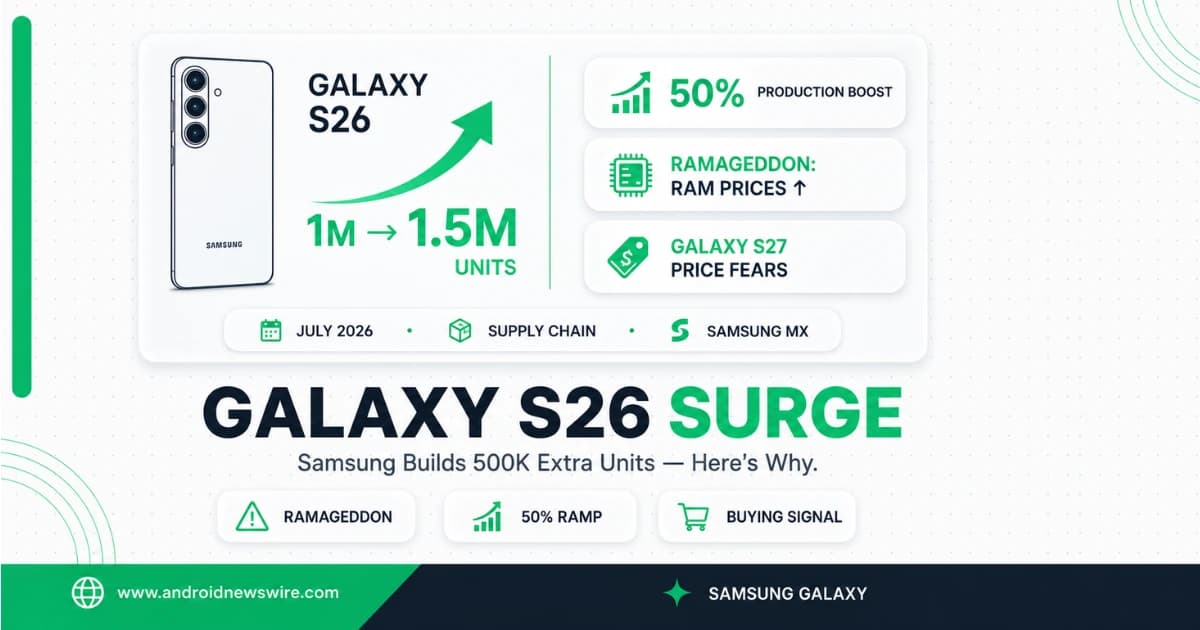
Samsung is not usually the kind of company that scrambles to build more of a phone that has already been on sale for six months. The fact that it has done exactly that this month – revising its July Galaxy S26 production target upward by 50 percent, from 1 million to 1.5 million units – tells a more interesting story than a simple sales win. Two forces are colliding to drive an unusual mid-cycle demand spike: strong promotional activity in Samsung’s home market, and a growing consumer conviction that the Galaxy S27, when it arrives next year, will cost significantly more due to the ongoing global memory shortage known as RAMageddon. Understanding both forces gives you a clearer picture not just of why Samsung is making more phones right now, but of where the entire Android flagship market is heading over the next 18 months.
The Numbers: 1 Million Becomes 1.5 Million
A report from ETNews claims that Samsung has increased its Galaxy S26 series production target for July to 1.5 million units after demand surpassed the company’s initial expectations. Samsung’s original production target for the month was 1 million units.
Galaxy S26 series getting production boost this month, that too by 50 percent, isn’t random. The current flagships are gaining more sales as consumers assume the Galaxy S27 series will be pricier due to memory price hikes. The report points out that the sales of the Galaxy S26 series were impressive in June 2026. Seeing the future potential of sales, the company is already taking measures to maintain a stable supply. Android Police
Samsung is increasing production of its Galaxy S26 series as sales continue to rise. The company has reportedly raised its production plan for July by more than 50% to fulfill demand for its latest flagship smartphones. Samsung could readjust its production target for August after reviewing this month’s sales figures.
500,000 additional units in a single month is not a minor adjustment. It represents a significant commitment of component supply chain resources, manufacturing capacity, and logistics – all on relatively short notice. The fact that Samsung could execute this ramp at all reflects the advantages of being a vertically integrated conglomerate: Samsung’s semiconductor division supplies the DRAM and NAND to its mobile division, giving it a supply stability that competitors without in-house memory production cannot match.
Force 1: The Korean Promotional Surge
Stronger sales have reportedly been driven by aggressive promotions. In South Korea, Samsung held a sales event called the ‘Samsung Electronics Appreciation Festival With The People,’ during which it offered a 20% refund in the form of Digital Onnuri Gift Certificates. As a result, Galaxy S26 series sales reportedly increased threefold through retailers such as 11th Street and Coupang. On Samsung’s own online store, delivery estimates for Galaxy S26 phones have slipped to August due to strong demand.
A 20% rebate in the form of Digital Onnuri Gift Certificates – South Korea’s government-backed digital voucher system – is a meaningful incentive that effectively reduced the Galaxy S26’s real consumer cost by a fifth. Combined with a multi-week promotional window that ran from June 8 to July 5, the event moved units at a pace that outstripped Samsung’s original production planning assumptions.
The threefold sales increase through major Korean e-commerce platforms is the kind of spike that immediately flags itself to supply chain teams. When delivery dates on Samsung.com push out to August for a phone that has been on sale since January, the production response is straightforward: build more.
Force 2: RAMageddon and the Galaxy S27 Price Fear
The promotional surge explains June’s sales numbers. It does not fully explain why Samsung believes the demand is structural enough to justify a 50% production increase in July, when the promotional event has already ended. For that, you need to understand RAMageddon.
The term entered the tech industry’s vocabulary in late 2025 and has only become more apt since. AI data centres – the infrastructure build-out behind every major language model and cloud AI service – require enormous quantities of high-bandwidth memory. That demand pulled production capacity away from mobile DRAM, driving prices for the LPDDR5X memory that smartphones use to roughly double within 18 months. The 12GB LPDDR5X chip that cost approximately $30 in early 2025 was sitting near $70 by the time Samsung negotiated its Galaxy S26 supply agreements.
Samsung’s mobile division chief Won-Joon Choi acknowledged the situation directly earlier this year, confirming that the memory shortage made a “significant contribution” to the Galaxy S26 and S26 Plus costing $100 more than their predecessors. The Galaxy S26 launched at a $100 premium over the Galaxy S25 – and Samsung was explicit about why.
Industry analysts also believe concerns about possible price increases for the upcoming Galaxy S27 series may have urged consumers to buy the Galaxy S26 earlier. In the coming months, rising memory chip prices due to solid investment in AI servers and data centres may greatly increase smartphone manufacturing costs. As a result, Samsung may pass some of the cost burden to customers with the Galaxy S27 lineup.
This is the logic that is driving a portion of Galaxy S26’s current demand. Consumers who were on the fence about upgrading have done the arithmetic and concluded that waiting for the Galaxy S27 means waiting for a phone that will likely cost even more than the Galaxy S26 did when it launched at its already-elevated price. Buying the Galaxy S26 now – especially during a promotional event that further reduced the effective price – looks like the more rational economic decision than waiting.
Previously, there were concerns that Samsung’s MX business could post a deficit due to rising memory costs. However, as Galaxy S26 sales continue to surge, that may not happen.
The Samsung Foundry Factor: Chip Prices Rising Too
The memory shortage is not the only component cost pressure on the Android flagship market. Samsung Foundry – the chip manufacturing arm that produces silicon for Samsung devices and external clients – has raised prices for new customers on its 4nm and 5nm processes by approximately 15 percent, following TSMC’s earlier decision to raise wafer prices across its 3nm, 5nm, and 7nm nodes.
TSMC notified clients including NVIDIA, Apple, and AMD of planned wafer price increases of 5 to 10 percent across its advanced manufacturing processes. Samsung Foundry’s price increase follows that same inflationary pressure, adding another cost layer on top of the DRAM situation.
For consumers and for Android flagship pricing over the next year, the compounding effect of higher memory costs and higher chip manufacturing costs creates a clear trajectory: Galaxy S27 is almost certainly going to cost more than Galaxy S26, which already cost more than Galaxy S25. The degree of the price increase will depend on how memory and foundry pricing evolves between now and Galaxy S27’s expected January 2027 launch window – but the directional pressure is unambiguous.
What This Means if You Are Considering a Galaxy S26
The production ramp and the demand context provide genuinely useful information for anyone weighing a Galaxy S26 purchase now versus waiting for the Galaxy S27.
The Galaxy S26 series is a strong phone by any objective measure. The Snapdragon 8 Elite for Galaxy, Samsung’s Galaxy AI features, the Privacy Display on the Ultra model, seven years of software updates, and now One UI 9 with Android 17 rolling out through the beta program – these are flagship-tier credentials that will remain relevant for several years of active use.
The Galaxy S26 Ultra has been particularly dominant: earlier reports from this year confirmed the Ultra accounts for 70 to 80 percent of total Galaxy S26 series demand – the highest share ever for an Ultra model. The Privacy Display feature, unique among Samsung’s 2026 lineup, appears to be the decisive differentiator driving that skew.
The honest buying advice: if you want a Galaxy flagship and the Galaxy S26 fits your budget at current pricing, buying now makes economic sense given the trajectory of component costs. If you are specifically invested in the new form factors Samsung is about to announce – the Galaxy Z Fold 8, Galaxy Z Fold 8 Ultra, and Galaxy Z Flip 8 at Galaxy Unpacked on July 22 – those are also built on the same Snapdragon 8 Elite Gen 5 and will ship with One UI 9 and Android 17 pre-installed.
What is not a good reason to wait: hoping the Galaxy S27 will be cheaper. Based on every available indicator, it will not be.