Top Android Stories: July 2026 Week 3 — Epic vs. Google Ends, Pixel 11 Goes Official, Gemma 4 Lands On-Device
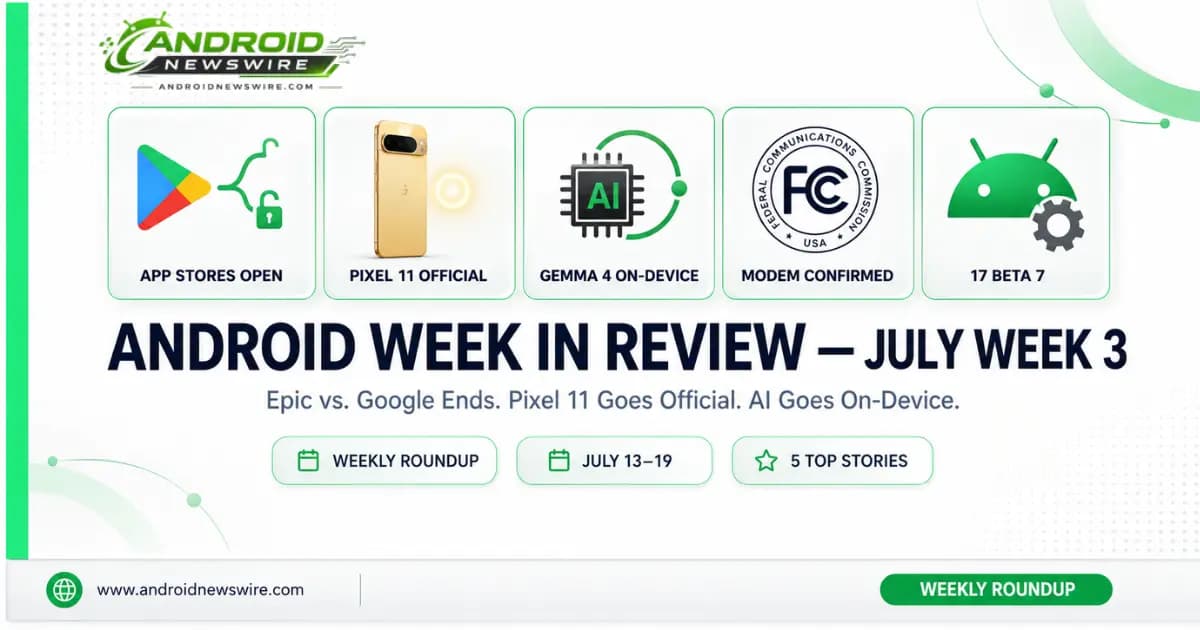
This was the week Android’s app store landscape actually changed, not just talked about changing. Between a landmark antitrust resolution, Google’s first official Pixel 11 confirmation, and a genuinely new approach to on-device AI, Week 3 of July delivered more structural news than hardware gossip. Here’s everything that mattered.
1. Google and Epic End Their Six-Year Fight — Third-Party App Stores Land Inside Play Store July 22
The biggest story of the week, by a wide margin. Google and Epic Games jointly withdrew their proposed settlement, which means Google is now bound by the original October 2024 court injunction it had spent months trying to soften. Starting July 22, US users will be able to install rival app stores directly from inside Google Play — no sideloading — and those stores will arrive pre-stocked with existing Play Store app listings unless developers opt out through the new Play Catalog Access Program.
The terms aren’t a free-for-all: competing stores must pay a $5,000 onboarding fee plus $5,000 annually, keep malware under 1% of install attempts, and operate US-only for now. Outside the US, Google’s separate Registered App Stores program continues to govern access. Six years after Epic pulled Fortnite from the Play Store to force this exact confrontation, Android’s distribution model is about to look meaningfully different, at least domestically.
Why it matters: every Android developer now has a concrete decision to make about opting in or out of third-party distribution, and every competing storefront has a real, if modest, cost of entry to clear.
2. Google Officially Confirms the Pixel 11 — and Pixel Glow Is Real (and Different Than Expected)
After weeks of leaks, an Amazon inventory slip-up, and a wave of beta-code speculation, Google put out its first official Pixel 11 teaser this week. The name is confirmed directly on Google’s own Store page for the first time. The teaser also gave the first real look at Pixel Glow — and it’s not the camera-bar light strip most coverage assumed. Instead, it’s a circular RGB light occupying the same spot as the flashlight, cycling through colors like a loading spinner.
The teaser leans heavily on a gold finish and confirms Gemini Intelligence will headline the August 12 keynote alongside the hardware reveal. A pre-order email promo is live now through August 7, with codes going out August 11 ahead of the August 12 launch.
Why it matters: this resolves the biggest open hardware-design question of the summer and confirms Google is positioning Glow as more than a notification light — possibly a Gemini voice-interaction indicator too.
3. Gemma 4 E2B for TPU Brings Genuine Offline AI to the Pixel 10
Announced at I/O Connect India in Bengaluru, Gemma 4 E2B for TPU is a version of Google’s open model built to run natively on the Pixel 10’s Tensor G5 chip — enabling offline chat, image recognition, private audio transcription, and hands-free device control with zero cloud connection. It’s positioned explicitly as the foundation for the upcoming Gemini Nano 4.
Google didn’t publish latency, memory, or battery figures alongside the announcement, so the real-world performance story is still unwritten. But it’s the clearest signal yet of what Google’s dedicated Tensor Processing Unit is actually built to do.
Why it matters: this is a genuine architecture bet — smaller, hardware-specific models running fully on-device rather than more cloud API calls — and it’s the same stack Gemini Nano 4 will build on.
4. Pixel 11 Clears FCC Certification, Confirms End of Samsung Modems
Five Pixel 11 devices passed FCC certification this week, confirming a switch to MediaTek modem hardware across the entire lineup — ending a six-year run of Samsung Exynos modems in Pixel phones. All five support standard 5G including mmWave and satellite connectivity, with UWB and Thread support varying by tier. The filings landed the same week as the earlier Amazon pricing leak, adding official documentation to what had mostly been retailer-sourced detail.
Why it matters: Samsung modems have a track record of reliability complaints in past Pixel generations; the MediaTek switch is a hardware change reviewers will be watching closely come August.
5. Android 17 QPR1 Beta 7 Rolls Out With Quick Settings Fixes
This week’s beta build resolves several nagging Quick Settings issues: Battery Share sometimes failing to start charging or getting stuck on the charging animation, a UI gap appearing between battery and mobile data icons after disabling Wi-Fi, and a crash affecting the font-size controller in Quick Settings. Solid incremental progress for beta testers running Android 17 ahead of its next quarterly refinement.
6. Xiaomi Becomes First Non-Google OEM to Ship Stable Android 17
Xiaomi 17 and Xiaomi 17 Ultra received official, stable Android 17 builds this week — the first manufacturer besides Google to complete the jump to stable Android 17, rolling out globally via OTA. It’s a notable speed marker for how quickly the broader OEM ecosystem is catching up to Google’s own release cadence this cycle.
7. Swiss Regulators Open Antitrust Probe Into Android’s Search Choice Screen
Adding to Google’s regulatory workload, Swiss authorities opened a fresh antitrust investigation into the search choice screen shown on Android devices — landing in the same week as the Epic settlement resolution. Together, the two stories underline the same theme: Google is facing simultaneous pressure on multiple fronts over how much control it holds over Android’s default distribution and search behavior.
The Rest of the Week, Briefly
- Chrome’s Android bottom bar now puts Gemini front and center, continuing Google’s push to make AI a persistent, one-tap-away UI element rather than a separate app.
- HMD reportedly cancels the Fusion 2, its modular phone follow-up — a quiet signal that the modular-phone concept still hasn’t found commercial footing.
- Samsung’s Voice Recorder app gets a cloud AI transcription upgrade, aimed at fixing historically unreliable text transcripts.
- Google DeepMind’s chief proposed a Wall Street-style regulatory body to oversee frontier AI development — a policy story worth watching as it’s likely to shape how Gemini and competing models get regulated going forward.
- Galaxy Unpacked (July 22) pre-order offers are now confirmed at up to $1,230 in bundled value, as Samsung’s marketing ramps up ahead of the Z Fold 8 and Z Flip 8 reveal — landing the same day as Google’s new third-party app store rules.
Looking Ahead
Next week is stacked: Galaxy Unpacked lands July 22, the same day Google’s Play Catalog Access Program officially opens the floodgates to third-party app stores in the US. Expect Samsung’s Z Fold 8, Z Flip 8, Watch 9, and Watch Ultra 2 to dominate hardware coverage, while the app-store story plays out in real time as the first wave of alternative storefronts attempt to onboard. With Pixel 11 now officially confirmed and just under a month from launch, expect the leak cadence to intensify heading into August 12.