
Android 17 QPR2 Beta 6 Just Landed — And It Quietly Left the Pixel 11 Behind
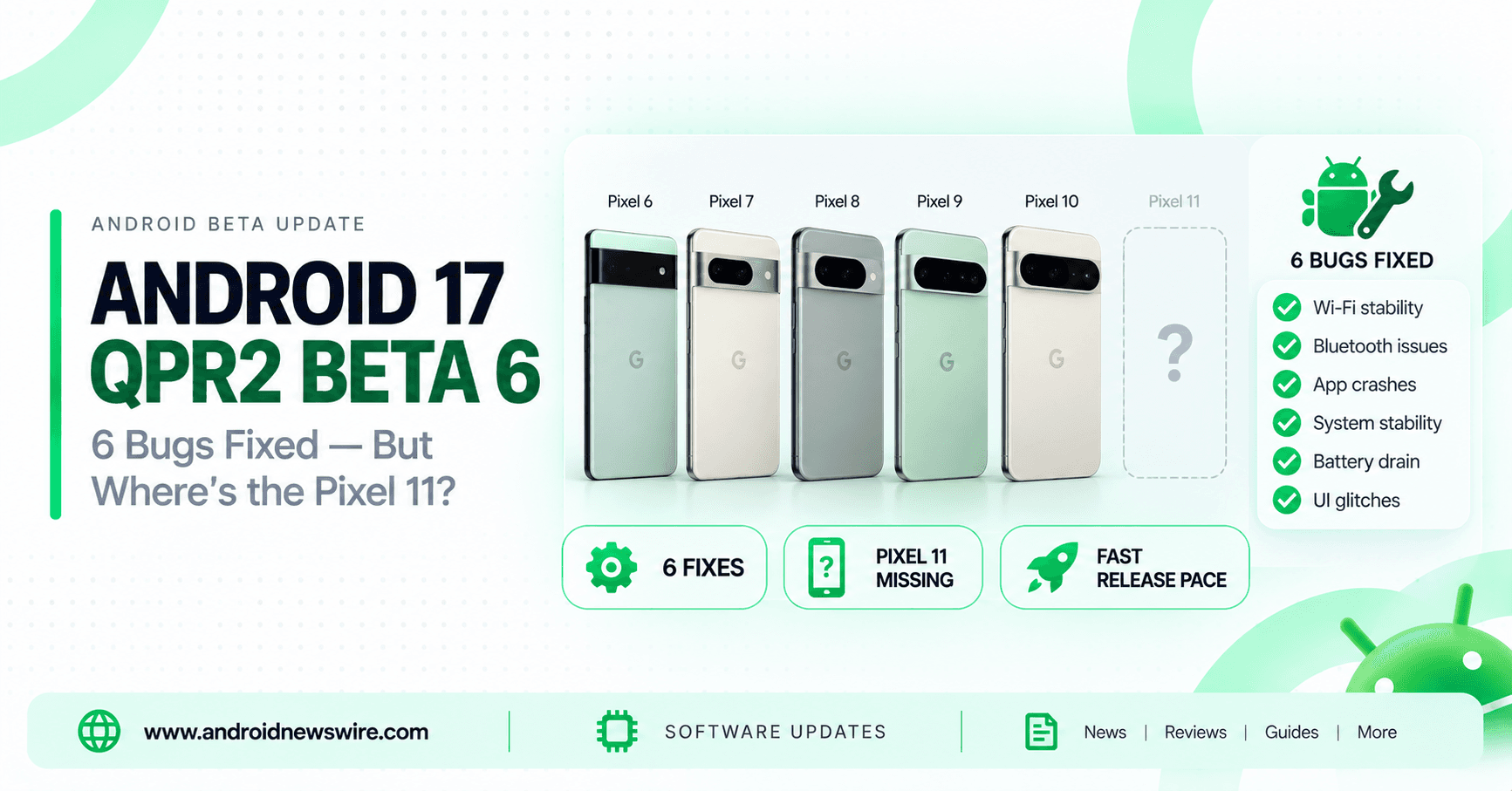
Google’s beta testing cadence for Android 17 QPR2 has been moving unusually fast lately, and today’s release keeps that momentum going in an odd direction. Beta 6 arrived today, September 24, barely a week after Beta 5 — shattering the roughly two-week pace Google had settled into for most of this cycle. The build itself is squarely a stability release, fixing six real, disruptive bugs. But the detail generating the most discussion isn’t what’s in it — it’s what’s conspicuously missing: Pixel 11 series support, present just one build ago, has quietly disappeared.
What Beta 6 Actually Fixes
This is a genuinely substantive stability release, not a cosmetic patch. Google’s own changelog, carried under build number CP41.260831.007, lists six specific fixes:
- A visual regression causing letterboxed content to leak through the status bar during activity transitions.
- The screensaver displaying a blank screen while charging, rather than the intended visual.
- Unexpected device reboots on the Pixel 9 Pro Fold specifically, triggered when third-party apps initialize the camera viewfinder.
- Locked applications failing to dismiss via swipe gestures in the Recents screen.
- A system kernel crash causing unexpected reboots when third-party apps request simultaneous camera and microphone access during biometric identity verification.
- A previously reported issue causing devices to crash or reboot while simply scrolling through content — arguably the most disruptive of the six, given how frequently scrolling happens in normal, everyday phone use.
That’s a genuinely broad spread of severity-worthy bugs squashed in one release: camera-triggered reboots, a full system kernel crash, and a crash tied to the single most common gesture on a touchscreen phone. It’s a build clearly aimed at real stability problems testers have been actively hitting, rather than routine housekeeping.
Call Forwarding Fraud Protection Continues
Beta 6 also continues work Google began in an earlier build this cycle: hardening Android against call forwarding fraud — the same anti-scam protection targeting programmatic call rerouting that we covered when it first appeared in Beta 3. Its continued presence in this build suggests Google is still actively refining that specific security feature rather than treating it as finished.
The Pixel 11 Mystery: Here Last Month, Gone This Month
Here’s the detail that’s genuinely puzzling, and worth taking at face value rather than reading too much into it. Beta 5, released roughly a week before this build, was the first QPR2 release to officially support the brand-new Pixel 11 series — a real milestone at the time, extending beta access to Google’s newest flagship lineup. Beta 6, released just a week later, doesn’t include Pixel 11 support at all. The build tops out at the Pixel 10 family.
Google has directly acknowledged the gap rather than staying silent about it. On the Reddit thread where the company shares these beta releases, Google’s Mishaal Rahman confirmed: “Builds for the Pixel 11 are coming, stay tuned!” That’s a clear, on-record acknowledgment that this is a temporary omission rather than Google quietly walking back Pixel 11 beta support entirely — but it doesn’t explain why a device that had support in the previous build lost it one release later, which is the part multiple outlets covering this release have flagged as genuinely unusual rather than routine.
Who’s Covered, and Who Isn’t
The full list of supported devices for Beta 6 spans a wide range: Pixel 6a, Pixel 7, Pixel 7 Pro, Pixel 7a, Pixel Tablet, Pixel Fold, Pixel 8, Pixel 8 Pro, Pixel 8a, Pixel 9, Pixel 9 Pro, Pixel 9 Pro XL, Pixel 9 Pro Fold, Pixel 9a, Pixel 10, Pixel 10 Pro, Pixel 10 Pro XL, Pixel 10 Pro Fold, and Pixel 10a, along with the Android Emulator.
As has been the case throughout this entire QPR2 cycle, the original Pixel 6 and Pixel 6 Pro remain excluded — and this time, that exclusion is now formally permanent rather than pending. Both devices officially hit their End of Life milestone with last week’s Android 17 QPR1 stable release, meaning QPR1 was genuinely their last supported update. If you’re still running one of these two phones, this isn’t a temporary gap the way the Pixel 11’s absence is — QPR2 and everything beyond it simply isn’t coming to that hardware.
An Unusually Fast Release Pace
It’s worth flagging the cadence itself as notable on its own. Google’s QPR2 beta releases had settled into a roughly two-week rhythm for most of this cycle — Beta 4 landed in late August, and Beta 5 followed about two weeks later. Beta 6 arriving barely a week after Beta 5 breaks that pattern meaningfully. One read on this acceleration: Google appears to be moving quickly to stamp out a cluster of genuinely disruptive crash bugs — camera-triggered reboots and a scrolling-related system crash chief among them — rather than waiting for the next scheduled two-week checkpoint to bundle fixes together.
How to Get It, and What to Do If You Hit a Bug
If you’re already enrolled in the Android Beta Program on an eligible device, Beta 6 should arrive as a standard over-the-air update — check under Settings > System > System update. Manual installation via system images and OTA zip files remains available for anyone who prefers flashing directly. Bugs can be reported through the Android Beta Feedback app, accessible from the app drawer or Quick Settings, which routes reports directly into Google’s public issue tracker — the same channel that appears to have surfaced several of the specific crashes fixed in this very build.
What This Means for the Road to Stable
Android 17 QPR2 continues to be described by Google as a relatively minor SDK release without significant planned behavior changes for developers, with the current cycle’s focus squarely on bug fixing and stability rather than new feature work at this stage. With six meaningful crash-related fixes landing in Beta 6 alone, and the release cadence accelerating rather than slowing down, this reads as a cycle actively converging toward a clean stable release — assuming the promised Pixel 11 support returns in the next build or two, rather than staying an open question for much longer.