Google Just Made the Car a First-Class Android Platform — Here Is the Developer Opportunity Nobody Is Talking About Yet
The Shift in Plain Language: From Dashboard to Brain
Modern cars are quickly becoming computers on wheels. From pre-heating your car in the morning to using your smartphone as a car key, many of today’s vehicle functions are controlled by software. These Software-Defined Vehicles allow for rapid innovation, bringing new features over the air much faster.
The previous version of Android Automotive – the version that Volvo, Renault, GM, Honda, and BMW have been deploying in infotainment systems since 2019 – was deliberately scoped to what a driver interacts with through the touchscreen. That scoping was appropriate for its time. Automakers were not ready to hand core vehicle functions to a platform they did not control end-to-end, and Google was not yet positioned to offer the kind of headless, low-level vehicle integration AAOS SDV now provides.
Google announced AAOS SDV to extend “beyond the car’s screen,” providing an open infrastructure for the non-safety parts of vehicles – allowing for in-car voice assistants that can control more vehicle functions, as well as proactive maintenance reminders. Over-the-air updates can deliver more of these features over time.
The distinction between “safety” and “non-safety” vehicle systems is the architectural boundary that makes this announcement both ambitious and precise. Google is not claiming jurisdiction over braking, steering, ADAS, or any system where a software failure could directly cause a crash. AAOS SDV is only providing an infrastructure to the non-safety parts of the vehicle. What it is claiming – and what represents an entirely new developer surface — is everything else: the vehicle comfort systems, convenience systems, personalization systems, and maintenance systems that constitute the majority of the software interactions a driver has with their car across a typical ownership period.
What the Non-Safety Vehicle Layer Actually Includes
When Google says “non-safety core vehicle software,” what does that mean in concrete terms for developers thinking about what applications are now possible?
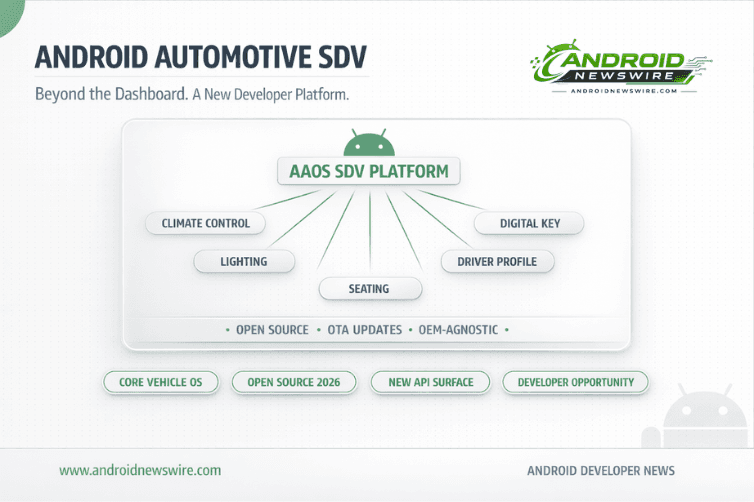
Non-driving functions like climate control, lighting, and seating adjustment would fall under Android’s control. The system would move beyond basic infotainment to create a unified ecosystem for features like remote cabin conditioning, digital key management, and personalized driver profiles.
Breaking each of these down:
Climate control means that the HVAC system – heating, ventilation, air conditioning, seat heating and cooling, steering wheel heating – is now addressable through Android APIs rather than through a proprietary, OEM-specific software layer. An app that wants to pre-condition a cabin based on calendar context, weather data, or user preferences can now interact with that system through a standardized interface rather than requiring OEM partnership or custom integration work.
Lighting means interior ambient lighting zones, exterior lighting signatures, and automatic lighting responses to context – time of day, driving mode, user identity. An app that wants to change the cabin’s ambient light color when a phone call starts, or dim interior lighting when the user watches video content parked, now has an API path to do that.
Seating adjustment means that driver and passenger seat positions – recline angle, lumbar support, seat height, headrest position – are accessible as a software layer. Combined with driver personalization profiles, this means an app can automatically restore a user’s exact preferred seat configuration when they enter the vehicle, synchronized across any vehicle on the same platform.
Remote cabin conditioning means that pre-heating and pre-cooling the cabin before departure – already available on some EVs through proprietary apps – becomes an Android-native capability accessible through standardized APIs rather than OEM-specific apps.
Digital key management means that the cryptographic keys that allow a smartphone to authenticate as a vehicle key can be managed through Android’s platform APIs, integrated with the existing Google Wallet infrastructure rather than requiring OEM-specific key management apps.
Personalized driver profiles means that the complete set of a driver’s preferences – seat position, mirror angles, climate preferences, display settings, audio equalization, preferred navigation routes – can be stored and synchronized as an Android account data structure, automatically applied when that driver enters a vehicle that recognizes them.
The Architecture: Why “Headless Android” Changes Everything
The technical foundation of AAOS SDV is as important as its feature scope. The platform is designed as a compact, performant, and scalable software foundation based on a “headless” Android native stack. Unlike the consumer-facing version of Android seen on tablets or in-dash displays, this version operates out of sight, extending deep into the vehicle’s electrical and electronic architecture.
“Headless” in this context means Android running without a display – operating as an invisible orchestration layer across the vehicle’s computing fabric. There is no Android home screen, no launcher, no visible UI. There is, however, a full Android runtime, a standard inter-process communication layer via Binder, a permissions and identity model, and – critically for developers – a set of APIs that provide programmatic access to the vehicle systems described above.
The platform is designed to power a wide array of vehicle controllers, tackling core compute, body controls, and instrument cluster domains. This means that instead of having dozens of isolated electronic control units from different suppliers – each running unique, incompatible software – automakers can utilize a unified Android-based operating system. This stack incorporates low-level automotive frameworks for communications, diagnostics, and software updates.
For developers, the “headless” architecture has a direct and practical implication: the programming model for vehicle function integration is not primarily a UI problem. It is a service and API problem. Apps that want to interact with vehicle climate systems or driver profiles are not building new screens — they are building service integrations that operate in the background, respond to context, and surface through the existing infotainment UI or through companion phone apps.
Vehicle functions are developed as “topology-agnostic services,” meaning they are reusable across different vehicle models and architectures. This allows for granular, service-level updates with built-in dependency handling. If Google updates the climate control service, or an OEM wants to add a new lighting capability, those changes ship as targeted OTA updates to specific services – not as full OS reflashes that require extended validation and dealer scheduling.
The Fragmentation Problem AAOS SDV Solves – and Why It Opens the Market
To understand why AAOS SDV matters for developers, you need to understand the problem it solves for automakers. Moving to software-defined vehicles does not come without challenges. Different manufacturers have developed different software architectures, integrating software modules from dozens of different suppliers. This fragmented approach means carmakers have to spend time on building infrastructure rather than what truly differentiates them in a fast-moving market.
Today, if a developer wants to build an app that integrates with a vehicle’s climate control system, they need a custom engineering agreement with each OEM whose vehicles they want to support. BMW’s HVAC software speaks a different protocol than Mercedes-Benz’s, which is different again from Hyundai’s, which is different again from Renault’s. There is no standardized API, no shared authentication model, no common data format. The result is that almost no independent developers attempt it – the integration cost per OEM is prohibitive, so vehicle integration has remained the exclusive domain of OEM internal teams and a small number of Tier 1 suppliers with deep manufacturer relationships.
AAOS SDV’s shared platform changes this calculus entirely. By providing “foundational code and a common language for their software,” Google says automakers will be free to design unique experiences for their customers on top of a common platform. For developers, that “common language” is what matters most – a shared API surface means that an integration built once targets every vehicle running AAOS SDV across every OEM that has adopted the platform.
Google is proactively working with leading industry carmakers, suppliers, silicon platforms, and software vendors to ensure that the AAOS SDV platform is well supported. Renault is currently leveraging AAOS SDV for its upcoming Renault Trafic e-Tech, with production set to begin in late 2026. Qualcomm is scaling the AAOS SDV platform through a strategic partnership, having introduced Snapdragon vSoC on Google Cloud at CES 2026 and announced a scaling collaboration to deliver a turnkey, pre-integrated AAOS SDV stack on Snapdragon Digital Chassis platforms.
The Open-Source Strategy: Android’s Proven Market Playbook
At Android, Google believes that open platforms can help to increase innovation and reduce complexity. By championing open platforms, the company empowers the industry to define what tomorrow’s cars will offer. The AAOS SDV platform is being open-sourced later this year.
This is exactly how Google built Android into the dominant mobile platform – open-source the foundation, lower the barrier to OEM adoption, build a developer ecosystem around the shared platform, and then differentiate through Google services layered on top. It is the same playbook Google used with Android smartphones, which now power roughly 70% of mobile devices worldwide.
For the automotive industry, open-sourcing AAOS SDV means any OEM can adopt the platform without licensing costs, customize on top of the shared foundation, and contribute improvements back to the common codebase. Tier 1 suppliers can build standardized modules that work across multiple OEMs rather than custom implementations per manufacturer. And developers can build on the platform knowing that a growing OEM adoption base creates a growing addressable market – rather than the locked, OEM-specific silos that have characterized automotive software development until now.
The Snapdragon vSoC on Google Cloud capability allows developers to run the exact same software in the cloud that will eventually run on the physical Qualcomm chips inside the car – a cloud-based emulation environment that means you do not need physical access to a Renault Trafic e-Tech to begin building and testing AAOS SDV integrations.
What App Categories Are Now Viable – The New Developer Opportunity Map
With the vehicle’s non-safety functions addressable through Android APIs, entirely new categories of apps become viable for developers. Here is a concrete map of what opens up:
Context-Aware Climate Apps. Imagine an app that connects your Google Calendar to your vehicle’s HVAC system. Monday morning at 7:45 AM, the app sees you have a 9 AM meeting across town. It checks the weather API, determines it is 2°C outside, and pre-conditions the cabin to your preferred temperature 15 minutes before your scheduled departure — automatically, without requiring you to open any app or touch any screen. This is now architecturally possible with AAOS SDV’s climate control API and the existing Gemini contextual awareness infrastructure from the March 2026 Pixel Drop.
Multi-Driver Personalization Services. A personalization service that maintains driver profiles — seat position, climate preferences, display settings, audio equalization, preferred navigation departure routes — and automatically applies them when a recognized driver enters the vehicle using Android’s digital key authentication. For fleet vehicles and shared mobility, this category has immediate commercial value. For family vehicles shared between multiple drivers, it solves a perennial friction point.
Predictive Maintenance Apps. AAOS SDV exposes vehicle diagnostic data through Android APIs. Apps that aggregate that data, apply machine learning models trained on fleet behavior, and surface proactive maintenance recommendations — “your brake pads will need replacement in approximately 3,000 kilometers based on current wear patterns” — can now operate as Android services rather than requiring OEM-specific telematics integrations.
Energy Management for EVs. Apps that optimize charging schedules based on electricity pricing APIs, departure time predictions from calendar data, battery health metrics from the vehicle layer, and route planning from Maps can now access the vehicle’s energy management functions through standardized APIs rather than proprietary OEM interfaces.
Ambient Experience Apps. Apps that adapt the vehicle’s interior environment — lighting zones, audio profile, climate — based on music mode, driving context, passenger presence, time of day, or user emotional state inferred from biometric data. This category overlaps significantly with the wellbeing and ambient computing space already being developed for Android phones and wearables.
Automotive Accessibility Apps. Apps that adapt vehicle controls and interfaces for drivers with specific accessibility needs – simplified climate controls, voice-first interfaces for all vehicle systems, automated lighting adjustments for drivers with photosensitivity – can now be built as Android apps rather than requiring OEM custom accommodation.
How to Start Building for AAOS SDV Today
Google has indicated that the AAOS SDV SDK will be available through AOSP when the open-source release happens later in 2026. In the meantime, developers can begin preparation through several concrete steps:
Step 1: Explore the existing Android Automotive OS developer documentation. The developer.android.com/cars documentation covers the current Android Automotive OS app model, which provides the foundation for AAOS SDV. Understanding how the existing platform works – the Car App Library, the Media, Navigation, and IOT categories, the safety requirements – gives you the baseline knowledge you need to extend into AAOS SDV’s expanded surface when the SDK lands.
Step 2: Register for the Android Automotive Developer Program. Google’s existing automotive developer program provides early access to documentation, sample code, and hardware emulator images. Registering positions you to receive AAOS SDV SDK access as it becomes available.
Step 3: Set up Qualcomm Snapdragon vSoC on Google Cloud when it becomes available. Qualcomm’s Snapdragon vSoC on Google Cloud allows developers to run the exact same software in the cloud that will run on Qualcomm chips inside real vehicles. This cloud-based development and testing environment eliminates the physical hardware dependency that has historically made automotive software development inaccessible to independent developers.
Step 4: Think in services, not screens. The AAOS SDV development model is fundamentally different from phone app development. You are not building UI – you are building services that expose vehicle functions through APIs, respond to context, and integrate with Google’s existing intelligence layer (Gemini, Calendar, Maps, Weather) to create proactive, ambient experiences rather than explicit user-invoked actions.
Step 5: Watch Google I/O 2026. Google I/O in May 2026 will almost certainly include a dedicated automotive session where AAOS SDV’s developer APIs, SDK availability timeline, and certification requirements are detailed. This is the event where the developer roadmap will become concrete. Make sure automotive sessions are in your I/O schedule.
The Competitive Context: Why Timing Matters
Tesla built its competitive advantage by controlling its full software stack from day one – every vehicle system, every OTA update, every data collection pipeline, all owned and operated internally. The gap between Tesla’s software velocity and traditional automakers’ has been widely discussed as a structural competitive disadvantage.
AAOS SDV is the most credible attempt yet to give traditional automakers a path to Tesla-comparable software agility without requiring them to rebuild their entire engineering organization from scratch. Development cycles for proprietary systems are long and expensive. Maintaining and updating these systems is equally resource-intensive. AAOS SDV allows automakers to offload much of this burden to Google, freeing them to focus on core competencies like vehicle design, manufacturing, and safety.
For developers, the competitive timing implication is equally important. The automotive developer ecosystem around AAOS SDV is, right now, essentially empty. The apps, services, and integrations that will define the AAOS SDV user experience have not been built yet. The developers who begin building now — who understand the platform before the ecosystem crowds – are in exactly the position that early Android phone app developers occupied in 2008 and 2009. The platform is validated, the OEM adoption pipeline is active, and the installed base is about to grow rapidly. The opportunity window for first-mover advantage is open right now.
The Bigger Android Platform Picture
AAOS SDV does not exist in isolation. It is the automotive expression of a consistent platform strategy Google is executing across every device category simultaneously. Gemini screen automation on Pixel 10 is Gemini acting as an agent on your phone. Android XR is Gemini acting as an agent in your field of view. AAOS SDV is Gemini acting as an agent in your vehicle – surfacing context, controlling systems, personalizing environments, and executing tasks across the full computing surface of the car.
Android 17’s “intelligent OS” positioning — where Gemini is described not as an app running on Android but as an architectural layer within the platform — is the coherent vision that connects phone, tablet, watch, glasses, TV, and now car into a single AI-native computing fabric. AAOS SDV is how that vision extends to the four-wheeled computing device that most people spend one to two hours inside every single day.
For developers, the invitation is clear: the Android platform surface that matters in 2026 is not just the phone in the user’s pocket. It is every screen, every speaker, every sensor, every actuator in the user’s life — and Google is building a unified platform layer across all of them. AAOS SDV is the car’s place in that picture. The question for every Android developer is how their app category fits into a world where the vehicle is a first-class Android computing platform, not just a dashboard.
Related on Android News Wire:
- Google Is Moving Android From Your Car’s Dashboard Into Its Brain
- Gemini Screen Automation Now on Pixel 10 — Tasks Done Hands-Free
- Android 17 “Cinnamon Bun”: Every Confirmed Feature & Release Date
- Android Studio Panda 2: AI-Powered Development Goes Agentic
- Top Android Stories: March 2026 Week 4 Sunday Roundup