
Android Developer Verifier Is Live: Google’s Ecosystem Shift Starts Now
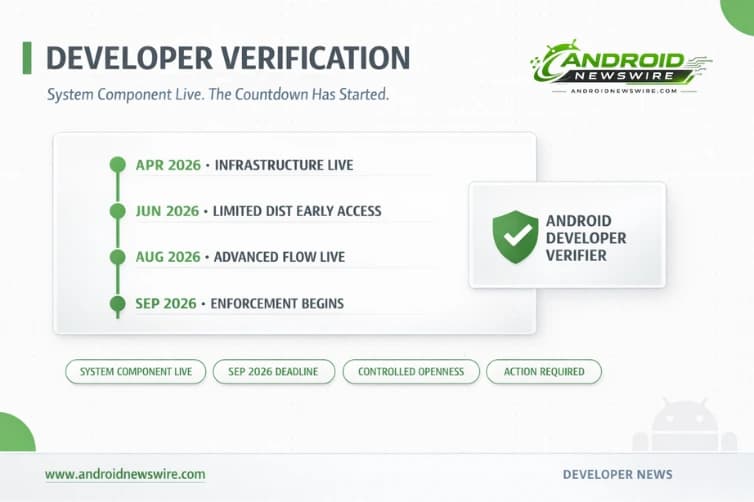
For months, Google’s mandatory developer identity verification policy has been a policy document, a blog post, and a community debate. As of April 2026, it has become something else: a system component running on Android devices. The “Android Developer Verifier” has begun appearing in device system services – the quiet infrastructure signal that a major platform shift has moved from announcement to implementation. If you distribute Android apps outside the Play Store, build internal enterprise APKs, maintain an alternative app store, or teach Android development, this component’s arrival is the starter gun. Here is exactly what the timeline looks like, what it means for every category of affected developer, and what you need to do right now.
The Signal: A New System Component Has Arrived
The appearance of “Android Developer Verifier” in Android’s system services list is not a headline feature – it is infrastructure. It does not show up in changelogs, it does not generate a notification, and it does not visibly change anything about how a user interacts with their device today. It is the plumbing Google is installing before the water starts flowing.
That is precisely why it matters. Google builds system components into devices months before they are activated, to ensure the rollout infrastructure is stable and to give the Android ecosystem time to adapt. The Developer Verifier component appearing in system services now means the enforcement machinery is being laid down in parallel with the developer-facing tools being built. By the time the June 2026 early access period opens and the September 2026 regional enforcement deadline arrives, the verification system will be deeply integrated into the Android platform – not bolted on at the last minute.
The official Google position, stated clearly in the Android Developers Blog post authored by Matthew Forsythe, Director of Product Management for Android App Safety: since announcing updated verification requirements, Google has worked with the community to ensure these protections are robust yet respectful of platform freedom, and that users won’t have to choose between an open ecosystem and a secure one.
The Developer Verifier component is how that balance gets implemented at the system level.
The Timeline: Four Phases Every Developer Needs to Map
Understanding the Developer Verification rollout requires tracking four distinct phases, each with different implications depending on who you are and how you distribute software.
Phase 1 – Now (March–April 2026): System Infrastructure and Early Visibility
The Android Developer Verifier component is appearing in system services. The Android Developer Console – the new developer-facing registration portal, separate from the existing Google Play Console – has been accepting early access participants since October 2025 and expanded to all developers in March 2026.
The Android Developer Console asks developers to provide their legal name, address, email, and phone number. Organizations will additionally need to provide their website and a D-U-N-S number. The D-U-N-S number – a standard business identifier from Dun & Bradstreet – is worth calling out specifically: the process can take up to 28 days to obtain. If you are an organization that does not already have a D-U-N-S number and you intend to distribute apps outside the Play Store, start that process today. Waiting until June is a meaningful risk to your distribution timeline.
Phase 2 – June 2026: Limited Distribution Account Early Access
Free, limited distribution accounts for students and hobbyists allow sharing apps with a small group of up to 20 devices without needing to provide a government-issued ID or pay a registration fee. This ensures Android remains an open platform for learning and experimentation while maintaining robust protections for the broader community.
An early preview of the limited distribution experience will be available to a small number of developers, with early access expected to begin in June 2026. This is the path for everyone who builds apps as a learning exercise, a hobby project, or a tool shared privately with a small group of trusted people. If your use case fits within 20 target devices, the limited distribution account is the clearest frictionless path through the new system – no government ID, no registration fee, no Advanced Flow required for your users to install your app.
Phase 3 – August 2026: Advanced Flow and Limited Distribution Go Live for All
Limited distribution accounts and the Advanced Flow for users will be available in August – before the new developer verification requirements take effect. The sequencing here is deliberate and worth noting: Google is giving users the tools to navigate the new system one month before enforcement begins. Anyone who needs to install apps from unverified developers will have had a full month to complete the one-time Advanced Flow process before it becomes necessary.
The Advanced Flow itself is a five-step one-time process: enable Developer mode, confirm you are not being coached by a scammer, restart the phone and reauthenticate, wait the mandatory 24-hour protective period, then confirm with biometric or PIN authentication. Once completed, users can install unverified apps either for seven days or indefinitely. Full step-by-step breakdown in our dedicated article: Android’s New 24-Hour Sideloading Process Explained.
Phase 4 – September 2026 Onward: Enforcement Begins Regionally, Then Globally
The requirements first take effect in September 2026 in Brazil, Indonesia, Singapore, and Thailand – markets chosen because they are experiencing higher rates of fraudulent app scams, often from repeat perpetrators. A global rollout is planned to continue through 2027.
After September 2026, in enforcement regions: any app installed on a certified Android device must come from a verified developer, or the installing user must have completed the Advanced Flow. Apps from developers who have not completed verification steps by the September 2026 deadline will be unavailable for new installation on certified Android devices in applicable countries.
What “Controlled Openness” Actually Means – The Architecture of the New Model
Google’s developer verification system is best understood not as closing Android, but as introducing a concept that has never existed in the Android distribution model before: verifiable authorship at the platform level.
Think of it like an ID check at the airport, which confirms a traveler’s identity but is separate from the security screening of their bags. Google will be confirming who the developer is, not reviewing the content of their app or where it came from.
Under the old model, anyone could build an APK, sign it with a self-generated key, and distribute it to any Android device without leaving any traceable identity behind. This is the structural property that makes Android’s sideloading ecosystem simultaneously valuable for legitimate developers and catastrophically exploitable by malware distributors. A malware author whose app is flagged and removed simply creates a new signing key, a new package name, and a new distribution channel – all within minutes, with no reputational or legal consequence tied to their real identity.
Under the new model, every app that installs on a certified Android device without the Advanced Flow will be signed by a key registered to a verified identity. The approach requires bad actors to use real identities when distributing malware, making attacks significantly more difficult and costly to scale compared to the current system where malicious developers can easily create new anonymous accounts after being caught.
The “controlled openness” label is the appropriate framing: Android remains open in the sense that there is no content review, no approval gate, no curation requirement, and no restriction on what kinds of apps can be built and distributed. It becomes “controlled” in the sense that the identity behind every app must be verifiable – moving from an anonymous-by-default distribution model to an accountable-by-default one, with a clearly defined path for users who want to accept the risks of anonymous software.
Who This Affects and How – A Category-by-Category Breakdown
The developer verification system does not affect all developers equally. Understanding which category you fall into determines what action you need to take and when.
Play Store Developers
For most users who download all their apps from the Google Play Store, nothing is changing. Play Store developers are already verified – the Play Console’s existing identity requirements satisfy the Developer Console requirements. Your users experience no friction changes whatsoever. The only developer action is confirming that your Play Console registration details are current and match what will be surfaced to users in app transparency contexts.
Independent Developers Distributing via Sideload or Third-Party Stores
This is the group with the most significant and most time-sensitive action required. If you distribute an APK through your own website, through an alternative app store, through direct download links, or through any channel other than the Play Store, you need to register through the Android Developer Console before September 2026 – ideally well before.
The registration process is equivalent in administrative scope to Play Store registration: legal name, address, email, phone number, and a $25 fee. Google says it will only verify the identity of developers, not check the contents of their apps or their origin. Your app’s content is not being reviewed. Your signing key is being tied to a verified identity. Once registered, your users experience no installation friction – apps from verified developers install exactly as they always have.
The practical argument for early registration is compelling: the developer registration program is open now, the process is straightforward, and completing it eliminates all user-side friction for your app’s installation in every enforcement region from September 2026 onward. Waiting until August or September creates deadline risk with no offsetting benefit.
Students, Hobbyists, and Educators
Free limited distribution accounts for students and hobbyists allow sharing apps with up to 20 devices without needing to provide a government-issued ID or pay a registration fee. This is specifically designed to ensure that learning Android development, building hobby apps, and sharing personal tools with family and friends remains accessible without bureaucratic burden.
The key limitation is the 20-device ceiling. If you are a classroom instructor distributing a teaching app to 30 students, the limited distribution account does not cover your use case. You will need to either register as a verified developer or direct your students to complete the Advanced Flow before installing the app. For educators teaching Android development specifically, walking students through the Advanced Flow is itself a useful exercise in understanding how the new system works.
Alternative App Store Operators
This is the category where the policy’s structural implications are most contested and most complex. F-Droid has called Google’s assurances that sideloading isn’t going anywhere misleading, arguing that the new process effectively puts independent app stores and developers under Google’s control.
The concern is legitimate and structural. An app store like F-Droid distributes hundreds of open-source apps from developers who may not have registered with Google’s system. Under the new policy, those apps – from unverified developers, distributed through F-Droid – are installable only by users who have completed the Advanced Flow. That is friction that the current F-Droid experience does not impose.
The practical path for alternative app stores is to either encourage their developer communities to register through the Android Developer Console (which requires only identity verification, not Play Store membership, and allows distribution through any channel of the developer’s choosing), or to clearly communicate to their users that the Advanced Flow will be required for app installations from unverified developers in enforcement regions after September 2026.
Verified developers will have the same freedom to distribute their apps directly to users through sideloading or to use any app store they prefer. The verification system does not restrict distribution channels – it establishes identity accountability within them.
Enterprise and Internal APK Distribution
Enterprise app distribution for managed devices has a clean exemption path. Apps distributed through your organization’s store, on managed devices, won’t need to complete the verification requirements since your IT admin has vetted them for safety and security.
Managed device deployment – through Android Enterprise, through EMM/MDM platforms – is out of scope for the Developer Verifier enforcement model. If your organization distributes internal apps through a managed device program, your IT administrator’s vetting serves as the accountability layer the verification system is designed to establish, and no additional developer registration is required.
The complication arises for enterprises that distribute internal apps through unmanaged sideloading – APKs shared via email, internal web portals, or direct download links to employee personal devices. This is the category that needs the most careful evaluation before September 2026. Options include: migrating to a managed device deployment model, registering the internal app’s developer identity with the Android Developer Console, or communicating to employees that the Advanced Flow will be required to install apps distributed this way in enforcement regions.
Power Users and Security Researchers
Developers and power users can still use Android Debug Bridge to build, test, and install modified or unverified apps on their own devices, which remains the standard method for development work. ADB sideloading is explicitly preserved and explicitly outside the Developer Verifier’s enforcement scope. Security researchers, ROM developers, and power users who install apps via ADB are unaffected by the policy.
For users who want to install unverified APKs without ADB, the Advanced Flow is the one-time path. Complete it in August when it becomes available, choose “indefinitely,” and the verification requirement is effectively disabled for your device going forward.
The “Android Developer Verifier” Component: What It Does in the Background
The system component itself operates as a verification daemon – a background service that the Android platform consults when an app installation is initiated outside the Play Store. The verification check is conceptually simple: is the signing key of this APK registered to a verified developer in Google’s Android Developer Console? If yes, installation proceeds normally. If no, the system routes to either the unverified developer warning flow (for users who have completed the Advanced Flow) or blocks installation with an explanation of the verification requirement.
The component’s presence in system services does not mean it is actively enforcing today. In enforcement regions, enforcement begins in September 2026. Before that date, the component is present but its enforcement logic is inactive – this is consistent with how Google deploys platform changes that require significant ecosystem lead time.
The component’s background operation also enables a capability that the current system does not have: aggregate, anonymized verification telemetry. Google can observe, at scale, what proportion of sideloaded apps are coming from verified versus unverified developers, how often the Advanced Flow is being triggered, and where policy friction is clustering across the ecosystem. This data will inform how aggressively enforcement is extended to additional regions through 2027.
The Deeper Philosophical Shift: Why This Is a One-Way Door
Developer verification represents a philosophical shift in Android’s relationship with the app distribution ecosystem that goes beyond the specific mechanics of the policy. For fifteen years, Android’s openness was primarily defined by what was absent: no mandatory content review, no identity requirement, no installation friction for non-Play Store apps. Openness meant the absence of controls.
The new model reframes openness around accountability rather than absence. Open means any developer can build any app and distribute it through any channel – with their verified identity attached. It is openness with authorship rather than openness with anonymity. As Android chief Sameer Samat puts it: if the platform doesn’t protect vulnerable users, it won’t be successful, and if it doesn’t honor openness, it also won’t be successful. This tension requires nuanced solutions rather than blanket restrictions.
Whether this reframing ultimately serves Android’s developer community depends entirely on implementation. If the verification process remains fast, accessible, genuinely free for hobbyists, and limited in scope to identity rather than content, the policy can achieve its security goals while preserving the developer freedom that makes Android distinct from iOS. If the process becomes bureaucratic, slow, or progressively expansive in what it requires developers to disclose or comply with, the criticism from F-Droid and the open-source community will be validated.
The Android Developer Verifier component appearing in system services means this is no longer a hypothetical debate. The infrastructure is live. The timeline is fixed. The policy is becoming reality. The window for developers to get ahead of it – rather than be caught flat-footed by it – is measured in weeks, not months.
Developer Action Checklist: What to Do Before Each Deadline
Right now (April 2026):
- Open the Android Developer Console at developer.android.com/developer-verification
- If you distribute apps outside the Play Store: begin the registration process today
- If you are an organization: start the D-U-N-S number process immediately (up to 28 days)
- If you use ADB for development: no action required – ADB is explicitly exempt
Before June 2026:
- Complete Developer Console registration if you distribute to general Android users
- If you are a student/hobbyist with ≤20 users: sign up for limited distribution early access when it opens in June
- Enterprise IT: audit which internal apps are distributed via unmanaged sideloading and evaluate whether managed device deployment is appropriate
In August 2026:
- Advanced Flow becomes available for end users – prepare user communication if your app is from an unverified developer
- Test the Advanced Flow yourself so you can explain it to users and provide accurate support documentation
- Limited distribution accounts become broadly available
Before September 2026:
- Confirm registration is complete and apps are signed with your registered key
- For alternative app stores: communicate Advanced Flow requirements to your user base for enforcement-region users
- For enterprises: ensure managed device deployment covers all internal app distribution, or register developer identities for unmanaged distribution paths
Related on Android News Wire:
- Android’s New 24-Hour Sideloading Process: The Advanced Flow Explained Step-by-Step
- Google’s Official Plan to Balance Android Openness With Safety
- Android Boss Confirms: Sideloading Is Here to Stay – But With New Safeguards
- Google Play Policy Changes 2026: Lower Fees, New Billing & App Stores
- Top Android Developer Stories: March 2026 Week 1