EU Orders Google to Open Android to ChatGPT and Claude
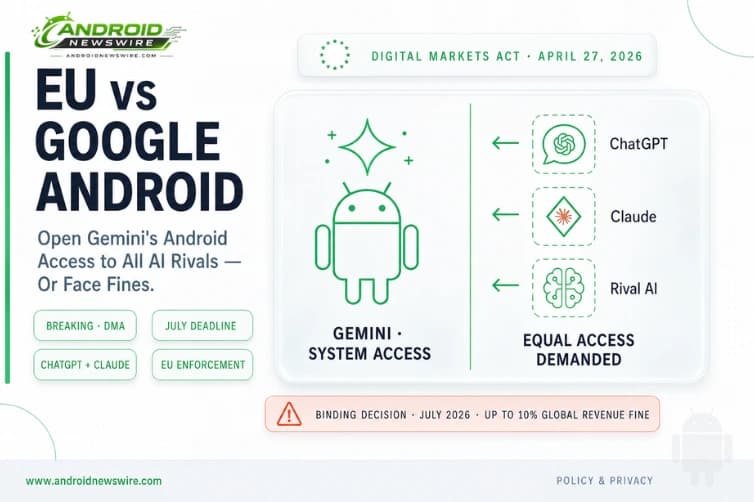
The European Commission fired its most consequential shot yet in the global regulatory battle over AI platform control on Monday, April 27, 2026 – formally telling Google what it must do to open Android to AI rivals, under threat of fines that could reach ten percent of its annual worldwide revenue.
The European Commission, the bloc’s executive arm, said Google should ensure competing AI services can “effectively interact” with applications on Android devices. Those services should be able to execute tasks such as sending an email using the user’s preferred email app, order from delivery apps, or share photos with the user’s friends.
The timing is pointed. Google completed the transition from Google Assistant to Gemini as the default AI experience on Android earlier this year. As Gemini becomes ever more deeply embedded in Android 17 – through screen automation, Magic Actions, ambient device intelligence, and system-level orchestration – the European Commission is simultaneously defining the legal terms on which competitors must be allowed to occupy exactly the same position.
What the EU Is Actually Demanding
The Commission’s action falls under the Digital Markets Act – the EU’s flagship framework for curbing the market power of the world’s largest tech platforms. The Commission opened two parallel specification proceedings on 27 January 2026, each targeting a different DMA obligation. The first, under Article 6(7), concerns interoperability: Google must provide third-party AI developers with “free and effective interoperability” to the Android hardware and software features that Gemini uses. The second, under Article 6(11), concerns data: Google must share anonymised search ranking, query, click, and view data with rival search engines and, critically, with AI chatbot providers on fair, reasonable, and non-discriminatory terms.
The interoperability requirement is the more structurally significant of the two. It goes directly to the question of what “open” means when applied to an AI assistant. That could mean letting users set ChatGPT or Claude as the default system assistant, giving third-party AI services the same hooks into voice activation and always-on listening, and allowing rivals to integrate with Gmail, Calendar, and other Google apps in the way Gemini does natively. It is the difference between being an app in a drawer and being the intelligence layer of the phone.
That distinction – availability versus access – is the core of the Commission’s argument. Google argues that “Android is open by design” and points to the fact that users can already download any AI app from the Play Store. The Commission’s implicit response is that availability is not the same as access. An AI assistant that cannot be triggered by voice, cannot read what is on the screen, and cannot interact with the operating system’s core apps is not competing on equal terms, regardless of whether it is available for download.
Google Pushes Back Sharply
Google’s response to the Commission’s measures was immediate and forceful. Clare Kelly, Google’s senior competition counsel, said: “Android already enables AI assistants to thrive – device makers have full autonomy to integrate and customize the AI experiences their users want. This unwarranted intervention would strip away that autonomy, mandate access to sensitive hardware and device permissions, unnecessarily driving up costs while undermining critical privacy and security protections for European users.”
Google’s position is that the Commission is mischaracterising Android’s actual openness. The company points to the fact that OEMs like Samsung already pre-install their own AI experiences – Bixby, Galaxy AI – alongside Gemini, and that users can set any assistant as their default through Android’s standard assistant settings. It also notes it is already licensing search data to competitors under DMA obligations accepted earlier.
The privacy and security framing is Google’s most substantive objection and not without merit. AI apps frequently need more access to device features to be useful – from access to contacts and messages to other apps, system access is critical to the effectiveness of an AI assistant. The Commission is concerned that restricting access to competitors creates an unfair advantage, while Google is concerned that open access could be a security threat.
This tension – between competitive openness and the genuine security risks of granting system-level access to arbitrary third-party AI services – is the hardest technical question the Commission’s measures raise. Gemini’s access to Android’s core app layer is not just a commercial advantage: it is built on a trust and permission architecture that Google has engineered and audited over years. Replicating that architecture for external AI services at speed, and at scale, is not straightforward.
The DMA Enforcement Machinery Behind This Move
The EU’s competition watchdog opened proceedings in January to instruct Google on how to comply with the DMA, which obliges the world’s largest tech companies to make it easier for rivals to compete with their widely used services such as app stores and smartphone operating systems. Companies can receive fines of up to 10% of their annual worldwide turnover if the Commission decides they are in breach of the rules.
For Alphabet, ten percent of annual worldwide revenue represents a potential fine measured in tens of billions of dollars – a figure that gives the Commission’s measures real teeth even before any formal non-compliance finding.
On 16 April, the Commission told Google what it must do to share search data with rivals, publishing preliminary findings in a 29-page specification document. The proposed measures for Android AI access follow the same pattern – detailed, operational, and tied to a binding decision timeline.
The Commission said it invited interested parties to comment via public consultation, a process open until May 13. The public consultation period means the measures are not yet binding – they are the Commission’s proposed requirements, and stakeholders including Google, rival AI providers, OEMs, and civil society organisations can submit feedback before the Commission issues its final specification. A binding decision is due by July 2026.
Who Stands to Benefit – And the Complications They Face
The AI services most directly positioned to benefit from mandatory Android system access are OpenAI’s ChatGPT and Anthropic’s Claude – the two most widely deployed AI assistant platforms currently competing with Gemini in the European market. Both already have Android apps. Both are available on the Play Store. Neither has the voice activation hooks, screen reading capabilities, or core app integration that Gemini enjoys through its default assistant position.
The EU is specifically seeking access for rivals such as ChatGPT and Claude to Android services like voice activation, which Gemini currently accesses through deeper system-level integration.
The irony of Claude’s potential inclusion in this group is not lost on the Android developer community. Anthropic – the company behind Claude – received a reported $40 billion investment commitment from Google announced on April 24, just three days before the Commission’s Android AI access measures were published. Google investing heavily in one of the AI rivals the EU wants to give mandatory Android access is a regulatory entanglement that neither party has yet addressed publicly.
The Broader DMA Enforcement Context
Monday’s Android AI access measures are not an isolated action. The Commission already found Google in breach of DMA obligations regarding search self-preferencing in 2024 and opened separate non-compliance proceedings over the Play Store’s anti-steering rules. The competition concerns raised by Google’s AI partnerships, including the UK Competition and Markets Authority’s investigation into Google’s $2 billion investment in Anthropic, suggest that regulators across jurisdictions see Google’s position in AI as an extension of its existing market power rather than a fresh competitive start.
Earlier this month, Google was also given instructions on how to allow rival search engines including AI chatbots access to its search data as part of its DMA compliance efforts. The two proceedings – search data access on April 16, Android AI interoperability on April 27 – together form a comprehensive regulatory effort to prevent Gemini from occupying the same structurally dominant position in AI that Google Search has occupied in web search for two decades.
“AI services are becoming more and more relevant for EU citizens’ daily interaction with their mobile devices,” Teresa Ribera, the EU’s top competition enforcer, said in a statement. “Today’s proposed measures will give more choice to Android users about the AI services they use and integrate in their phone, including from the vast range of AI services that compete with Google’s own AI.”
The US government’s position complicates the picture further. US President Donald Trump’s government has railed against the DMA and its sister content moderation law the Digital Services Act, accusing Brussels of unfairly targeting US firms. That political pressure has not slowed DMA enforcement – the Commission has continued opening proceedings and issuing specification measures on its own timeline – but it adds a geopolitical dimension to what would otherwise be a straightforward competition regulation dispute.
What This Means for the Android Ecosystem
For Android users in the EU, the Commission’s measures – if they result in a binding decision in July and Google complies – could produce a meaningfully different Android experience than the one rolling out globally with Android 17. An Android where ChatGPT or Claude can be set as the true default assistant – activatable by voice, capable of reading the screen, able to interact with Gmail, Calendar, and Maps on the user’s behalf – is a different product from one where those AI services are simply downloadable apps.
For developers building on Android outside the EU, the implications are less immediate but worth tracking. If the Commission’s interoperability requirements produce a standardised AI assistant API on Android – a system-level interface that any verified AI service can call – that API surface would likely become available globally, not just in Europe. Google has historically shipped a single Android codebase globally rather than maintaining separate EU and non-EU builds. The architecture required to satisfy the Commission’s interoperability demand would, by default, be an architecture that every AI developer globally could potentially target.
For the Android platform itself, the EU’s action arrives at the precise moment Google is making its most ambitious argument about Gemini’s role – not as an app you open, but as an intelligence layer woven into the OS. Android 17’s “intelligent OS” positioning, the Gemini screen automation features now live on Pixel 10 and Galaxy S26, the Magic Actions in Android 17’s notification system – all of these represent exactly the kind of deep, system-level AI integration that the Commission’s interoperability requirement targets. The EU is not just telling Google to open a drawer. It is telling Google that the intelligence layer of Android cannot be a proprietary moat.
The Timeline
January 27, 2026: Commission opens two parallel DMA specification proceedings targeting Android AI interoperability and search data sharing.
April 16, 2026: Commission publishes preliminary findings on search data access – a 29-page specification document detailing exactly what data Google must share with rivals and on what terms.
April 27, 2026: Commission publishes proposed measures for Android AI interoperability – telling Google that rival AI services must get the same system-level access that Gemini enjoys.
May 13, 2026: Public consultation closes. Google, rival AI providers, OEMs, and other stakeholders can submit responses to the proposed measures.
July 2026: Binding decision expected. If Google is found non-compliant at this stage, formal enforcement proceedings – and potential fines of up to ten percent of annual global revenue – become live.
Related on Android News Wire:
- Android’s New 24-Hour Sideloading Process: The Advanced Flow Explained
- Google Play Policy Changes 2026: Lower Fees, New Billing & Third-Party App Stores
- Google & Epic Games Settlement: Play Store Commissions Drop to 20%
- GrapheneOS: The Privacy Android Fork Born From a Bitter Split
- Android 17 “Cinnamon Bun”: Every Confirmed Feature & Release Date