Google’s $135 Million Android Settlement: Are You Eligible and How Do You Get Paid?
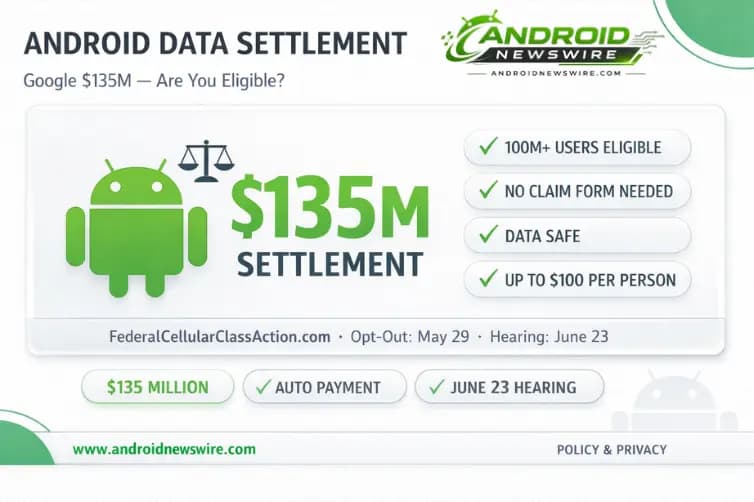
If you have used an Android phone in the United States at any point since November 2017, you may be eligible for a payment from Google’s $135 million class-action settlement. The case — Taylor v. Google LLC — alleges that Google’s Android operating system caused devices to transfer user information to Google without permission, consuming cellular data that users had paid for. Google has denied wrongdoing but agreed to settle. No claim form is required. Here is the complete breakdown: who qualifies, how much you might receive, the key deadlines, and exactly what you need to do
What the Lawsuit Actually Alleged
The lawsuit, filed in 2020, alleged that Google’s Android platform transferred data without device owners’ knowledge. Data was allegedly transmitted even when devices were idle, including when they were not in use and when all apps were closed, eating up people’s cellular data.
The lawsuit alleged: “Google effectively forces these users to subsidize its surveillance by secretly programming Android devices to constantly transmit user information to Google in real time, thus appropriating the valuable cellular data users have purchased.”
The specific legal theory is what makes this case interesting. The plaintiffs argued that Google could have designed these background transfers to occur only when devices were connected to Wi-Fi but instead allowed them to run over cellular networks — consuming data users had purchased from their carriers, for Google’s benefit, without user consent. The legal term used in the complaint is “conversion” — taking unauthorized control over someone else’s property. In this case, the “property” is the cellular data users bought and paid for.
Google has denied the claims in this lawsuit and says it did nothing wrong. Google agreed to a $135 million settlement to resolve the allegations rather than continue litigation.
The settlement received preliminary approval on March 5, 2026. Google must deposit the $135 million into the settlement trust within 45 days of the preliminary approval order, so the money is already being set aside. No money goes back to Google.
Who Is Eligible
The eligibility criteria are straightforward. The settlement benefits consumers who have used mobile devices running the Android operating system to access the internet through cellular data networks since November 12, 2017.
More specifically, to qualify you must be a US resident who used an Android mobile device with a cellular data plan from a mobile carrier at any time since November 12, 2017.
There is one important exclusion: California-based Android users are excluded from this federal settlement. They are covered by a separate, pending class action in Santa Clara County Superior Court on behalf of approximately 14 million California users. If you are a California resident, check for the separate Csupo v. Google LLC settlement covering your state.
It is estimated that there are approximately 100 million people who may qualify for this settlement. Given that mobile market share data suggests there are roughly 117 million Android users in the US, the eligible population is essentially all non-California Android users in the country.
How Much Will You Get?
The lawsuit states that it is currently unknown exactly how much each settlement class member will receive, because it depends in part on how many members are successfully paid.
The arithmetic is sobering but honest. Roughly 100 million people could be eligible for payments, so amounts could be fairly small. The $135 million settlement will also be reduced by court-approved attorneys’ fees, costs, taxes, and other expenses.
Early estimates suggest individual payouts might be modest, possibly around $1 to $1.50 per person. However, payments could potentially reach a $100 cap per person.
The mechanics work as follows: each class member is expected to receive the same amount from the settlement fund. If any funds remain in the settlement after distribution, the settlement administrator may redistribute the funds to class members who were previously paid successfully — up to $100 per person. If it is not economically feasible to redistribute the funds, they will be distributed to an organization approved by the court.
The individual payout amount is small. That is the reality of class-action settlements at this scale — the legal mechanism matters more for its accountability function than its individual compensation value. The injunctive relief component — the transparency and disclosure changes Google must make going forward — is arguably the more meaningful outcome for Android users as a whole.
The Injunctive Relief: What Google Must Change
Beyond the cash payout, the settlement requires concrete changes to how Google discloses its data practices to Android users. Google will update its Google Play terms of service to explicitly explain that certain data transfers occur in the background, even when users are not actively using their devices, and may rely on cellular data when a device is not connected to Wi-Fi.
Google will also be required to update its Help Center website and certain setup screens shown to Android users during device configuration. These disclosures are intended to ensure that future Android users make informed decisions about data usage rather than having background transfers happen without their knowledge.
For privacy-conscious Android users, these required disclosures are the lasting consequence of the lawsuit regardless of individual payout size.
No Claim Form Required — But You Should Still Act
The most important operational detail of this settlement: no claim form is required to benefit from the settlement. Class members who do not exclude themselves will automatically receive settlement benefits.
This is meaningfully different from many class-action settlements that require users to actively submit a claim form by a deadline. Here, if you are eligible and do not opt out, you are automatically included and will receive payment.
However, there is still an important action item. You are encouraged to visit the official settlement website at FederalCellularClassAction.com to choose how you want to be paid so the money actually reaches you.
People filing a claim must enter their preferred method of payment at the settlement website. The link asks for your notice ID and confirmation code to confirm the payment method. Electronic payment options include Zelle, PayPal, and Venmo. Check your Gmail inbox — and spam folder — for a notification containing your unique notice ID and confirmation code.
The settlement administrator will still try to pay Android users who qualify, even if they don’t enter their payment information. But entering your preferred payment method is the most reliable way to ensure funds reach you directly.
Key Dates and Deadlines
March 5, 2026: Preliminary approval granted. Google ordered to deposit $135 million into settlement trust within 45 days.
May 29, 2026: Deadline to object to the settlement or opt out. If you want to preserve your right to sue Google independently over these allegations, you must opt out by this date. If you do nothing, you remain in the class and will receive a payment but give up individual legal claims.
June 23, 2026: Final approval hearing. A federal judge will determine whether the settlement is fair and reasonable. If approved, the payment distribution process begins.
Post-June 23: Payments distributed after court approval and resolution of any appeals. The exact payment timeline will depend on whether any class members appeal the settlement approval.
What to Do Right Now
Step 1: Check your Gmail inbox and spam folder for an email about the settlement containing your notice ID and confirmation code. This will be from the settlement administrator.
Step 2: Visit FederalCellularClassAction.com and enter your notice ID and confirmation code to register your preferred payment method. Options include Zelle, PayPal, and Venmo.
Step 3: If you are a California resident, do not use this settlement website — you are covered by the separate Csupo v. Google LLC settlement in California state court.
Step 4: If you want to opt out and preserve your right to sue Google independently, complete the opt-out process before May 29, 2026. Instructions are on the settlement website.
Step 5: If you did not receive a notice email, contact the settlement administrator at [email protected] to verify your eligibility and access your claim information.
The Broader Context: A Pattern of Privacy Settlements
The Google Android settlement is the latest in a sequence of Big Tech privacy settlements that have moved through US courts over the past two years. Earlier in 2026, Google also agreed to pay $68 million to settle a class action lawsuit arguing that its voice-activated Google Assistant secretly recorded smart device users in violation of their privacy — accused of illegally recording and disseminating private conversations after its Google Assistant tool was triggered so it could send them targeted advertising. Apple reached a similar settlement with smartphone users in December 2024 over its virtual assistant, Siri, for $95 million.
The pattern of large-scale privacy settlements reflects two converging forces: increasingly aggressive plaintiff litigation around data collection practices, and a court system that has shown willingness to certify large class actions on privacy grounds. For Android users, the practical outcome of each settlement is typically a small individual payment and — more meaningfully — new disclosure requirements and behavioral changes from the platform that generated the underlying complaint.
The $135 million settlement will not make most eligible users financially whole for the cellular data costs they may have incurred through background transfers. But it will change how Google discloses those transfers going forward — and it establishes a public legal record of the specific practices that gave rise to the litigation.