Google Ships Three New Gemini Models Today — But the One Everyone’s Waiting For Is Still Missing
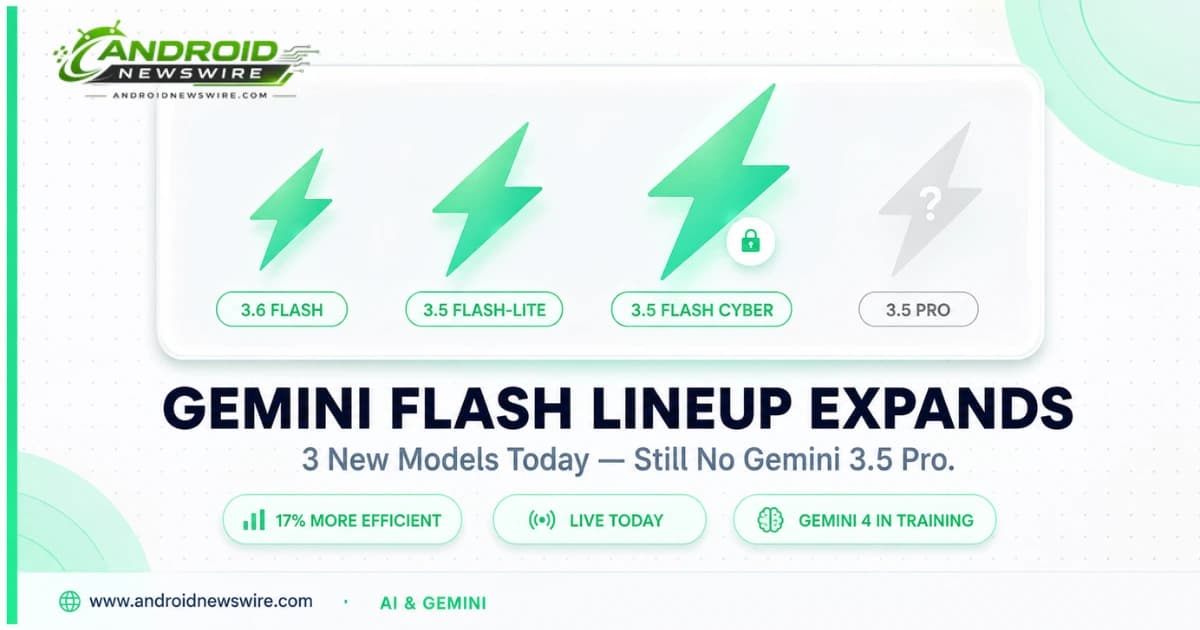
Google just gave the Gemini Flash lineup its biggest refresh since I/O 2026, and did it without touching the model most developers have actually been asking about. Today, Google released Gemini 3.6 Flash, Gemini 3.5 Flash-Lite, and a specialized security model called Gemini 3.5 Flash Cyber — three releases aimed squarely at making agentic AI cheaper and faster to run at scale. Gemini 3.5 Pro, promised back in May, still hasn’t shipped.
Gemini 3.6 Flash: The New Workhorse
Gemini 3.6 Flash replaces Gemini 3.5 Flash, which had only been Google’s top speed model for about two months since its May release. Google is positioning it as the “workhorse” model — the one meant to handle coding, knowledge work, and multimodal tasks across the widest range of everyday use cases.
The headline number is efficiency, not raw capability. Google says 3.6 Flash consumes 17% fewer output tokens than 3.5 Flash, based on the Artificial Analysis Index, while requiring fewer reasoning steps and tool calls to complete multi-step workflows. That efficiency gain comes with a price cut too: 3.6 Flash runs at $1.50 per million input tokens and $7.50 per million output tokens, down from $9 per million output tokens on 3.5 Flash.
Performance moved as well, not just cost. On the DeepSWE coding benchmark, 3.6 Flash scores 49%, up from 37% on 3.5 Flash. Computer-use capability — the model’s ability to operate software interfaces directly — improved from 78.4% to 83%, and that computer-use function is now available as a built-in tool through the Gemini API rather than a separate integration. Google also says the model produces fewer unwanted code edits and reduces execution loops, which in practice means less babysitting for anyone running it inside an agentic coding workflow.
Gemini 3.5 Flash-Lite: Built for Volume, Not Nuance
The second release, Gemini 3.5 Flash-Lite, is aimed at a different problem entirely: high-throughput, low-latency tasks like agentic search and bulk document processing, where speed and cost per call matter more than top-end reasoning. Google says it delivers 350 output tokens per second, making it the fastest model currently in the 3.5 family, priced at $0.30 per million input tokens and $2.50 per million output tokens.
The performance jump over its predecessor is substantial. Compared to 3.1 Flash-Lite from March, Google reports meaningfully better quality across the board. More notably, 3.5 Flash-Lite outperforms the larger Gemini 3 Flash on several benchmarks despite being the smaller, cheaper model — including Terminal-Bench 2.1 (54% versus 31% for 3.1 Flash-Lite), SWE-Bench Pro (54.2% versus 49.6% for Gemini 3 Flash), and OSWorld-Verified (74.0% versus 65.1%). For teams running high-volume agentic pipelines where every extra cent per call adds up at scale, that’s the more interesting comparison than 3.6 Flash’s improvements — a smaller model beating a larger one on real task-execution benchmarks changes the calculus on which tier actually makes sense for production use.
Gemini 3.5 Flash Cyber: Not for Everyone
The third model announced today, Gemini 3.5 Flash Cyber, is a fine-tuned version of 3.5 Flash built specifically to find and fix software security vulnerabilities at scale — Google’s answer to competing cybersecurity-focused models from rival AI labs. Google says it can detect, validate, and patch code security issues at a lower price per token than larger models would require for the same task.
This one isn’t broadly available. Access is currently restricted to governments and trusted partners through a limited-access pilot program tied to CodeMender, Google’s automated vulnerability-patching initiative. For everyday developers, this is a model to be aware of rather than one to expect hands-on access to anytime soon.
Where Safety Fits In
Google built additional safeguards into 3.6 Flash specifically around Chemical, Biological, Radiological, and Nuclear (CBRN) misuse and cyber-offense misuse — a detail worth noting given how directly this model line is being pushed toward agentic, tool-using workflows where a model has more real-world leverage than a pure chat assistant would.
Where You Can Actually Use These Today
Availability is broad and immediate rather than staged behind a waitlist:
- Gemini 3.6 Flash is live now for developers through the Gemini API via Google AI Studio and Android Studio, for enterprises through the Gemini Enterprise Agent Platform and Gemini Enterprise app, and it’s also available inside Google Antigravity.
- Gemini 3.5 Flash-Lite is rolling out the same way, and is additionally showing up in Google Search and the standard Gemini app for general users.
- Anyone using the Gemini app can select either model directly from the model dropdown menu to try them right away.
The Elephant Not in the Room: Gemini 3.5 Pro
The most notable thing about today’s announcement might be what’s absent from it. Google said back in May that Gemini 3.5 Pro was already running internally and would ship the following month. That didn’t happen, and today’s release doesn’t change that — 3.5 Pro’s release timeline remains unconfirmed. Google has reiterated it plans to make 3.5 Pro broadly available “soon,” but soon has now stretched roughly two months past the original internal timeline Google shared at I/O.
There’s a silver lining buried in the same announcement, though: Google confirmed that pre-training has already begun on Gemini 4, the next full generational jump beyond the current 3.x model family. No timeline was attached to that either, but it’s the first official confirmation that Google is already looking past the current Gemini 3.5 line entirely.
Why This Release Matters More Than It Looks
On the surface, this reads like a routine Flash-tier refresh — nobody’s flagship model changed today. But the framing matters. Every one of today’s three releases is optimized around the same target: making agentic AI — models that call tools, browse, execute code, and complete multi-step tasks with minimal human correction — cheaper and faster to run at production scale, not smarter in the abstract. That’s a deliberate signal about where Google sees the actual competitive and commercial pressure right now: not in benchmark bragging rights for a single flagship model, but in the token-cost economics of running AI agents continuously, at volume, inside real products.
For Android developers building anything that touches the Gemini API — from in-app AI features to agentic coding tools inside Android Studio — today’s changes are worth testing directly rather than assuming continuity with 3.5 Flash. A model swap that cuts token costs by 17% while improving coding precision is the kind of change that can shift per-request economics meaningfully if you’re running anything at scale.