Google I/O Connect India 2026: Free AI Education, Gemini in 25 Indian Languages, and the $60 Billion Android Ecosystem Story
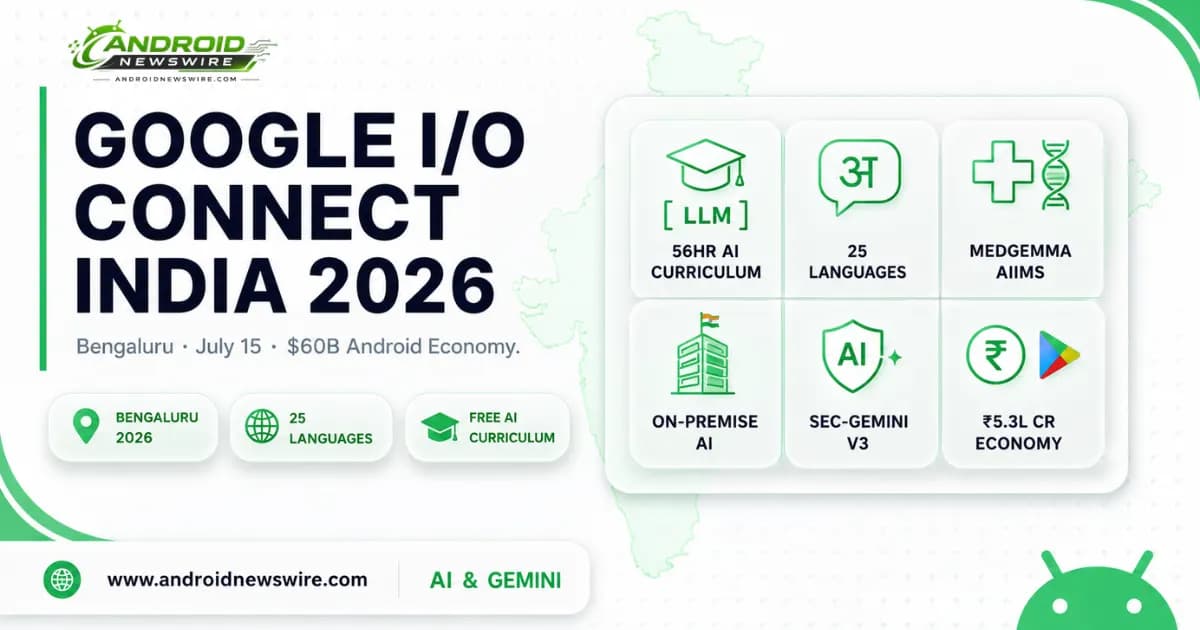
Google held its India-specific developer conference – Google I/O Connect India 2026 – in Bengaluru on Tuesday, July 15, 2026. The event was one of the most substantive India-focused Google announcements in years, spanning AI education, healthcare, enterprise infrastructure, cybersecurity, and language access. But the number that sets the context for everything else: Google’s Android and Google Play ecosystem generated an estimated Rs 5.3 lakh crore – approximately $60 billion – for Indian app publishers and the wider Indian economy in 2025, representing 28 percent growth year-on-year. That figure reframes every developer initiative Google announced at the summit. India is not a growth market Google is investing in speculatively. It is a platform economy already operating at enormous scale, and Google is racing to equip the developers, startups, and enterprises building on that platform with tools sophisticated enough to match its ambition. Here is everything announced.
The Number That Defines the Event: $60 Billion
Google said its Google Play Store and Android ecosystem generated an estimated Rs 5.3 lakh crore – around $60 billion – in revenue for app publishers and the wider economy in India in 2025, up 28 percent from the previous year.
This figure requires a moment to absorb. The Android and Play Store ecosystem generating $60 billion in economic value for India in a single year is not a projection or an aspiration – it is a third-party evaluated economic impact number covering app publishers, adjacent services, and the broader digital economy activity the platform enables. The 28 percent year-on-year growth rate means this number was closer to $47 billion in 2024 and is on track to cross $75 billion by the end of 2026 at the current trajectory.
Karnataka Chief Minister D.K. Shivakumar, who addressed the event, acknowledged Google’s role directly: Google has played a key role in expanding internet access and digital services in India through products such as Search, Android, YouTube, Maps, and Google Pay.
For Android developers in India – whether building apps for the domestic market, the Indian diaspora globally, or leveraging India’s developer talent for international products – the $60 billion figure establishes the platform’s economic legitimacy and the scale of opportunity that every announcement at the summit is designed to help capture.
Education: A Free 56-Hour AI Curriculum Built for India’s Next Wave of Developers
The flagship education announcement at I/O Connect India 2026 addresses a fundamental bottleneck in India’s AI ambitions: the shortage of developers who understand how to build, fine-tune, and deploy large language models at a deep technical level.
Google DeepMind launched the AI Research Foundations curriculum – a free 56-hour training programme designed to help learners build and fine-tune large language models. The programme will be available through Google Skills and will be expanded in partnership with NASSCOM, the Indian Institute of Science (IISc) Bengaluru, and AVPN.
56 hours of free, DeepMind-authored AI curriculum – structured specifically around LLM construction and fine-tuning – is a meaningfully different offering from the general-purpose AI introduction content that has proliferated across online platforms. This curriculum teaches the engineering, not just the application. A developer who completes it understands how to build a model from architecture decisions, how to fine-tune a pre-trained foundation model on domain-specific data, and how to evaluate model quality – skills that are currently in critically short supply globally and acutely so in India.
The partnership architecture is equally significant. NASSCOM – India’s technology industry body, representing companies that employ over 5 million technology professionals – provides the distribution pipeline. IISc Bengaluru, one of India’s most respected research institutions, provides academic credibility and access to the research community. AVPN brings the social enterprise and development sector into the curriculum’s reach. Together, this partnership structure means the curriculum can credibly reach students, working professionals, researchers, and social impact builders simultaneously.
Google framed the moves as part of its commitment to India’s AI ecosystem. The announcements largely extend existing partnerships and pilot programmes rather than introducing entirely new products. That honest assessment is fair – but the DeepMind curriculum is genuinely new, and the scale of distribution the NASSCOM partnership enables distinguishes it from previous Google education initiatives in India.
For Android developers specifically: the AI Research Foundations curriculum’s LLM fine-tuning content directly supports the AppFunctions and Gemini Intelligence integration capabilities that Google announced at I/O 2026 in May. Understanding how to fine-tune models on domain-specific data is the same skill required to build compelling on-device AI experiences for Android apps. The curriculum and the platform are pointing in the same direction.
Gemini in the Classroom: AI Science Lab Assistant
Alongside the DeepMind curriculum, Google announced a Gemini-powered AI Science Lab Assistant designed for India’s school infrastructure. The assistant is built to help students in science laboratories – guiding experiments, explaining concepts in local languages, and providing real-time assistance in contexts where a human teacher cannot always be physically present.
The practical target for this tool is India’s vast secondary school system, where science lab infrastructure exists across thousands of schools but where teacher availability and subject expertise can be inconsistent. A Gemini-powered assistant that can walk a student through a chemistry experiment in Hindi, Telugu, or Tamil – adapting its explanation to the student’s level and local curriculum – addresses a genuine educational equity gap.
The Gemini Science Lab Assistant also demonstrates one of the specific use cases where AI genuinely outperforms a static textbook or video: real-time, adaptive, interactive guidance for hands-on activities. This is Android-adjacent in the sense that these tools are being built on top of Gemini APIs that Android developers can access – the patterns that make a science lab assistant work are the same patterns that make vertically specialized AI features work in any Android app.
Language Access: Gemini Live Now Speaks 25 Indian Languages
Google announced that Gemini Live now supports 25 Indian languages and dialects, including Sanskrit, Bhojpuri, and Maithili.
The expansion to 25 languages is the I/O Connect India announcement with the single broadest immediate user impact. Gemini Live – the real-time conversational AI feature that enables continuous, natural-paced spoken conversation with Gemini rather than typed query-and-response – has been a flagship feature for users in English and a small number of major global languages. Expanding it to 25 Indian languages including relatively low-resource languages like Bhojpuri, Maithili, and Sanskrit is a significant technical and social commitment.
India has 22 scheduled languages under the Indian Constitution and hundreds of regional dialects. The gap between digital services available in English and those available in other Indian languages has historically been one of the most significant barriers to digital inclusion – not because people lack devices or connectivity, but because the AI tools that increasingly mediate access to information, services, and economic opportunity have required English fluency that many Indians do not have or prefer not to use.
Google positioned the language expansion as central to making its AI tools accessible beyond English speaking users, though it did not detail accuracy benchmarks or performance across the newly added languages. That caveat is worth noting – language support for lower-resource languages typically involves accuracy trade-offs compared to English and major global languages. But the directional commitment matters enormously: Google is investing in making Gemini genuinely multilingual for India’s linguistic diversity, not just adding languages as a checkbox.
For Android developers building for Indian markets: the 25-language Gemini Live expansion means your apps can now integrate Gemini Live as a voice interface for users across India’s linguistic spectrum. Building a health information app in Bhojpuri, a financial literacy tool in Maithili, or an educational assistant in Sanskrit – all were technically constrained by Gemini’s language limitations until this announcement. Those constraints are now removed.
Healthcare: MedGemma at AIIMS, Aarogya Setu 2.0
Google said researchers at AIIMS Delhi are using its MedGemma open AI models to develop India-specific AI models for leprosy and sexual and reproductive health. The models are designed to assist healthcare professionals by analysing images and text inputs.
MedGemma – Google DeepMind’s open-source foundation model specifically fine-tuned for medical applications – is being used at AIIMS Delhi to build two specific clinical tools. The leprosy detection model uses image analysis to assist healthcare workers in identifying leprosy presentations, particularly in settings where specialist dermatologists are not available. The sexual and reproductive health model works with both image and text inputs to support clinical decision-making in reproductive health contexts.
AIIMS researchers are developing models aimed at leprosy detection and sexual and reproductive health, working with both medical images and text inputs. AIIMS intends to make these localised clinical models available to India’s developer community, though further details on access and timelines were not disclosed.
The commitment to making AIIMS-developed models available to India’s developer community is particularly significant. Clinical AI models built on India-specific population data, validated by one of India’s premier medical institutions, and released for developer use represent exactly the kind of locally relevant AI foundation that India’s health tech startup ecosystem needs. The gap between global AI health tools – trained predominantly on Western clinical data – and India’s specific disease burden and presentation patterns is a well-documented problem. MedGemma fine-tuned on Indian clinical data closes that gap.
The National Health Authority has used Gemma 4 and Google’s open-sourced Medical Data Toolkit in building Aarogya Setu 2.0, the successor to India’s pandemic-era health record application. Aarogya Setu’s evolution from a pandemic contact tracing app into a broader health record platform – powered by Gemma 4 and Google’s Medical Data Toolkit – represents one of the most significant government AI deployments in India’s digital public infrastructure. The application runs on Android and has previously reached over 200 million Indian users.
Enterprise Infrastructure: Gemini On-Premise, In-Country Processing
For India’s regulated enterprise sectors – banking, healthcare, telecommunications, and government – data residency and sovereignty requirements have historically been a barrier to adopting cloud-based AI tools. Google directly addressed this at I/O Connect India 2026.
Indian organisations can now run Gemini on Google Distributed Cloud from within Indian data centres, keeping prompts, model outputs, and workloads within their own environment. Google described the setup as targeted at regulated sectors including banking, healthcare, telecommunications, and government, where compliance obligations around data governance are significant.
Gemini 3.5 Flash model will now be available with in-country machine learning processing commitments for Indian businesses. The company is also enabling enterprises and public sector organisations to run Gemini on Google Distributed Cloud within Indian data centres to meet localisation requirements.
For Android developers building enterprise applications – mobile banking apps, government services, healthcare platforms, telecom customer tools – this infrastructure change matters directly. Enterprise clients that previously couldn’t deploy AI-enhanced Android apps due to data residency restrictions now have a technically compliant path to doing so. Gemini 3.5 Flash’s speed and cost characteristics make it the right model tier for real-time enterprise Android app features.
Cybersecurity: Sec-Gemini v3 and Open-Source Agent Security
Sec-Gemini v3, an AI-powered cybersecurity agent, will be made available to selected government and enterprise testers, including Flipkart.
Sec-Gemini v3 is Google DeepMind’s purpose-built AI agent for cybersecurity threat analysis and response. Its inclusion in I/O Connect India’s announcements reflects both the scale of India’s cybersecurity challenge – the country is among the most targeted for cyber attacks globally – and the sophistication of India’s enterprise security requirements.
By introducing specialized cybersecurity agents, open-sourcing secure runtime environments to isolate agents, driving interoperable standard protocols for secure interactions, and deepening academic research partnerships, Google remains focused on enabling India’s developers to scale securely from day one.
The open-sourcing of secure runtime environments for agent isolation is a developer-facing announcement with significant implications for Android developers building agentic applications. One of the legitimate concerns around agentic AI – AI that autonomously executes tasks across apps and services – is the security surface created when an agent has broad system access. Open-source secure runtime environments that isolate agents from each other and from the broader system address this concern at the infrastructure level, rather than leaving each developer to implement their own isolation strategy.
Startup Support: Architecture, Accelerators, and Global Market Access
Through a comprehensive support pipeline providing technical architecture, localized accelerator cohorts, and global market access, Google is helping India’s developers and startups scale, while unlocking localized solutions that answer real-world needs.
Google’s startup support structure at I/O Connect India 2026 operates across three tiers. Technical architecture support – direct engineering assistance for startups building on Google’s AI and Android platforms – addresses the gap between having access to powerful tools and knowing how to deploy them correctly at scale. Localized accelerator cohorts bring the startup support format that Google for Startups has operated globally into India-specific contexts, with mentors, curriculum, and partner networks that understand India’s market dynamics. Global market access – helping Indian startups reach international distribution through Google’s partner network – is the tier that unlocks the monetization potential of the $60 billion Android economy number cited at the event’s opening.
What This Means for Indian Android Developers Right Now
Three immediate action items emerge from the I/O Connect India 2026 announcements for Android developers in India:
Enroll in the AI Research Foundations curriculum. The 56-hour free DeepMind curriculum through Google Skills is the most direct path to the LLM engineering skills that underpin every meaningful Android AI integration – from Gemini API calls to AppFunctions agentic app building to on-device model deployment with Gemini Nano. Enroll at skillshop.google.com and search for AI Research Foundations.
Integrate Gemini Live’s 25-language support. If your Android app targets Indian users and you have not yet explored voice-first interfaces, the 25-language Gemini Live expansion removes the language barrier that previously made voice AI impractical for many Indian markets. The Gemini API documentation covers Gemini Live integration for Android apps.
Evaluate Gemini 3.5 Flash for enterprise Android features. If your app serves enterprise clients in regulated sectors – banking, healthcare, government, telecom – Google’s in-country processing commitments and Distributed Cloud deployment option now give those clients a technically compliant path to adopting AI-enhanced Android app features. This is the conversation to initiate with enterprise prospects who previously cited data residency as a blocking concern.
Preeti Lobana, Country Manager of Google India, framed the event’s overarching direction clearly: “India’s builders are already deploying AI faster than almost anywhere else. As we drive the shift into the agentic era, where AI moves from answering queries to securely executing tasks, our focus is on providing the underlying infrastructure and guardrails the ecosystem needs to scale safely.”
The $60 billion number is the proof. The I/O Connect India 2026 announcements are the investment in making the next $60 billion come faster.