Google Brings Gemini Live to Its Oldest Smart Speakers — First-Gen Home Mini and Nest Hub
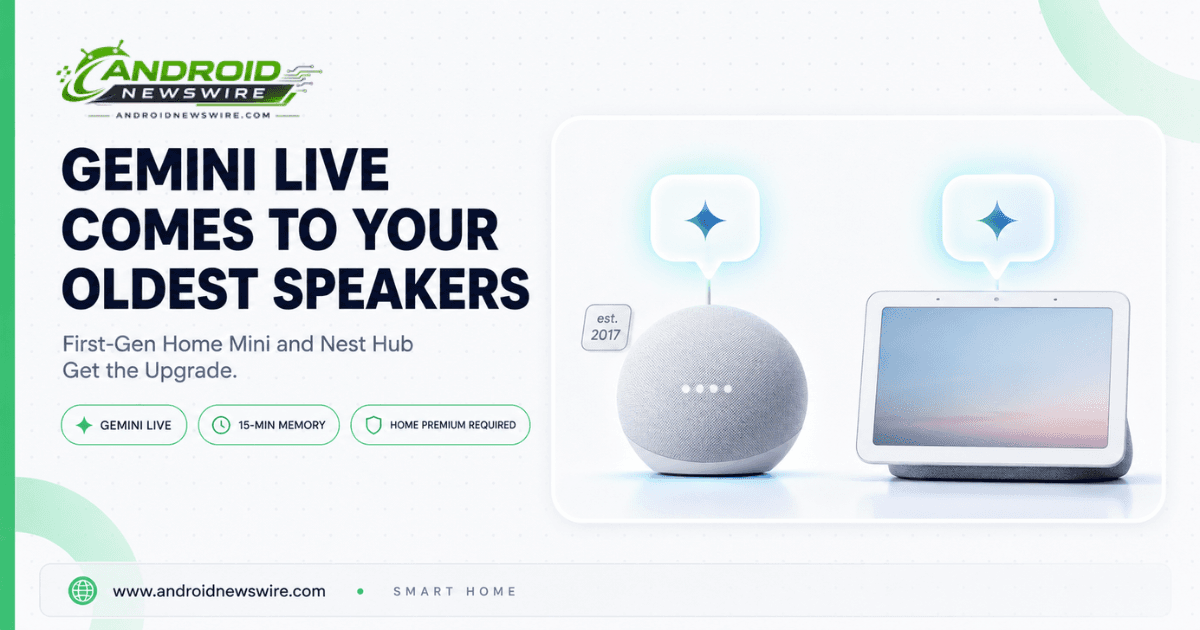
Tech companies don’t usually go out of their way to bring their newest AI features to nearly decade-old hardware. Google is doing exactly that. The company has begun rolling out Gemini Live — its fluid, back-and-forth conversational AI mode — to the first-generation Google Home Mini and the original Google Nest Hub, two of the very first devices in Google’s smart home lineup, alongside a new conversation memory upgrade that applies across the entire Gemini for Home ecosystem.
The Devices Getting the Upgrade
This rollout specifically targets the original Home Mini speaker and the first-gen Nest Hub display — hardware that, in the Home Mini’s case, dates back roughly seven years. That’s a meaningfully different approach than the typical tech-industry pattern of reserving cutting-edge AI features for the newest hardware and quietly letting older devices fall behind until they’re replaced.
These two devices join a list of hardware that already had Gemini Live: the Nest Mini, Nest Audio, Nest Hub, and Nest Hub Max all received the conversational assistant when Google first began this rollout back in October 2025. The brand-new Google Home Speaker, which launched June 25 for $99.99, ships with Gemini Live built in from the start.
How to Actually Use It
Getting started is deliberately simple. If you’re a Google Home Premium subscriber enrolled in the Gemini for Home early access program, you can start a conversation on your Home Mini or Nest Hub just by saying, “Hey Google, let’s chat.” A chime confirms Gemini is now listening in conversational mode, and from there you can ask about recipe ideas, brainstorm trip plans, or dig into detailed questions — all without needing to repeat “Hey Google” before every follow-up.
The Real Catch: A Subscription Requirement
There’s an important condition worth being upfront about. Because these older devices lack the on-device processing hardware found in newer smart speakers, accessing Gemini Live on them requires a Google Home Premium subscription — Standard or Premium tier, running around $10 a month — plus enrollment in the Gemini for Home early access program specifically. This isn’t a free firmware update landing on hardware you already own; it’s a subscription-gated feature.
That’s a reasonable trade-off to flag honestly rather than gloss over. If you’re already paying for Home Premium for other reasons — Nest camera storage or advanced automations, for instance — this is a genuine added-value feature at no extra cost. If you’re not already subscribed, getting Gemini Live specifically on a seven-year-old speaker means taking on a new recurring cost for hardware you may have assumed was long past receiving significant upgrades.
A Longer Conversation Memory, System-Wide
Alongside the hardware expansion, Google increased Gemini’s conversation memory window to 15 minutes, and this change applies across the entire Gemini for Home ecosystem — not just the two newly supported devices. In practice, that means you can ask your speaker to adjust the bedroom thermostat, then come back ten minutes later and ask it to nudge the temperature slightly further, without needing to restate the original context. Google’s own explanation is straightforward: any follow-up question asked within that 15-minute window will be understood in context of what was previously discussed.
Smaller Fixes Worth Knowing About
This update wasn’t just about Gemini Live. A handful of practical refinements landed alongside it:
- Clearer automation warnings now prevent users from accidentally saving automations that are missing an essential starting trigger.
- Smart blind and window covering controls got more precise, with updated interface labels making it easier to set coverings to an exact percentage position rather than approximate open/closed states.
- Security reminder for smart locks: the interface now explicitly reminds users to manually revoke smart lock passcodes when removing someone from a shared home network — a detail worth knowing if you’ve ever removed a family member or guest from your Google Home setup and assumed their lock access was automatically revoked.
- Camera reliability fixes targeting unexpected connection drops and misfiring alerts, specifically for the Nest Cam Indoor (wired, 3rd gen), Nest Cam Outdoor (wired, 2nd gen), and Nest Doorbell (wired, 3rd gen).
- New budget camera support: Walmart’s onn-branded Outdoor Camera Plug-In and Outdoor Floodlight Camera Hardwired have been added to the Gemini built-in camera lineup, extending Gemini smart home compatibility beyond Google’s own first-party hardware and into more affordable third-party options.
Why This Matters
Google has a well-earned reputation for retiring products and cutting off older hardware sooner than many users would like. This rollout runs counter to that pattern in a small but genuine way — actively investing engineering effort into making a nearly decade-old $25 speaker capable of holding a fluid AI conversation, rather than treating it as a reason to push an upgrade purchase instead.
The rollout is described as gradual, so if you own one of these devices and don’t see the feature immediately, it’s worth checking back over the coming days rather than assuming you’ve been excluded. For anyone already paying for Google Home Premium, this is a straightforward value-add. For anyone weighing whether to finally replace an original Home Mini, it’s now a slightly harder call to make.