Nothing OS 5.0 Officially Arrives Today – Here’s Everything Android 17 Brings to Nothing’s Phones
Nothing has kept most of the specifics under wraps for weeks, offering little beyond a cryptic tagline and some dot-matrix teaser animations. Today, that changes. Nothing OS 5.0, built on Android 17, begins its rollout starting August 25, 2026, at 11:00 AM BST, and while the company’s own official messaging has stayed characteristically minimal, the picture assembled from beta testing, community builds, and Nothing’s own prior software patterns is now considerably clearer.
“More Joy, Every Day” – Nothing’s Deliberately Sparse Official Tease
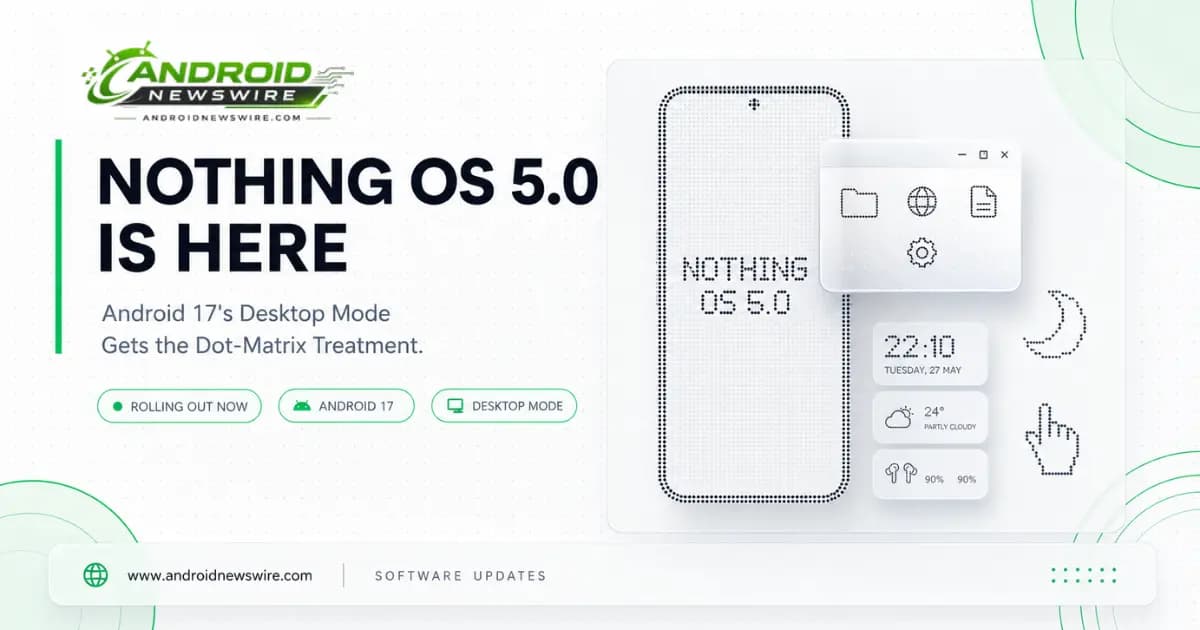
Nothing’s own public framing for this release has been about as minimal as a software announcement gets: “More joy, every day.” That’s genuinely all the company said publicly ahead of today’s rollout – no feature list, no changelog, no screenshots beyond stylized teaser animations built around Nothing’s signature dot-matrix aesthetic, including recurring visual motifs like a hand cursor, a crescent moon, and a swirling vortex graphic.
That sparse messaging isn’t unusual for Nothing specifically, but it does mean most of what’s known about this release comes from Nothing’s own beta testing program rather than official company statements. A Community Review Program has already been inviting Nothing Phone (3) owners to test an unnamed build ahead of today’s public unveiling, suggesting closed beta testing has been underway for some time before this official rollout date.
What Android 17 Itself Brings to the Table
The single biggest structural addition arriving with Android 17 underneath Nothing OS 5.0 is a proper desktop mode with free-form floating windows – functionality Motorola’s Ready For and Samsung’s DeX have offered for years, now arriving as a native Android 17 platform capability that Nothing’s software layer builds directly on top of. Beyond desktop mode, expect the usual under-the-hood improvements and security refinements that come bundled with any major Android version bump, layered beneath Nothing’s own distinctive visual identity.
Nothing’s Own Layer on Top: A Deeper Visual Refresh Than Usual
Based on teaser material and early build details, Nothing OS 5.0 appears to be a more substantial visual overhaul than a typical annual refresh, built specifically around the brand’s established dot-matrix design language:
• A system-wide font overhaul, reportedly moving to Geist Mono across system menus – a notable typography shift for a company that’s built real brand identity around its distinctive visual style.
• Redesigned volume sliders and refined lock screen clock options.
• Expanded lock screen customization, including the ability to stack multi-page widgets directly on the lock screen and switch between new minimalist clock styles.
• Upgraded desktop mode and multitasking, building on Android 17’s native floating-window support with what’s described as better split-screen app pairing and improved external display support.
• Smarter on-device AI utilities, expanding beyond basic voice tools to include smart notifications, an upgraded AI Playground suite, and real-time contextual suggestions.
• An enhanced Nothing Warp Sharing feature, reportedly adding instant drag-and-drop file transfers between Nothing OS, macOS, Windows, and Linux.
A previous Gallery app redesign – featuring live blur effects and updated icons – is widely read as an early preview of the broader visual direction Nothing OS 5.0 is expected to take across the rest of the system.
Which Devices Get It – and Which Three Definitely Don’t
Nothing has confirmed the update covers devices going back to the Nothing Phone (2a) Plus and the CMF Phone 2 Pro, with every newer model expected to be in line as well, though Nothing hasn’t yet published exact per-device availability timing beyond today’s initial rollout start.
Three specific devices, however, are officially confirmed to be excluded, having already fulfilled their promised major-OS-upgrade quota under Nothing’s software support commitments:
• Nothing Phone (1) – already at end of software support, remaining on Android 15 with no further security updates expected.
• Nothing Phone (2) – has received its final promised Android upgrade and will remain on Android 16, though continuing to receive security patches for a period.
• CMF Phone 1 – similarly capped at its final major update, staying on Android 16 with continued security support for now.
If you own one of these three specific devices, Nothing OS 5.0 simply isn’t coming to you – that’s a firm, already-confirmed limit rather than something still being decided.
A Notably Faster Release Cadence Than Last Year
Worth flagging for anyone tracking Nothing’s release rhythm: this year’s announcement lands considerably earlier than last cycle’s equivalent. Nothing introduced Nothing OS 4.0 on September 16 of the previous year – meaning this year’s August 25 unveiling represents a genuine acceleration in Nothing’s software release timeline, arriving roughly three weeks earlier than the prior cycle’s announcement date.
What to Actually Expect Today vs. In the Coming Weeks
It’s worth setting realistic expectations about what “arrives August 25” actually means in practice. Today marks the rollout beginning and the official public unveiling – not necessarily every eligible device receiving the stable update simultaneously. Based on how Nothing has staged previous major releases, expect the Nothing Phone (3) and the Phone (4a) series to be among the first devices in line for beta access, with a broader stable rollout to the rest of the eligible lineup following over the following weeks rather than landing everywhere on day one.
Why This Release Matters Beyond Nothing’s Own User Base
Nothing has built a genuine reputation, still relatively rare in the Android skin landscape, for a distinctive, restrained visual identity rather than the feature-bloated, heavily customized skins that dominate much of the rest of the Android OEM ecosystem. A release this visually ambitious – a full font overhaul, deeper lock screen customization, and a genuinely built-out desktop mode – while still keeping the company’s core dot-matrix identity intact, is a useful data point for how a smaller, design-focused Android manufacturer can meaningfully differentiate itself even while building on the exact same Android 17 foundation every other manufacturer is adopting this cycle.