
Android’s Developer Verification System Is Actually Rolling Out Now – Here’s Exactly What Changes, and When
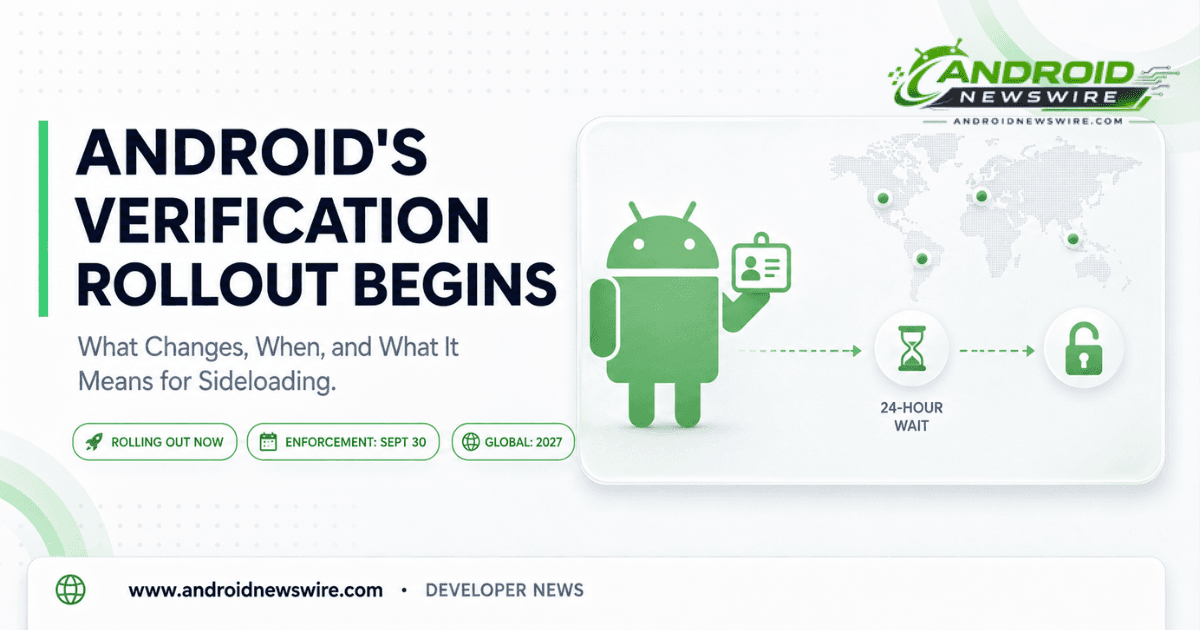
For over a year, Google’s plan to require identity verification for every Android app developer has existed mostly as an announcement and a distant deadline. That’s changing. Google has begun gradually rolling out the new “advanced” sideloading flow – the mechanism that will govern how apps from unverified developers get installed once enforcement actually begins. It’s a genuinely significant shift for a platform whose entire identity has historically rested on being the more open alternative to iOS, and it’s worth being precise about what’s live right now versus what’s still months away.
The Actual Timeline, Clearly Laid Out
There’s been a lot of shifting language around this policy since it was first announced, and different reports have used “August 2026” and “September 2026” almost interchangeably – so it’s worth stating the confirmed schedule plainly:
- August 2026 (now): The advanced sideloading flow and free limited-distribution developer accounts are rolling out globally, gradually, through Google Play services. This is the phase we’re in right now.
- September 30, 2026: Actual enforcement begins – but only in four countries: Brazil, Indonesia, Singapore, and Thailand. From this date, apps must be registered by verified developers to be installed or updated on certified Android devices in those specific markets, covering installations through Google Play and several participating third-party app stores, including HONOR App Market, OPPO App Market, Galaxy Store, Palm Store, V-Appstore, and GetApps.
- 2027 and beyond: Global expansion, eventually reaching every market – including the United States, where no changes take effect before this global rollout phase.
If you’re an Android user outside those four pilot countries, including anyone in the US, nothing changes for you yet. If you only install apps from the Play Store or another built-in app store, verification happens invisibly in the background regardless of where you live – there’s no extra step for you to take, now or later.
What the “Advanced Flow” Actually Is
The advanced flow is the mechanism Google built specifically to avoid an all-or-nothing outcome – either abandoning verification requirements entirely, or locking sideloading down so tightly that students, hobbyists, and privacy-conscious developers get shut out. It’s described as a more involved installation path specifically for apps from developers who haven’t completed verification, and it includes a genuinely notable friction point: a mandatory 24-hour waiting period before the app can actually be installed.
That waiting period is a deliberate anti-fraud design choice, not a bug or an oversight. It directly targets a well-documented scam pattern where a fraudster pressures a victim in real time – “install this app right now, while I’m on the phone with you” – by making that kind of immediate, high-pressure installation structurally impossible. ADB (Android Debug Bridge) remains available as always for developers and power users who need direct installation without going through this flow.
The Verification Options Aren’t One-Size-Fits-All
One detail that’s gotten lost in some of the more alarmist coverage of this policy: Google didn’t build a single, uniform verification tier requiring every developer to hand over a government ID. There are effectively two paths:
- A standard verified developer account, carrying roughly a $25 fee, intended for developers distributing more broadly.
- A free limited-distribution account, which lets students, hobbyists, and casual developers distribute apps to up to 20 devices without providing any government ID at all.
That second tier matters a lot for exactly the population most likely to be affected by a verification requirement they can’t easily meet – students in regions without straightforward access to official documentation, people building small tools for a closed circle of trusted friends or teammates, and hobbyist developers who never intended wide public distribution in the first place.
Google’s Own Numbers Suggest Broad Compliance Already
It’s worth noting Google’s own reported progress on this, since it complicates the narrative that this policy is being forced onto a resistant developer base. According to Google, most Play Store developers have already completed verification, and more than 99% of apps have already been registered ahead of the enforcement deadline. That’s a striking compliance rate this early, though it’s also worth remembering that Play Store developers – who were already operating inside Google’s existing review and registration systems – represent a fundamentally easier population to bring into compliance than the broader universe of sideloaded, hobbyist, and alternative-store app distribution this policy is ultimately meant to cover.
Why Google Says This Exists
The policy’s origin traces back to a genuine, well-documented problem: sophisticated social engineering and coercion scams that rely on victims installing malicious software outside any official review process. Android chief Sameer Samat has previously argued that existing warning systems have proven insufficient against attackers who’ve spent years refining psychological manipulation techniques specifically designed to get victims past standard security warnings. Google’s own framing consistently emphasizes that developer verification is about accountability and traceability – making it harder for a bad actor to distribute malware anonymously – rather than an attempt to lock down sideloading itself, which Google has repeatedly stated it is not removing.
There’s also an important legal backdrop worth understanding: this entire verification framework emerged in the same period as Google’s antitrust settlement with Epic Games, which created real legal and regulatory pressure toward more platform openness – third-party app stores, alternative billing, easier sideloading – at almost exactly the same moment Google was trying to address genuine, escalating fraud risks. The verification system is Google’s attempt to satisfy both pressures simultaneously: preserve and even expand structural openness while adding a traceability layer that makes anonymous malware distribution meaningfully harder.
The Real Debate: Is This Actually a Fair Trade-Off?
This policy remains genuinely controversial within parts of the Android developer and power-user community, and it’s worth representing that pushback fairly rather than only relaying Google’s framing. Critics argue that requiring registration for any app installation – including casual beta builds shared with a small team, personal tools, or experimental software never intended for public distribution – represents a meaningful erosion of what’s made Android distinct from iOS for over a decade: the ability to install software independently of any centralized gatekeeper’s approval. Stores built specifically around that openness, like F-Droid, Aptoide, and Aurora Store, exist precisely because that freedom has real value to a segment of the Android community, and some of that community sees this policy as quietly closing a door that’s always been open.
Google’s counterargument – that verification tracks identity rather than blocking distribution, that a free no-ID tier exists specifically for casual use, and that the advanced flow preserves sideloading rather than eliminating it – is a genuinely reasonable position too. Whether the balance struck actually satisfies both the fraud-prevention goal and Android’s historical openness, or whether it represents the beginning of a slow tightening that expands over time, is a fair question that won’t have a real answer until the September 30 enforcement date arrives in its four pilot countries and the community can observe how it actually functions in practice, rather than how it reads on paper.
What Developers Should Actually Do Right Now
If you’re an Android developer distributing apps in any capacity – through Play, a third-party store, or direct sideloading to testers or teammates – the practical action item is checking your Play Console or Android Developer Console account for a verification prompt now, rather than waiting until closer to a regional enforcement date. Google has also introduced a suite of developer-requested APIs specifically to help registration scale – allowing bulk app registration and direct integration into CI/CD pipelines, which matters considerably for teams managing large app portfolios or frequent internal builds rather than a single consumer-facing product.