Top Android Stories: August 2026 Week 3 — Verification Rules Roll Out, Beta 3 Delivers, Smart Glasses Surge
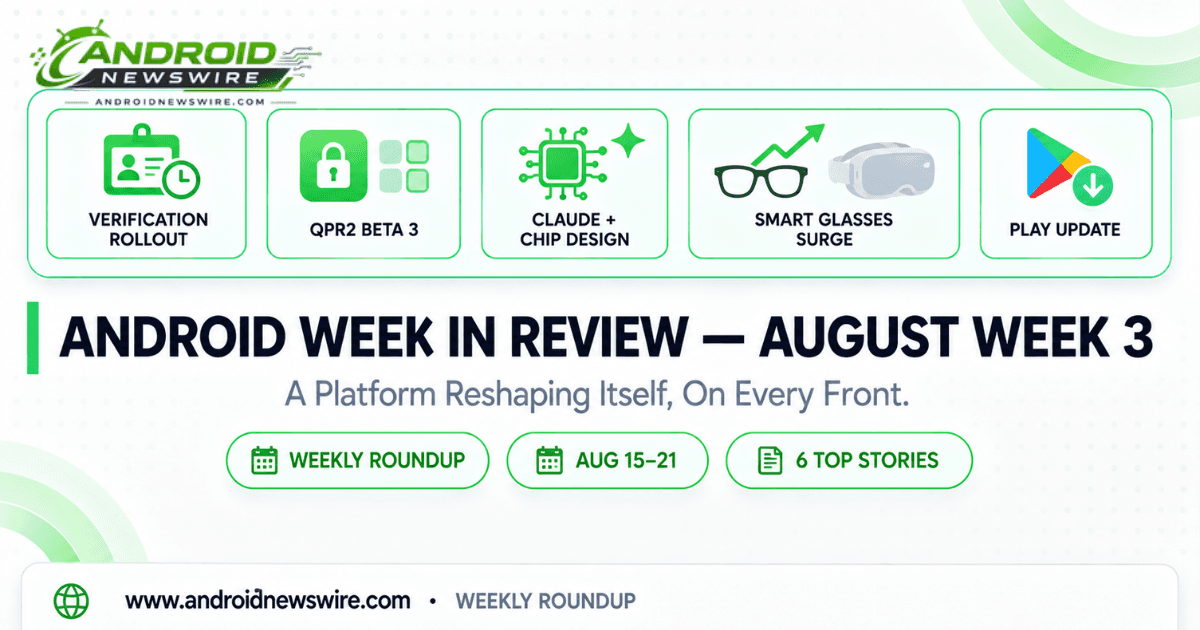
This week didn’t have one single dominant headline the way Made by Google or Galaxy Unpacked did earlier this summer. Instead, it was the kind of week where several genuinely structural changes moved forward simultaneously — Android’s core openness model, its beta software, its chip-design workflow, and the broader wearables market Android now competes in. Here’s everything that mattered.
1. Google’s Developer Verification System Actually Starts Rolling Out
After more than a year of announcements and distant deadlines, Google began gradually rolling out the “advanced” sideloading flow that underpins its Android developer verification requirement. Enforcement itself doesn’t begin until September 30, 2026, and even then only in Brazil, Indonesia, Singapore, and Thailand, with US and global rollout not arriving until 2027. The advanced flow adds a mandatory 24-hour waiting period for installing apps from unverified developers, while a free limited-distribution tier lets students and hobbyists distribute to up to 20 devices without a government ID. Google says over 99% of Play Store apps are already registered.
Why it matters: this is the clearest sign yet that Android’s traditional “install anything, anywhere” openness is being reshaped — carefully, gradually, and not without real pushback from parts of the developer community who see it as the start of a slow tightening.
2. Android 17 QPR2 Beta 3 Delivers the Cycle’s Biggest Feature Drop
In a surprise Friday release, Google shipped the most substantial Android 17 QPR2 beta build yet: a native App Lock feature for securing individual apps, a full Quick Settings layout editor letting users drag and reorder tiles, expanded Dynamic Color theming with a new hue slider and four additional color styles, more lock screen blur effects, and genuine multitasking upgrades for foldables including new app-window handles.
Why it matters: after two comparatively quiet QPR2 builds, this is the clearest signal yet of what Android 17’s December 2026 stable release will actually look like.
3. Samsung Uses Claude AI to Cut Month-Long Chip Design Work to Two Days
Samsung’s System LSI division has deployed Anthropic’s Claude Code for semiconductor design and verification, reportedly compressing a month-long custom SoC verification task into roughly two days, and helping a second-year engineer complete a month’s worth of unfamiliar technical work in a single day. The push comes as Samsung’s chip-design team, at roughly 6,000 employees, competes against Qualcomm’s estimated 52,000-person team. Samsung has also encountered real mistakes from the tool, including unintended file changes, and continues requiring careful human review of all AI-generated output.
Why it matters: this is a concrete, numbers-backed example of AI reshaping a highly technical engineering workflow, with Samsung betting it can help close a structural workforce gap against a much larger rival.
4. AI Smart Glasses Shipments Surge 776% While VR Headsets Collapse
Fresh Q2 2026 industry data showed AI smart glasses shipments up 776% year-over-year, while VR headset shipments fell 79% over the same period. Meta currently dominates the category with over 76% market share, and its glasses revenue has now surpassed its own Quest VR hardware revenue for the first time. Critically, this growth happened entirely before Google, Samsung, and Apple bring their own dedicated smart glasses to market — including Samsung’s Android XR-powered Intelligent Eyewear, built with Google, unveiled at Galaxy Unpacked and arriving this fall.
Why it matters: Android XR is positioned to enter a genuinely expanding market at what may be close to the ideal moment — after Meta has proven real demand exists, but before any serious platform-backed competitor has entered.
5. August 2026 Google Play System Update Starts Reaching Galaxy Devices
Nearly two weeks after Google first detailed it, the August Play System Update began actually rolling out to Samsung Galaxy devices as an 80-81MB OTA. It brings Google Wallet pass improvements, a new sports discovery carousel starting with the ICC Women’s T20 World Cup, an upgraded Quick Start device setup flow, and new Cross Device Services beta settings.
6. Pixel 11’s Rambler Feature Quickly Becomes a Real Favorite
Early user reaction to Rambler — the Gboard AI feature that cleans up filler words and false starts from speech-to-text in real time, confirmed at Made by Google — has been notably positive in the week-plus since launch, suggesting it’s landing as one of the Pixel 11’s more genuinely useful everyday AI features rather than a stage-demo gimmick.
The Rest of the Week, Briefly
- Google mistakenly sent a false warning to Pixel Watch owners suggesting they’d lose Google Health sync — a confirmed bug, not an actual change; affected users retain full sync.
- Galaxy S26 FE confirmed to arrive August 27, alongside a One UI 9.5 update bringing a built-in search bar to older Samsung devices.
- Google Messages is getting a redesigned Pinned Conversations feature, and Spotify’s Running Mode arrived on Android.
- A new Pixel Search app launched for both Pixel 11 and Galaxy Z Fold 8 devices.
- Early hands-on coverage of the Galaxy Z Fold 8 after several weeks of real use has been largely positive, with reviewers flagging specific areas for Samsung to improve in future iterations.
Looking Ahead
With Android 17 QPR2’s beta cycle now delivering real, substantial features, expect continued builds refining App Lock and the Quick Settings editor over the coming weeks as the December stable release approaches. On the hardware side, the Galaxy S26 FE’s August 27 arrival is the next concrete date on the calendar, and with smart glasses shipment data this strong, expect increasing attention on how Samsung’s Intelligent Eyewear performs once it actually reaches buyers this fall.