Top Android Stories: July 2026 Week 4 – Samsung’s Biggest Launch of the Summer, the End of an OS, and a Week of Genuine Engineering Wins
This was a week where Android’s hardware and software stories moved almost in parallel – a landmark Samsung launch on one side, and a string of substantive Google engineering and AI announcements on the other. Here’s everything that mattered.
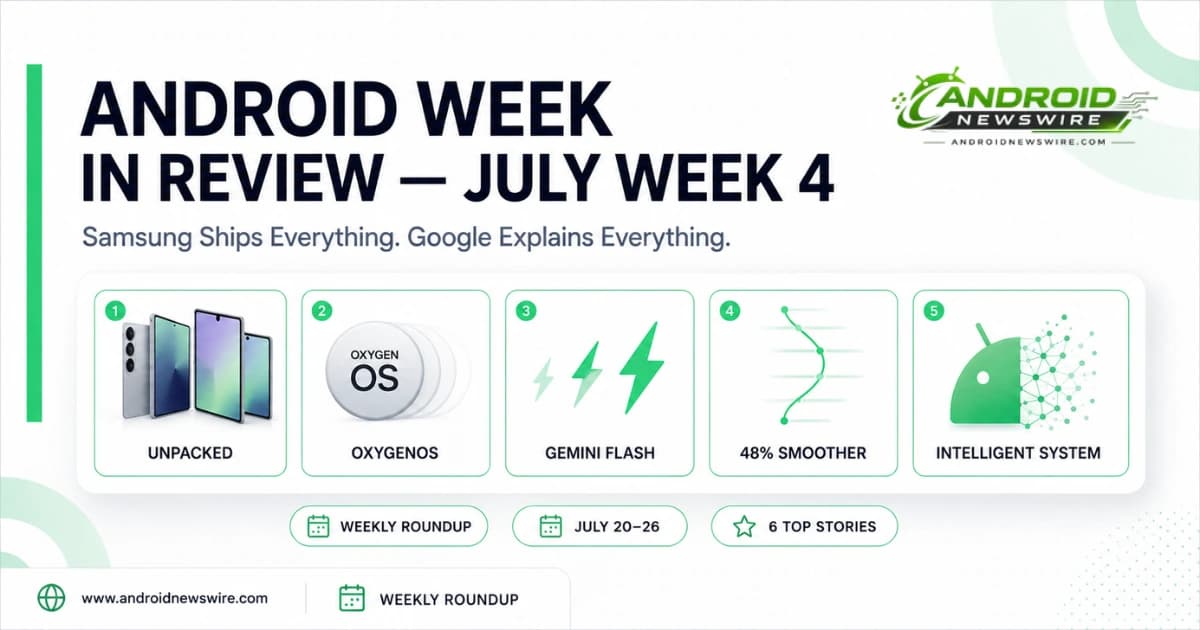
1. Samsung Galaxy Unpacked Delivers Three Foldables, Two Watches, and Smart Glasses
Samsung’s summer Unpacked event took place July 22 in London – the company’s first UK event in 14 years – and it delivered essentially everything the leaks had promised, plus a genuine surprise. Three new foldables launched: the Galaxy Z Fold 8 Ultra, a new “passport-style” Galaxy Z Fold 8 that’s shorter and wider than any previous Fold generation, and the Galaxy Z Flip 8. All three share the same Snapdragon 8 Elite Gen 5 for Galaxy chipset, with base models offering 12GB of RAM and 256GB or 512GB storage.
Alongside the phones, Samsung introduced the Galaxy Watch 9 and Galaxy Watch Ultra 2, and gave the full official reveal of its Intelligent Eyewear – smart glasses built in partnership with Google, running Android XR with Gemini built in, available in styles designed with Gentle Monster and Warby Parker. The first generation has no display; all output is audio-only, positioning it as a hands-free extension of the Galaxy ecosystem rather than a display-first device. Samsung also opened applications for its first-ever credit product, the Galaxy Card, timed to coincide with the reveal.
Why it matters: this is Samsung’s biggest single hardware event of the year, and the redesigned wide-format Z Fold 8 is a genuine form-factor experiment that several outlets are already reading as a preview of what Apple’s rumored iPhone Ultra might look like.
2. Report: OxygenOS Is Being Discontinued Alongside Realme UI
Just days after OnePlus made its US and Europe market exit official, a new report suggests the fallout runs deeper than a regional pullback – OxygenOS itself is reportedly being discontinued, alongside sibling skin Realme UI. If accurate, this marks a significant consolidation within the BBK Electronics family of brands, which includes OnePlus, Realme, Oppo, and Vivo.
Why it matters: OxygenOS built its reputation as one of the cleanest, most well-regarded Android skins in the industry for years. Its potential discontinuation raises real questions for existing OnePlus and Realme device owners about long-term software support.
3. Google Ships Three New Gemini Models – Still No Gemini 3.5 Pro
Google released Gemini 3.6 Flash, Gemini 3.5 Flash-Lite, and a specialized Gemini 3.5 Flash Cyber security model this week. The 3.6 Flash update cuts output token usage by 17% versus its predecessor while improving coding and computer-use benchmarks. The Flash-Lite model hits 350 output tokens per second – the fastest in the 3.5 family – and notably beats the larger Gemini 3 Flash on several real-world coding benchmarks. Flash Cyber, aimed at automated vulnerability detection, is currently restricted to governments and trusted partners.
Conspicuously absent: Gemini 3.5 Pro, promised back in May and still without a firm release date. Google did confirm, however, that pre-training has already begun on Gemini 4.
Why it matters: every release this week is optimized around making agentic AI cheaper and faster to run at scale – a clear signal of where Google sees the real competitive pressure right now.
4. Google Reveals a 48% Cut in Chrome for Android Scroll Jank
In a detailed engineering blog post, Google explained how a multi-year effort since 2023 reduced janky, stuttering scrolls in Chrome for Android by 48%. The work centers on frame delivery consistency rather than raw speed – including input prediction that generates synthetic scroll updates when touch input lags, and architectural changes like “Input Vizard” that bypass Chrome’s busy main thread entirely.
Why it matters: scrolling is arguably the single most repeated gesture in mobile computing, and this is a rare case of Google publishing real before-and-after data on years of unglamorous performance engineering rather than a flashy feature launch.
5. Android Chief Sameer Samat: Android 17 Is Becoming an “Intelligent System”
In an extended Google for Developers discussion, Android President Sameer Samat framed Android 17 as the point where the platform shifts “from an operating system to an intelligent system” – including agentic features like Rambler, app automation, and Superfill, plus a live demo of Gemini using a Volvo EX60’s cameras for real-time road awareness inside Android Automotive OS.
Why it matters: Samat also revealed Google deliberately avoided saying the word “AI” during its most recent Android Show, choosing instead to focus messaging on concrete user benefits – a notable shift in how Google talks about its own technology.
6. Gboard’s Long-Tested Shortcuts Redesign Finally Goes Stable
After roughly seven months of on-and-off beta testing, Gboard’s Material 3 Expressive redesign of its shortcuts page rolled out to the stable channel this week via version 17.7 – replacing the old grid of small cards with larger pill-shaped buttons, at the cost of showing fewer shortcuts per screen.
The Rest of the Week, Briefly
- Google quietly added a new “Signatures” utility app to Android, spotted in recent system updates.
- Samsung’s July security patch – 57 fixes including five critical vulnerabilities – began rolling out to Galaxy devices.
- Some Pixel users reported missed or unreceived calls, an issue currently under investigation.
- Global smartphone shipments hit a 13-year low in Q2 2026, according to industry analyst data, adding useful context to just how competitive this launch season has become.
Looking Ahead
With Galaxy Unpacked now behind us, expect the next few weeks to bring early Z Fold 8 and Flip 8 reviews as devices reach reviewers and early buyers. On the Google side, all eyes turn toward August 12, when the Pixel 11 series and Pixel Watch 5 are set to be officially unveiled at Made by Google – arriving with Pixel Glow, a redesigned camera bar light feature, already confirmed. Between Samsung’s foldables shipping and Google’s own flagship reveal three weeks out, early August is shaping up to be one of the most head-to-head competitive stretches of the year.