
Android’s Developer Verification Enforcement Officially Begins Today — Here’s Exactly What Changes
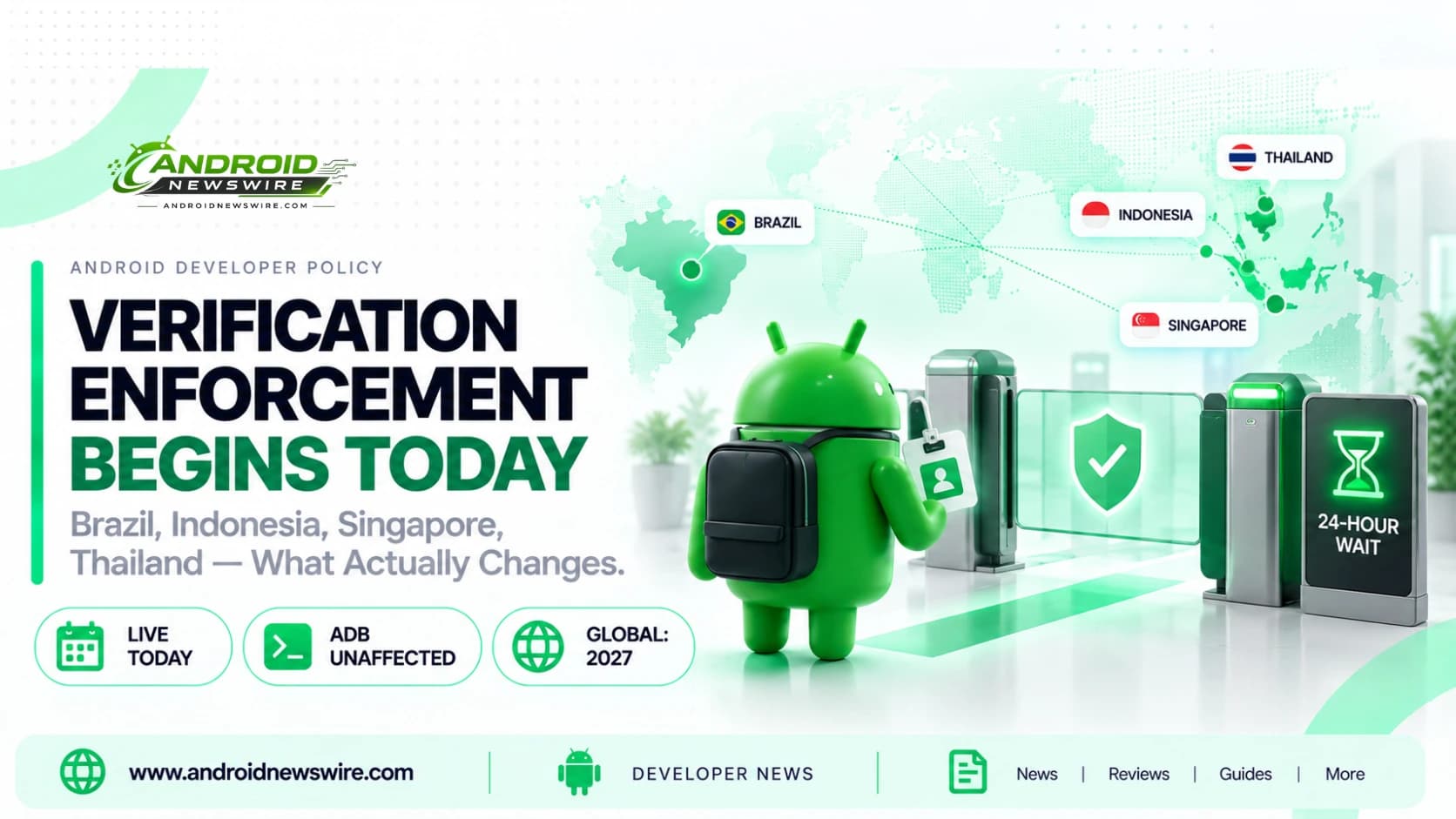
After more than a year of announcements, gradual rollouts, and one high-profile organized pushback campaign, the date we previewed back in August has finally arrived. As of today, September 30, 2026, Google’s Android developer verification requirement moves from “coming soon” to actively enforced — starting in exactly the four countries Google confirmed months ago: Brazil, Indonesia, Singapore, and Thailand.
What Actually Flips Today
The mechanics are precise, and worth stating plainly rather than in vague terms. From today, only apps registered to a verified developer can be installed or updated through the normal path on certified Android devices in those four countries — specifically through seven participating app stores: Google Play, HONOR App Market, OPPO App Market, Galaxy Store, Palm Store, V-Appstore, and GetApps. “Certified devices” means hardware that ships with Google’s services and Play Protect built in, which by F-Droid’s own count represents more than 95% of Android devices outside China — this is not a narrow, niche-hardware policy.
Verification itself means something specific and technical, not just a name and email on a form: an identity check, plus registering each package name against the SHA-256 fingerprint of its signing key. That’s a meaningful detail for developers specifically — the signing key registered has to be the exact one used to sign the build being distributed, which is the kind of process detail that’s easy to get wrong if you’re managing multiple build environments or QA pipelines.
The Workarounds That Still Exist — And Why They Matter
It’s worth being genuinely precise here, because a lot of the public conversation around this policy has understandably focused on the most alarming framing rather than the actual mechanics. ADB (Android Debug Bridge) installs are completely unaffected by today’s enforcement — local development, testing, and sideloading over adb install continue working exactly as they always have. This is not a policy that closes off developer testing or hobbyist tinkering entirely.
For everyone else installing an app from an unverified developer outside of ADB, there’s the advanced flow — a deliberately high-friction installation path Google built specifically to interrupt real-time coercion scams. It began rolling out globally back on August 18, ahead of today’s enforcement date. The mechanics include a genuinely interesting detail: users choosing this path can select whether an exemption for a specific unofficial app lasts seven days or indefinitely, and the flow can involve up to a 24-hour waiting period before some installations actually complete. That waiting period is the entire point — it’s structurally difficult for a scammer to pressure someone into “install this app right now while I’m on the phone with you” when the platform itself forces a mandatory delay.
Why These Four Countries First
Google didn’t pick Brazil, Indonesia, Singapore, and Thailand arbitrarily. The company selected this initial rollout group specifically citing high levels of app-based scams in these markets — a direct, stated rationale rather than a randomly staged geographic test. Sameer Samat, Google’s President of the Android Ecosystem, has previously made the company’s core distinction clear in comments to Android Authority: verification confirming a developer’s identity “doesn’t mean that the app is safe” — it means an identity check has passed and the app is traceable to a real, registered developer, which is a meaningfully narrower claim than “this app has been vetted for malware,” even though the two get conflated in casual discussion of the policy.
The Opposition Hasn’t Gone Away
This enforcement date arrives with real, organized resistance still very much active, not quietly resolved. The Keep Android Open campaign — now backed by 71 organizations across 23 countries — continues actively opposing the requirement, and its core technical argument is worth representing fairly rather than dismissing: verification doesn’t stop the specific trick scammers use most often, which is simply buying already-verified developer accounts rather than trying to fake a new identity from scratch. If that critique holds up, it complicates Google’s core security justification for the policy considerably — a verified account that changes hands to a bad actor provides the same traceability failure the policy was designed to prevent in the first place.
F-Droid, the open-source Android app repository that’s built its entire identity around installation independent of centralized gatekeepers, remains firmly opposed alongside the Keep Android Open coalition. Their concern isn’t really about today’s specific four-country rollout — it’s about the trajectory the policy represents for Android’s traditional openness as global enforcement approaches in 2027.
An Unexpected Geopolitical Wrinkle: Russia
One genuinely unexpected angle surfaced just yesterday, worth including for anyone tracking how this policy’s implications ripple beyond its stated fraud-prevention purpose. Russian officials and developers are reportedly expressing concern that Google’s verification checks could eventually restrict access to domestic Russian applications — a worry rooted in nearly five years of geopolitical tension since the start of the war in Ukraine. While Russia isn’t part of today’s four-country enforcement group, and nothing about today’s rollout directly targets Russian developers or apps, the fear is forward-looking: that a global identity-verification requirement, layered onto an already-tense sanctions and technology-restriction environment, could become a mechanism for broader app access restriction down the line, intentionally or not. It’s a useful reminder that a policy framed purely around consumer fraud protection can carry meaningfully different implications depending on which government and which developer community is looking at it.
If You’re Outside These Four Countries: Nothing Changes Today
For the overwhelming majority of Android users worldwide — including the US, UK, EU, and virtually everywhere outside this specific pilot group — today’s enforcement date changes absolutely nothing about your installation experience. The Android Developer Verifier system service has been quietly present on Android 8+ devices since Google began deploying it back in June, but its actual enforcement logic simply isn’t active outside Brazil, Indonesia, Singapore, and Thailand yet. If you’re a developer or user outside these four markets and you’ve been putting off thinking about this policy, today isn’t the deadline that affects you — 2027’s global rollout is.
What Developers Should Do Right Now, Regardless of Location
Even for developers well outside today’s enforcement zone, this is a reasonable moment to actually check your status rather than waiting for a deadline that directly affects your own market. Google has stated that most Play developers have already completed verification, and more than 99% of apps have already been registered — a genuinely high compliance rate. You can check your own verification status directly in Play Console, and register any apps that weren’t automatically registered as part of that broader process. Given that global enforcement is confirmed for 2027 rather than an open-ended “someday,” there’s real value in confirming your developer account and signing key situation now, well ahead of any deadline that actually affects your own distribution.
The Bigger Picture
Today marks the point where a policy that’s existed largely as an announcement, a distant date, and a slowly deploying background system service becomes something with real, live consequences for real users — even if, for now, that’s confined to four specific markets rather than the whole Android ecosystem at once. Whatever your view on the underlying trade-off between fraud prevention and platform openness, today is the first genuine test of how this system actually functions in practice, for the people it directly affects, rather than how it reads in a policy document or a company blog post. How smoothly (or not) the advanced flow, the 24-hour waiting periods, and the broader verification requirement play out in these four countries over the coming weeks will be the clearest real-world signal yet of what global 2027 enforcement is actually going to look like for everyone else.