
June 2026 Android Drop: Fake Call Detection & 7 New Features
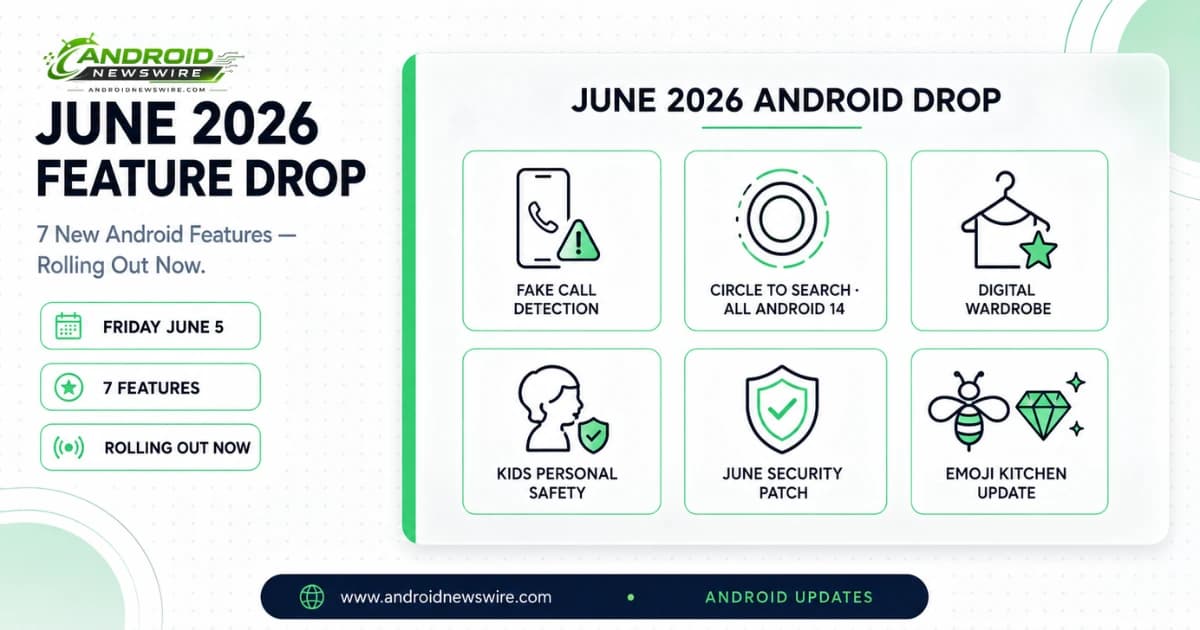
Google has announced its June 2026 Android Feature Drop — seven new capabilities rolling out across Android devices this month, either immediately or in the coming weeks. The update focuses on security, personalisation, and safety, with the headline addition being a new fake call detection feature that addresses one of the most concerning evolutions in phone scam technology.
1. Fake Call Detection — Android Now Spots Scammers Impersonating Your Contacts
The most important addition in the June Feature Drop is fake call detection, built into the Phone by Google app. The feature extends beyond the verified financial calls system that launched in May — this one specifically targets a newer and more psychologically sophisticated threat: scammers spoofing the numbers of people already in your contact list.
How It Works
The Phone by Google app can now verify whether an incoming call is actually coming from the device registered to the contact in your address book. When a scammer spoofs a number belonging to one of your contacts and calls you, the app detects the discrepancy between the claimed caller identity and the actual originating device, and displays a warning before you answer.
The warning gives you the information you need to make an informed decision — you can see that the call appears to be coming from your contact’s number but cannot be verified as originating from their device. In an era where AI voice cloning can make a call sound convincingly like a family member or colleague, that visual warning is a meaningful intervention before the conversation begins.
Requirements and Rollout
Fake call detection requires the Phone by Google app, Contacts, and Google Messages with RCS active on both ends of the call — both the caller’s device and yours. The feature is available on Android 12 and above. Rollout begins this month with Pixel devices, expanding to Samsung Galaxy S25 series, S24 series, Z Flip 7, Z Fold 7, Z Flip 6, Z Fold 6, and Z TriFold in subsequent weeks.
The dual-device requirement is the one practical limitation. It means the protection is strongest between two Android users both running the Phone by Google app and RCS. Calls from iPhone users, users without the Phone by Google app, or calls from numbers not in your contacts are outside this specific protection scope — though the existing verified financial calls protection and Live Threat Detection continue to cover other attack vectors.
2. Circle to Search Multi-Object Identification Expands to All Android 14 Devices
Earlier this year, Circle to Search gained the ability to identify multiple objects within a single image — allowing users to search for every item in an outfit, every product in a scene, or every element of a complex image with a single query. At launch, the capability was limited to the Galaxy S26 series and Pixel 10 series.
Google is now expanding Circle to Search’s multi-object identification to all Android 14 and above devices that have Circle to Search installed. This is a significant expansion — Android 14 covers hundreds of millions of devices, bringing the feature to the majority of the Android user base rather than the flagship tier.
The multi-object identification allows you to draw a circle around an entire outfit photo and have Circle to Search identify each garment, each accessory, and each item independently, generating shoppable results for every element simultaneously. For fashion, interior design, cooking, and product research use cases, this turns Circle to Search from a single-item tool into a scene-level intelligence surface.
3. Google Photos Digital Wardrobe — Starts Rolling Out Next Week
Google announced Digital Wardrobe for Google Photos in late April, describing a feature that scans your past photos to identify and categorise the clothing you own. The system builds a virtual wardrobe from your existing photos, then allows you to mix and match pieces to build new looks and virtually try on combinations.
The rollout begins next week for eligible users in the United States, India, and Brazil on devices running Android 10 or later. The India launch in the first wave is notable — it reflects Google’s recognition of India as a priority market for AI-powered consumer features alongside the US, rather than as a secondary rollout destination.
The virtual try-on capability — which overlays clothing combinations onto your photos to simulate how different outfits would look — directly connects to the Circle to Search multi-object expansion also arriving this month. Together, the two features create a clothing discovery and outfit planning loop: Circle to Search identifies items you see and want to buy, Digital Wardrobe catalogues items you already own and helps you style them.
4. Personal Safety Tools Come to Kids Under 13
The Personal Safety app — which allows adults to store medical information, set emergency contacts, enable automatic crash detection, and schedule Safety Checks — is extending a meaningful subset of its capabilities to children under 13.
Starting this month, children can display their medical information and emergency contacts directly on their phone’s lock screen — accessible to emergency responders without needing to unlock the device. Car crash detection, which automatically contacts emergency services in the event of a detected collision, is now available for children’s devices. Safety Check scheduling — a way to automatically notify an emergency contact that you are safe at a predetermined time — is also included.
The rollout is global and is arriving soon across all eligible Android devices. For parents who have set up Android devices for children, reviewing the Personal Safety app settings after this update arrives is a worthwhile few minutes — particularly the lock screen emergency information, which provides critical context to emergency responders without requiring device access.
5. June 2026 Security Patch — Critical Privilege Escalation Fixed
The June 2026 Android security update closes CVE-2025-48595, a high-severity privilege escalation vulnerability in the Android Framework component that Google notes may have been under limited, targeted exploitation in the wild. This is the most critical individual fix in the June patch alongside the broader update.
Google has split the June update between the 2026-06-01 and 2026-06-05 patch levels, introducing stability and security enhancements across Framework, System, and Kernel modules for MediaTek, Qualcomm, and Unisoc chipsets.
Pixel devices from Pixel 8 series through Pixel 10 are receiving the update over the air starting immediately. Samsung Galaxy users will see the security fixes bundled alongside upcoming One UI updates in the coming weeks. Motorola, Xiaomi, and OnePlus will roll out the changes across June and July on their specific hardware deployment cycles.
Do not defer this update. A privilege escalation vulnerability that has been under targeted exploitation requires prompt installation — particularly for enterprise devices and devices belonging to users with elevated personal risk profiles.
6. Emoji Kitchen June 2026 — New Stickers and Custom Animal Mashups
Gboard’s Emoji Kitchen receives its June 2026 update with new combinations centred around bugs, small animals, and playful mashups. Highlighted new combinations include blingy bees — merging a honeybee with a diamond ring — and custom animal variants including a mouse merged with a heart symbol.
Emoji Kitchen stickers are generated by tapping two emoji in sequence in the Gboard keyboard. New combinations appear automatically as the Emoji Kitchen library updates — no app update or settings change required. The June batch expands the existing library with the new combinations described above, available immediately to all Gboard users.
7. Circle to Search Arrives on More Mid-Range Devices
Beyond the multi-object identification expansion, Circle to Search itself is continuing its rollout to mid-range Android devices that did not have access at launch. New devices receiving Circle to Search this month include the Xiaomi 17T Pro, OnePlus 15, and Honor Magic V6, with the Motorola Razr Fold 2026, Oppo Find X8 series, and Honor Magic 8 Pro confirmed for arrival soon.
The expansion continues Google’s strategy of making Circle to Search a platform-wide feature rather than a flagship differentiator — consistent with the broader move to push AI features down the price tiers through Play Services delivery rather than gating them on hardware tiers.