Every Android Story From Google I/O 2026 That You Still Need to Read
The biggest stories from Google I/O 2026 are already live on Android News Wire. Gemini Intelligence and the AppFunctions API. Google AI Studio building native Android apps from a browser. Wear OS 7. Android XR glasses confirmed for 2026. But I/O produced more than any four articles can contain. Here is every remaining story, tight and complete.
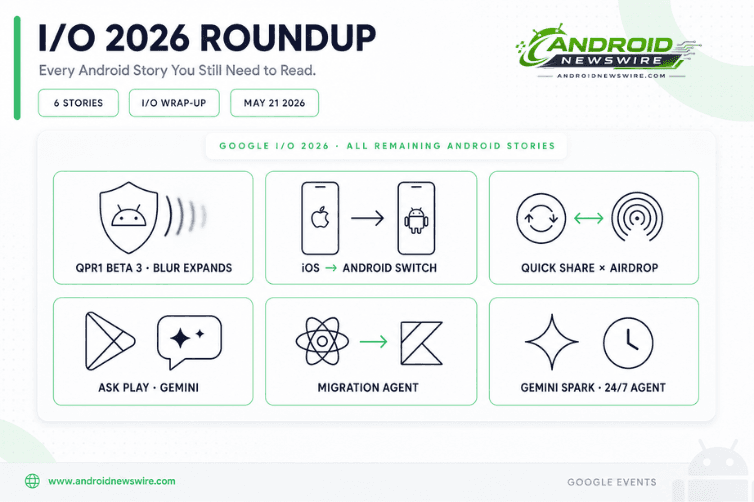
Android 17 QPR1 Beta 3 Drops — Background Blur Expands
Among the bug fixes, Android 17 QPR1 Beta 3 brings background blur to more parts of the user interface. Pixel users enrolled in the Android Beta Programme should receive this update automatically.
QPR1 Beta 3 is the third in the quarterly platform release series following Android 17’s Platform Stability confirmation. Background blur expanding to more system UI surfaces is consistent with the Liquid Glass-adjacent aesthetic direction visible throughout Android 17 — every system overlay, panel, and sheet gradually gaining the frosted depth that was previously limited to the notification shade and Quick Settings. Stable Android 17 is targeting June; QPR1 stable follows around September.
iOS-to-Android Switching Gets Dramatically Easier
This is one of the most quietly consequential announcements from The Android Show that deserves more attention than it received. Google says it teamed up with Apple to make the process of switching from iOS to Android easier by wirelessly transferring data including passwords, photos, messages, apps, contacts and even your eSIM. Pixel and Samsung Galaxy devices will be the first to support this option, starting later this year.
The eSIM transfer is the critical detail. Previous iOS-to-Android migrations required physical SIM swapping or a carrier store visit to transfer the cellular plan. Wireless eSIM transfer eliminates that friction entirely — your phone number, carrier plan, and service follow you across the switch without leaving your home. Combined with password, photo, message, and contact migration, the switching process is being reduced from a multi-hour ordeal to a one-session transfer.
Quick Share Goes Cross-Platform — Works With AirDrop
Google is making Quick Share compatible with Apple’s AirDrop across Android handsets from partners including Samsung, Oppo, OnePlus, Vivo, Xiaomi and Honor later this year. Plus, starting today, you’ll be able to generate a QR code on any Android phone via Quick Share, and use this to share information to iOS devices via the cloud.
Full Quick Share × AirDrop compatibility — where an Android phone appears in the AirDrop list on a nearby iPhone — is coming later this year. The QR code cloud sharing path is available today as an immediate workaround. For users who frequently share files between Android and iOS devices in mixed households or workplaces, this closes the last major friction point in cross-platform file transfer.
Ask Play — Gemini Recommends Apps Inside the Play Store
Google Play Store gets a new “Ask Play” chatbot as Gemini starts recommending apps.
Ask Play is a conversational Gemini interface inside the Google Play Store that allows users to describe what they are looking for in natural language — “an app that tracks my water intake and syncs with my watch” — and receive curated recommendations rather than keyword search results. For developers, Ask Play is a new discoverability surface that rewards apps with clear, well-structured descriptions, complete metadata, and strong keyword coverage. Apps optimised purely for traditional Play Store search may rank differently — better or worse — in conversational recommendation contexts.
Android Studio Migration Agent — React Native, Web, and iOS to Android
We previewed an exciting new Android Studio feature that migrates your app code to a native Kotlin Android app, regardless of whether your source is React Native, a web framework, or iOS.
The Migration Agent expands the iOS-to-Android porting capability announced in the main I/O keynote into a more general-purpose cross-framework migration tool. React Native apps — which represent a significant portion of the mid-market Android app ecosystem — can now be migrated to native Kotlin and Jetpack Compose through an AI-assisted process that preserves business logic while regenerating the UI layer in platform-native code.
For React Native developers who have been deferring a native migration due to the engineering cost, the Migration Agent is the moment to re-evaluate that calculus. An AI-assisted starting point that converts component trees to Compose and business logic to Kotlin is not a complete migration — it is the 60% that has historically been the most tedious part.
Gemini Spark — A 24/7 AI Agent You Subscribe To
During Google I/O 2026, the company unveiled a new AI Ultra tier that costs $100 per month. It’s meant for devs, creators and power users. This includes the newly unveiled Gemini Spark model which Google calls a “24/7 AI agent.”
Gemini Spark is a persistent, always-available AI agent that operates continuously in the background — monitoring, suggesting, and acting on the user’s behalf without requiring explicit invocation. The $100/month AI Ultra subscription also includes 5x higher usage limits in Google Antigravity. For developers evaluating their AI tooling budget, the Ultra tier is relevant if Antigravity usage is the bottleneck — particularly for teams running heavy multi-agent app generation workflows in Android Studio.
Gemini 3.5 Flash Is Live — Faster Than Everything at Frontier Quality
At Google I/O 2026, Google launched Gemini 3.5 Flash. Combining frontier intelligence with incredible speed, 3.5 Flash outperforms Gemini 3.1 Pro across almost all benchmarks while running four times faster than other frontier models.
Gemini 3.5 Flash is available in the Gemini API now. For developers using the Gemini API in production applications — chatbots, content generation, document processing, code assistance — the upgrade path from 3.1 Pro to 3.5 Flash delivers better benchmark performance at four times the speed and typically lower per-token cost. Evaluate your current API tier and model selection against the 3.5 Flash specification before your next billing cycle.
Everything I/O in One Calendar
The on-demand session library for all 85+ I/O 2026 sessions, codelabs, and workshops is live at io.google as of today, May 21. If you missed the live keynotes, every session is available to watch on demand. The Android-specific sessions worth prioritising: the Adaptive Everywhere deep dive for large-screen compliance, the AppFunctions integration walkthrough, the Wear OS 7 developer session, the Android XR SDK Developer Preview 4 tour, and the Android Studio agentic coding sessions that detail the Migration Agent and AI Studio Android builder.