
Google’s Sideloading Restrictions Are Worrying Independent Android Developers — And the Concerns Go Deeper Than the Policy Itself
The official story Google tells about its 2026 developer verification mandate is clean and defensible: malicious actors hide behind anonymity to harm users by impersonating developers and using their brand image to create convincing fake apps. The scale of this threat is significant — over 50 times more malware from internet-sideloaded sources than on apps available through Google Play. The solution, in Google’s framing, is accountability without censorship — a developer ID check that confirms who published an app without inspecting what the app does.
That framing has not convinced independent developers. Across forums, the Keep Android Open campaign, F-Droid’s public statements, developer community petitions, and a growing body of commentary from open-source contributors, the response to Google’s verification mandate has been sustained, substantive, and in many cases angry. Android has long been the more flexible alternative to Apple’s tightly controlled iOS model. That flexibility helped Android become the default platform for hardware makers, emerging-market users, independent developers, and anyone who wanted a mobile device that did not treat the official app store as the only practical route to software. Developer verification does not erase that history in one move, but it narrows the space where independent distribution can operate without asking Google for a seat at the table.
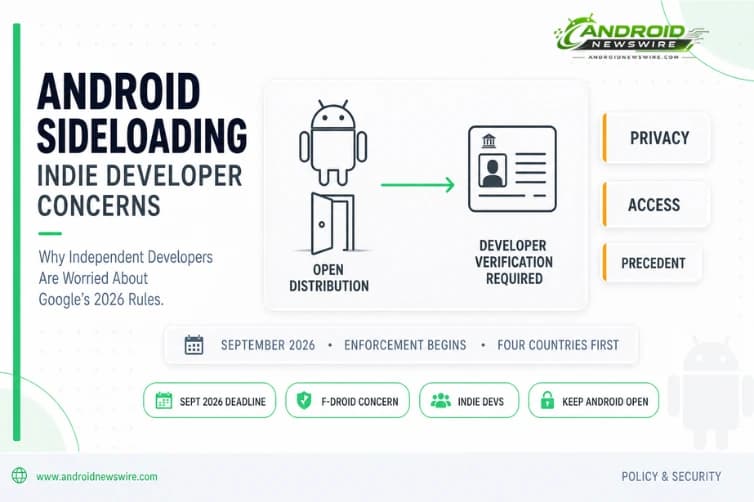
The concerns are not uniform. They cluster around three distinct but related anxieties: privacy, access, and precedent. Understanding each one separately — and why they combine into something larger than their individual parts — is the key to understanding why this debate has the staying power it does.
Concern 1: Privacy — The Government ID Problem
The most immediate and personal objection to Google’s developer verification requirements is the identity disclosure demand. Developers who distribute outside Google Play will need to create an Android Developer Console account, verify their identity, and register their app package names. For an individual developer, that means providing a legal name, home address, email address, and phone number. For organisations, it additionally requires a D-U-N-S number — a formal business identifier. And in both cases, it means signing Google’s terms of service and agreeing to Google’s policies on an ongoing basis.
Submitting government ID to Google is a non-starter for pseudonymous contributors and privacy researchers. This is not a fringe concern. Anonymous open-source contribution has a history that predates Google, and a significant portion of the independent Android development ecosystem operates under pseudonyms — not because developers are doing anything wrong, but because they reasonably prefer not to have their real-world identity attached to every piece of software they publish or contribute to.
Whistleblowers, journalists, and activists under authoritarian governments will be the first victims. People in domestic abuse situations are next. All these groups have legitimate reasons to distribute or use software without putting their legal identity in a Google database. Anonymous open-source contribution is a tradition older than Google itself. This policy ends it on Android. The Keep Android Open campaign’s framing of who specifically loses from mandatory identity disclosure — not general privacy enthusiasts but people for whom pseudonymity is a genuine safety requirement — is among the most substantive arguments against the policy’s design.
Google’s answer to this concern is the limited distribution account: a free account for students and hobbyists that allows sharing apps with up to 20 devices without requiring government ID or a registration fee. For a developer building a tool for personal use or sharing something with a small group of trusted friends, the limited distribution path avoids the full identity disclosure. But the 20-device ceiling means it does not scale beyond genuinely private distribution — it is not an option for independent developers who want to reach hundreds or thousands of users without going through Google’s verified developer program.
Concern 2: Access — The Structural Barriers to Registration
The second cluster of concerns is about who the verification process is actually accessible to. The $25 registration fee and government ID requirement may feel routine to a developer in the United States or Western Europe with a stable identity, a bank account, and access to standard financial services. They look very different to developers in the global majority.
Developers in countries with complex documentation requirements or limited banking access face disproportionate barriers. The XDA developer community — which spans a global user base with particularly strong representation in South Asia, Southeast Asia, and Latin America — has been vocal about this asymmetry. A developer in rural India or Indonesia building a community tool or a language localisation app faces a different relationship with government ID verification and international financial transactions than a developer in California.
Many respondents ask: “Really Google, you’re not allowing some dev from even a third world country to test their own app without paying 25 bucks and without registering with their identity?” The registration fee is modest by US standards but represents a meaningful barrier in markets where disposable income and banking access are not universal — markets where, not coincidentally, Android’s market share is often highest precisely because its traditional openness lowered the barrier to participation in the mobile ecosystem.
For startups, the issue is not just philosophical. Distribution rules shape product strategy. A young company may use sideloading to test an enterprise tool with early customers, ship a companion app for specialized hardware, or reach a community that distrusts mainstream app stores. If every path eventually runs through verification, package registration, and compliance with Google’s evolving policies, the cost of experimentation rises. Early-stage startups that use sideloading as a distribution shortcut while they test product-market fit face a new compliance layer that adds friction before they have the revenue to absorb it easily.
Concern 3: Precedent — The Slippery Slope That Worries Developers Most
The third and deepest concern is not about the specific requirements of the current policy — it is about what normalising those requirements makes possible next.
Once identity verification is normalized for APK distribution, the next step — restricting which APKs can be installed without Play Store approval — becomes much easier to justify. The developer community’s worry is not really about the $25 fee or the identity check in isolation. It is about the architecture being built beneath those requirements: a system where every app that installs on a certified Android device is traceable to a registered developer, where Google holds the registry, and where Google’s terms of service govern the conditions under which that registration can be maintained or revoked.
Google has a documented track record of complying when authoritarian governments demand app removals. With this program, the software that runs your country’s institutions will exist at the pleasure of a single unaccountable foreign corporation. The Keep Android Open campaign’s most pointed argument is not about the privacy of individual developers — it is about the structural power this registry gives Google over the entire Android app ecosystem, including apps that never touch the Play Store.
Nine steps, 24-hour wait, buried in Developer Options, delivered through a proprietary service that Google can revoke whenever they want. That’s not sideloading. That’s a deterrence mechanism built to ensure almost nobody completes it. And since it runs through Play Services rather than the OS, Google can tighten or kill it silently. The specific critique of the Advanced Flow — the five-step process that allows power users to install unverified apps — is that its delivery mechanism through Play Services means Google retains unilateral control over the sideloading exception pathway itself.
The real concern is that while the barrier to entry is low now, it might rise over time. A $25 fee today could become higher. Identity verification requirements today could expand in scope. Terms of service that today require only basic identity could tomorrow require compliance with content policies. Each individual step is justifiable in isolation; the trajectory they collectively describe is toward a level of platform control that eliminates the meaningful distinction between Android and iOS in practice, even if Android retains formal openness in theory.
F-Droid’s Existential Concern
No organisation has more directly expressed the concrete stakes of developer verification than F-Droid — the open-source Android app repository that has served as the primary alternative distribution channel for free and open-source Android software for over fifteen years.
F-Droid, home to thousands of free and open-source Android apps, has called this an “existential” threat. F-Droid’s concern is structural: the repository’s entire model is built on distributing apps from developers who have not necessarily registered with any commercial platform. Many F-Droid contributors are pseudonymous. Many contribute small utilities, privacy tools, or niche apps that serve hundreds of users rather than thousands. The registration fee and identity requirements create a compliance burden that many F-Droid contributors simply will not meet — not because they cannot afford it, but because the identity disclosure requirement is incompatible with the principles under which they contribute to open-source software.
Stores like Aptoide, F-Droid, and Aurora Store exist because developers could publish freely. Once verification becomes mandatory, many independent developers won’t register — privacy concerns, bureaucratic friction, or simply not knowing — meaning their apps will stop installing on most Android devices. The ripple effect for F-Droid is that its catalogue, built over more than a decade, may progressively hollow out as developers with unverified identities find their apps blocked on users’ devices.
Google has offered F-Droid a path through the Registered App Stores program — a formal registration mechanism for alternative marketplaces that, once approved, provides a streamlined installation flow and implies that apps distributed through the registered store come from a vetted ecosystem. But F-Droid’s objection to this path is principled rather than practical: the move has provoked visible backlash from developer communities and projects like F-Droid and the Keep Android Open campaign, who warn that forcing identity disclosure and registration could chill small developers and dissident voices. Accepting Google’s terms as a registered app store means operating within Google’s framework — which is precisely the kind of relationship F-Droid was built to exist outside of.
The EU Dimension: A Week Where Everything Converged
The timing of this developer community anxiety converging with Monday’s EU Digital Markets Act action against Google is not accidental. Regulators across jurisdictions see Google’s position in AI as an extension of its existing market power rather than a fresh competitive start. The same pattern applies to Android’s distribution model: regulators who spent years scrutinising the Play Store’s commercial terms are now examining whether Google’s security-framed verification requirements represent a de facto extension of Play Store gatekeeping to the entire Android ecosystem.
I hope some EU regulation will put a stop to this kind of locking of a device because this is just bad for the user and more so for the developer. That hope, expressed in XDA forum discussions since the verification policy was announced in August 2025, is now a live regulatory question. The EU’s DMA interoperability requirements — telling Google that rival AI services must get the same Android access as Gemini — and the developer verification policy are two manifestations of the same underlying tension: how much control can a platform operator exercise over an ecosystem it presents as open?
The practical question now is whether Google can prove that developer verification improves safety without turning Android’s open distribution channels into a permission system in all but name. F-Droid’s response, developer petitions, regulator interest in Europe, and the design of Google’s advanced sideloading flow will show how much room remains for independent Android software. Android is not becoming iOS overnight. But the direction of travel is clear enough for developers and startups to pay attention.
Google’s Position — And Its Limitations
It is worth being precise about what Google has and has not done in response to the community pushback. The original August 2025 announcement included no mention of a bypass flow for power users and no mention of a limited distribution account for hobbyists. Both of those provisions — the Advanced Flow and the student/hobbyist account — were added in response to community feedback in the months that followed.
Google says the system is meant to make Android safer by linking apps to real-world developers and making it harder for malicious actors to disappear and return under new names. That rationale is real. The 50x malware differential between sideloaded and Play Store apps is a genuine safety problem, and the social engineering attacks that the Advanced Flow’s 24-hour wait is specifically designed to interrupt are real attacks affecting real people, disproportionately in the exact markets where enforcement begins in September 2026.
But the independent developer community’s response — and the EU regulators’ scrutiny — suggests that Google’s safety framing, however sincere, does not resolve the structural concerns the policy raises. Safety and openness are not inevitably in conflict; the question is whether this specific implementation of safety achieves its goals without unnecessarily restricting the legitimate, non-harmful uses of Android’s open distribution model that have defined the platform’s identity for fifteen years.
The two platforms that defined “open vs. closed” are converging from opposite ends. If this trajectory continues, the distinction between them becomes much murkier by 2027. Whether that convergence is the price of a safer mobile ecosystem or an unnecessary narrowing of what Android was always supposed to be — that debate is not resolved by the policy’s September 2026 enforcement date. It is just beginning.
What Independent Developers Should Do Right Now
If you are an independent developer distributing apps outside the Play Store, the September 2026 regional enforcement deadline is real and the compliance window is closing. Here is the most practical path through the current landscape.
If you are willing to verify: Register at the Android Developer Console now. The verification process requires legal name, address, email, and phone number, plus the $25 registration fee. Organisations need a D-U-N-S number — a process that can take up to 28 days. Completing verification before August 2026 means your users in enforcement regions face no installation friction whatsoever after September.
If you serve fewer than 20 users: Apply for a limited distribution account when early access opens in June 2026. No government ID required, no fee, no registration — your users receive your app via a device identifier sharing flow. This is the path Google designed specifically for the hobbyist, student, and small community use case.
If you are not willing to verify and serve more than 20 users: Your users in Brazil, Indonesia, Singapore, and Thailand will need to complete the Advanced Flow — the five-step, 24-hour-wait process — before they can install your app after September 2026. Communicate this to your user base clearly and well in advance. The Advanced Flow is a one-time process per device — users who complete it can install your app (and all other unverified apps) without repeating it.
If you operate a third-party app store: Evaluate the Registered App Stores program carefully. Registration provides your users with a streamlined installation flow, but it requires agreeing to Google’s quality and safety standards. If that is incompatible with your store’s principles, your users in enforcement regions will face the Advanced Flow for every app install from your store.
In all cases: Track the timeline. September 2026 is enforcement in four countries. 2027 is the global rollout. The window to prepare — and to make your position heard through the public consultation process open until May 13, through the Keep Android Open campaign, and through feedback to Google’s own developer verification survey — is open right now.
Related on Android News Wire:
- Android’s New 24-Hour Sideloading Process: The Advanced Flow Explained Step-by-Step
- Android Developer Verifier Is Live: Google’s Ecosystem Shift Starts Now
- Google’s Official Plan to Balance Android Openness With Safety
- EU Orders Google to Open Android to ChatGPT and Claude Under DMA
- GrapheneOS: The Privacy Android Fork Born From a Bitter Split
- Android Boss Confirms: Sideloading Is Here to Stay — But With New Safeguards