June 2026 Google System Updates: New Android Features Without an OS Upgrade
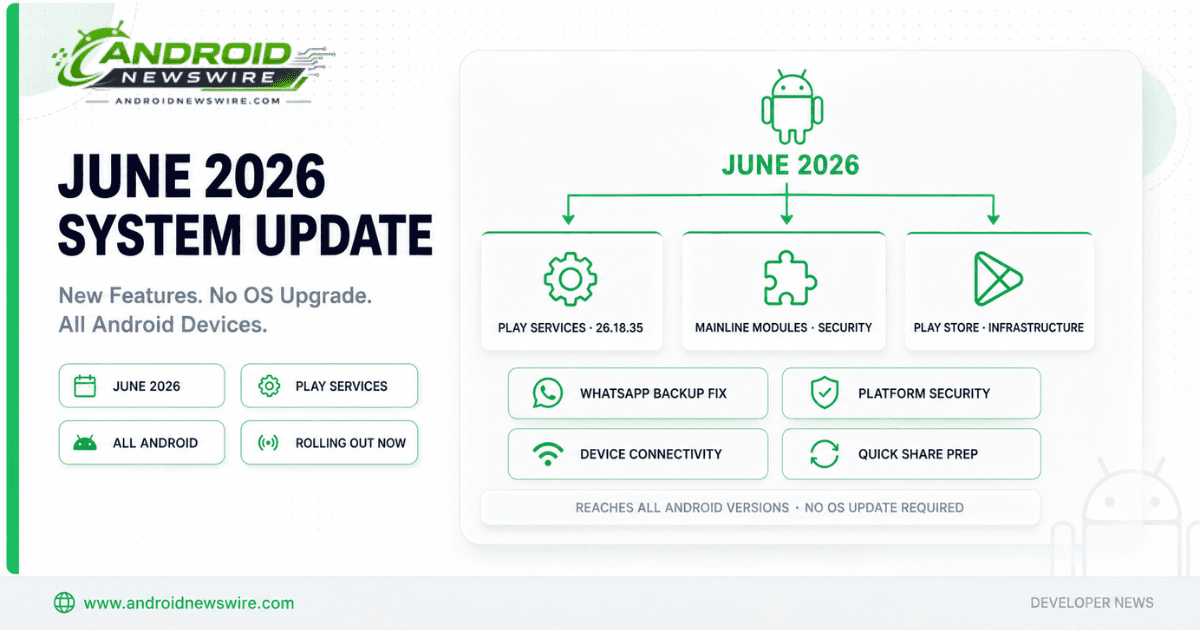
Google’s June 2026 Google System Updates are rolling out now across Android devices worldwide. Delivered through Google Play Services, the Play Store, and Play System Updates rather than a full operating system release, this month’s changelog brings meaningful improvements to WhatsApp backup handling, platform security, device connectivity, and broader ecosystem services — reaching devices running Android versions as old as Android 10 without waiting for a manufacturer update cycle.
The updates follow the significant May 2026 system update that landed the AppFunctions API in Play Services, password and passkey portability via the Credential Exchange standard, and Theft Protection on by default for Android 17 devices. June’s update continues the same cadence of substantive capability additions delivered through the modular channel.
What Is In the June 2026 System Update
WhatsApp Backup Handling Improvements
Google has improved how Android manages WhatsApp backup operations in the June system update. The changes address the backup pipeline between WhatsApp’s on-device data and Google Drive — specifically targeting reliability issues that have caused incomplete or failed backups for users on certain device configurations.
WhatsApp backup on Android operates through a combination of WhatsApp’s own backup scheduling, Google Drive’s backup API, and the Android system backup services layer that mediates between them. When any element of this three-part chain encounters an error, the failure can be silent — users discover incomplete backups only when they attempt to restore on a new device. The June system update addresses reliability in the handoff between the Android backup services layer and the Drive destination, reducing the probability of silent backup failures.
For the approximately two billion WhatsApp users globally, a significant proportion of whom use Android as their primary platform, reliable backup handling is not a minor convenience improvement — it is the safety net that makes device switching, factory resets, and device loss recoverable without losing conversation history. The June fix does not change the backup interface or workflow that users interact with directly. It is an infrastructure improvement in the system layer that manages backup reliability beneath the surface.
Platform Security Enhancements
The June system update delivers targeted platform security improvements across the Android security stack, complementing the June 2026 security bulletin that fixed CVE-2025-48595 — the high-severity Framework privilege escalation vulnerability under active exploitation covered in detail in our June 2026 Security Patch article.
The Play System Update security additions this month focus on the infrastructure layer — the components of the Android platform delivered through the Mainline module system rather than the core OS. Mainline modules, introduced in Android 10, allow Google to update security-critical components — DNS resolver, media codecs, network stack, document UI — through the Play Store without requiring a full OS update. The June security additions to the Mainline module set extend the security hardening applied in the base security bulletin to the modular components that the bulletin does not directly cover.
This matters most for devices running older Android versions. A Pixel 7 on Android 15 and a Galaxy A35 on Android 13 both receive the same June Mainline module security improvements through the Play System Update, regardless of the OS version gap between them. The module system is specifically designed to deliver critical security fixes below the OS version boundary — which is why Google has invested heavily in expanding the Mainline module surface area with each successive Android release.
Device Connectivity Upgrades
New developer features for device connectivity have been added in June’s Play Services update — continuing the expansion of the connectivity API surface that appeared in both the April and May system updates.
The June connectivity additions target three areas. Cross-device discovery API improvements expand the reliability of the Nearby Connections and Wearable Data Layer APIs that apps use to find and communicate with nearby Android devices — including the Wear OS companion device discovery that powers the in-app install prompt flow we detailed in our FotMob Wear OS cross-device discovery guide.
Bluetooth LE advertising enhancements improve the precision and efficiency of BLE advertisement scanning — reducing power consumption during background device discovery while maintaining detection reliability. For apps that use BLE for proximity-based features, the June improvements reduce the battery cost of maintaining awareness of nearby devices.
The third connectivity addition is infrastructure preparation for the Quick Share × AirDrop cross-platform compatibility confirmed for later in 2026. The June system update adds handshake protocol improvements in the Quick Share foundation layer — the device-to-device negotiation that will need to work across Android and iOS when bidirectional Quick Share × AirDrop ships later this year.
Ecosystem Services Improvements
Broader ecosystem service improvements in June’s update cover Google Account services, Play Store infrastructure, and Google One backup handling.
The Google Account services update improves the reliability of the account migration flow introduced in May — the transition from service flag to account capability that affects apps querying Google Account API states. The June update smooths edge cases in the migration that were producing inconsistent account state on certain device configurations.
Play Store infrastructure improvements address a performance regression in the Play Store’s app update delivery pipeline that was causing slower-than-expected OTA update downloads for apps over 100MB. The fix improves delta compression efficiency for large app updates — reducing both download size and the time between a developer publishing an update and users receiving it.
Google One backup handling receives a targeted fix for an edge case where scheduled nightly backups were completing but not registering correctly in the backup status display — showing as “Pending” rather than “Completed” even after a successful backup had run. The fix is cosmetic in terms of data safety — backups were completing successfully — but the false “Pending” status caused unnecessary user concern and support requests.
Why This Monthly Update Cycle Matters More Than It Appears
The Modular Architecture Behind System Updates
The June Google System Updates are delivered through three distinct channels, each targeting a different layer of the Android platform:
Google Play Services is the most broadly deployed channel — running on virtually every Android device with Google apps installed, updated silently in the background. Play Services powers capabilities including Google Account authentication, Google Maps APIs, Push Notifications via Firebase Cloud Messaging, the Fused Location Provider, Google Sign-In, and — since the May 2026 update — the AppFunctions API that connects apps to Gemini Intelligence.
Play System Updates (Project Mainline modules) are modular OS components distributed through the Play Store. Each module is a discrete piece of the Android platform — the DNS resolver, media decoder components, the network stack, the document picker UI, the permissions controller — that can be updated independently of the base OS version. There are currently over 30 Mainline modules in active distribution.
Play Store updates deliver improvements to the app store infrastructure itself — search ranking, pricing display, review systems, install reliability, and the developer console tooling.
The Fragmentation Argument — Why Modular Delivery Matters
Android fragmentation has been a persistent challenge since the platform’s early days. The traditional OS update model — where Google releases a new Android version, OEMs adapt it for their hardware, carriers approve it, and users eventually receive it — has historically produced a multi-year gap between a new Android capability being announced and it reaching the majority of active Android users.
The modular delivery system systematically addresses this gap for capabilities that can be implemented below the OS version boundary. When Google adds the AppFunctions API to Play Services, it does not need to wait for OEM Android 17 updates to ship in Q3 and Q4 to reach Samsung, Motorola, and Xiaomi users. The capability arrives with the next Play Services update — which rolls out within days or weeks to hundreds of millions of devices across all supported Android versions.
The implications for the developer experience are significant. Platform capabilities delivered through Play Services and Mainline modules arrive without version gating — developers do not need to target a minimum Android version to use them. The reliability improvements in the June WhatsApp backup handling update reach a Galaxy A35 on Android 13 and a Pixel 10 on Android 17 simultaneously. The security improvements in the June Mainline module update reach both equally.
The June Update in the Broader 2026 Context
June’s system update arrives at a particularly consequential moment in the 2026 platform calendar. Android 17 stable has just launched on Pixel devices. The AppFunctions API — the developer surface for Gemini Intelligence integration — is already deployed in Play Services across the existing Android installed base. The verified financial calls protection, the Theft Protection default-on policy, the Credential Exchange password portability standard — all of these arrived through the modular channel in May and June rather than through an OS release.
The cumulative effect is that the Android platform a user is running in June 2026 is meaningfully more capable, more secure, and more AI-integrated than the platform they were running in December 2025 — even if they are running the same major Android version. The OS version number is increasingly a less complete description of the platform’s capability surface than the Play Services version and Mainline module versions running on top of it.
For developers, this shifts the conversation about minimum SDK targeting. The traditional calculus — “target a minimum SDK version that covers X% of your user base” — does not capture whether those users have AppFunctions support, whether they have the June security improvements, or whether they have the improved device connectivity APIs. All of those capabilities arrive through channels that SDK version targeting does not reflect.
Developer Action Items for the June System Update
Check Play Services Version Dependency
If your app uses any API delivered through Google Play Services — which includes the vast majority of apps using Google Account, Maps, Firebase, Gemini, or AppFunctions — verify the minimum Play Services version your app declares as a dependency. Google Play Services 26.18.35 is the current stable version carrying June 2026 capabilities. If your app targets Play Services features introduced in May or June 2026, update your dependency declarations accordingly.
Test WhatsApp Backup Integration if Applicable
If your app participates in the Android backup system — using BackupAgent or android:allowBackup with cloud backup enabled — the June backup handling improvements are worth testing against. Apps that manage large data sets or have complex backup configurations should verify that the June system update does not change backup timing, completion notification behaviour, or restore accuracy on test devices.
Validate Connectivity API Behaviour
If your app uses Nearby Connections, the Wearable Data Layer API, or BLE advertising for proximity-based features, test your connection establishment and discovery flows against the June Play Services build. The connectivity API improvements may change the timing or sequence of connection callbacks in ways that are net improvements but could surface edge cases in apps that make assumptions about exact timing.
Monitor the AppFunctions Early Access Programme
The AppFunctions API — delivered to the existing Android installed base through the May Play Services update — is still in early access. The June system update does not change the AppFunctions API surface, but the programme is actively expanding. If you have not yet applied for AppFunctions Early Access and your app operates in a category where cross-app Gemini task automation is relevant — food delivery, ride-sharing, messaging, calendar, shopping, fitness — apply now. Early access participation positions your app for the summer Gemini Intelligence rollout on qualifying Pixel 10 and Galaxy S26 hardware.
How to Apply the June System Update
To check your current Play Services version and trigger an update: Settings → Apps → Google Play Services → App info → Version number.
The June system update rolls out progressively — a feature appearing in the June changelog does not guarantee same-day availability on every device. Most Play Services updates reach full deployment within two to four weeks of the initial rollout. Mainline module updates typically reach full deployment within four to six weeks.
To check for Mainline module updates: Settings → Security & privacy → System & updates → Google Play system update. If an update is available, it will appear here and can be applied without a device restart on most module updates.