Microsoft Built Its AI Agent Platform on Android — Project Solara Announced at Build 2026
Microsoft announced Project Solara at its Build 2026 developer conference in San Francisco on June 2 — a new platform designed from the ground up for AI agent-first devices. The platform is already generating significant discussion in the Android developer community for one reason above all others: Microsoft did not build it on Windows. Project Solara runs on the Android Open Source Project.
What Project Solara Is
Project Solara is Microsoft’s bet that the next major platform shift in computing is from applications to AI agents — and that this shift is consequential enough to require an entirely new platform rather than an extension of existing ones.
“Project Solara is specifically designed for the new era of agent-first devices,” Microsoft stated at Build 2026. “It establishes hardware and software requirements that will meet enterprise needs for manageability, security, and privacy, while ensuring critical user experiences are delivered.”
The platform spans from chip to cloud. At the hardware layer, it defines reference specifications for devices built around AI agent interactions rather than traditional application interfaces. At the software layer, it provides a lightweight operating system, an Agent Shell for dynamically loading cloud-based agents, enterprise management through Microsoft Intune and Entra ID, and what Microsoft calls “just-in-time UI” — an interface model that adapts dynamically to whichever device and context the agent is running on.
Devices built on Project Solara do not have a traditional app store, a browser-first experience, or a conventional desktop. The entire interaction model assumes that the user’s relationship with software is mediated by agents rather than by opening and navigating individual applications.
The Android Foundation — The Detail Nobody Expected
The most significant announcement within the Project Solara reveal for the Android community is not the hardware concepts or the enterprise pilots. It is the operating system underneath the platform.
Project Solara runs on MDEP — the Microsoft Device Ecosystem Platform — which is an enterprise-grade operating system built directly on the Android Open Source Project.
Microsoft is not building the platform of the future on Windows. It is building it on Android.
Steven Bathiche, Microsoft CVP and Technical Fellow who leads the company’s Applied Sciences Group, framed the choice during the Build keynote. AOSP provides the flexibility, the broad chipset support, and the lightweight footprint that new agent-first form factors require. Windows, designed for a world of applications and traditional input models, carries architectural assumptions that do not map cleanly onto devices where the interaction model is voice, facial recognition, and ambient presence rather than keyboard and cursor.
The practical implication is significant. Microsoft — which famously missed the mobile era and has spent years working to ensure it does not miss the next platform shift — has looked at the landscape of available foundations for AI-first hardware and chosen Android’s open-source base over its own most valuable software asset.
What MDEP Adds to AOSP
MDEP is not stock Android. Microsoft has modified the AOSP foundation with enterprise-grade security integration, Intune device management, Entra ID identity and access management, and the Agent Shell architecture that replaces the traditional Android launcher with an agent orchestration layer. The result is a platform that benefits from Android’s broad hardware compatibility and ecosystem maturity while removing the consumer-facing application layer entirely.
For Android developers familiar with enterprise deployments, MDEP is conceptually similar to Android Enterprise with Managed Device mode — but taken to its logical extreme, where the managed experience is not a restricted version of Android but a purpose-built agent platform that happens to share Android’s foundations.
The Two Reference Devices
Microsoft demonstrated two working concept devices at Build 2026. Both are explicitly reference designs rather than products Microsoft intends to ship itself — they are demonstrations of what is possible on the platform rather than product announcements.
The Desk Companion
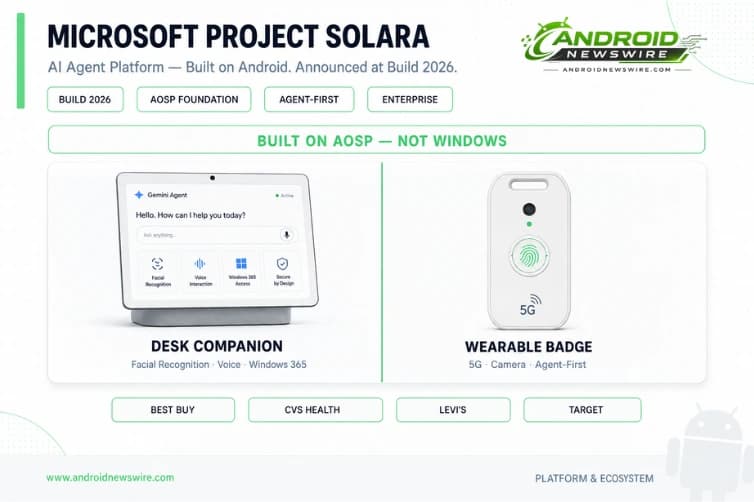
The desk companion is a standalone display device — approximately Echo Show form factor — designed to sit beside a workplace PC. It authenticates users via facial recognition through Microsoft Hello for Business, surfaces relevant Microsoft 365 data including upcoming Outlook calendar events and Excel data, accepts voice input for agent queries, and executes tasks on the user’s behalf through connected agents.
The more interesting capability is what happens when the device is connected to an external display via USB-C. In that configuration it becomes a Windows 365 cloud PC client — a thin client that delivers a full Windows computing environment streamed from Microsoft’s cloud infrastructure. A single device that functions as both an ambient AI agent companion and a Windows PC thin client, depending on context, represents a new category of enterprise hardware that did not previously exist.
The Wearable Badge
The wearable badge reimagines the standard enterprise employee ID card. A fingerprint button wakes an AI agent in a single press. A small camera captures visual context. A touchscreen displays information and accepts input. 5G connectivity provides standalone operation without relying on a nearby phone or network infrastructure.
In healthcare scenarios demonstrated at Build, a nurse wearing the badge can capture patient interactions, surface relevant records, and track follow-up tasks — a fundamentally different workflow from the same nurse typing into a laptop between patients. GitHub Copilot and Dragon Copilot, Microsoft’s healthcare AI product, are both exploring agent-first experiences on the Solara platform.
Enterprise Pilots Already Underway
Microsoft confirmed that early pilot programmes for Project Solara devices are already running with four major enterprise partners: Best Buy, CVS Health, Levi’s, and Target.
The selection of retail and healthcare enterprises as the first pilot partners is deliberate. These are industries where workers are physically mobile, frequently away from traditional computing workstations, and interact with information — product data, customer records, patient histories, inventory systems — in ways that benefit from ambient, hands-free AI assistance.
A retail floor associate wearing a Solara badge who can ask a question and receive an instant answer from connected inventory and product systems, without picking up a phone or walking to a terminal, represents a genuine productivity improvement over existing workflows. The value proposition in these contexts is clear enough to justify the procurement and deployment complexity of introducing a new device category.
Qualcomm and MediaTek have partnered with Microsoft for the reference designs — both chipmakers are already deeply invested in the Android ecosystem, which makes their participation in an AOSP-based platform a natural extension of existing relationships.
What This Means for Android Developers
AOSP as the Platform of the Future
The most important takeaway for Android developers from the Project Solara announcement is the validation it represents for the AOSP foundation. Google is building Googlebooks on Android. Microsoft is building its next-generation enterprise device platform on Android. AOSP is not just the basis for consumer smartphones — it is the foundation that both the world’s largest search company and the world’s largest enterprise software company are choosing for their AI-first hardware platforms.
The Convergence With Google’s AppFunctions Story
There is a meaningful parallel between what Microsoft announced at Build 2026 and what Google announced at The Android Show on May 12. Google’s AppFunctions API allows developers to expose their app’s actions directly to Gemini agents for cross-app task orchestration. Microsoft’s Project Solara replaces the app model entirely with an agent orchestration layer.
Both companies are describing the same underlying shift — from a world where users open applications to do things, to a world where agents do things on the user’s behalf across connected services — from different positions in the ecosystem. Google is extending the existing Android application model to accommodate agents. Microsoft is building a new platform that skips the application layer entirely.
For Android developers, the Google path is the immediately relevant one. AppFunctions and Gemini Intelligence, covered in our detailed breakdown at Gemini Intelligence: Android Becomes an Intelligence System, are the practical implementation of the same agent-first vision on the platform that already has two billion active users.
The Enterprise Android Opportunity
Project Solara’s enterprise focus — Intune management, Entra ID, Hello for Business, Microsoft 365 integration — describes an enterprise device ecosystem that runs on Android infrastructure but is managed through Microsoft’s enterprise toolchain. For Android developers building enterprise applications, the emergence of MDEP-based devices alongside Google’s existing Android Enterprise framework expands the addressable market for professional-grade Android applications.
The Open Questions
Microsoft provided a detailed platform vision at Build 2026 while leaving several commercial questions unanswered.
The business model is not confirmed. Microsoft has not stated whether Project Solara will be licensed to hardware manufacturers the way Windows is, whether it will be tied to Azure AI Services and Microsoft 365 subscriptions, or whether it will follow an open model more consistent with AOSP’s own licensing terms.
No availability dates have been announced. The reference designs are pilots, not products. The path from enterprise pilot to general availability for Project Solara hardware remains undefined.
Whether enterprises will adopt an entirely new device category — with the procurement, management, security certification, and change management overhead that entails — is the fundamental adoption question. The value proposition in specific contexts like healthcare and retail is clear. Whether that value proposition generalises across enterprise computing broadly enough to sustain a new platform is a question that pilot programmes will need to answer before Project Solara moves beyond reference designs.
The Bigger Picture
Microsoft’s decision to build Project Solara on AOSP rather than Windows is a consequential signal about where the computing landscape is heading. The company that defined personal computing through Windows is building its vision for the next era of computing on Google’s open-source mobile foundation.
For the Android ecosystem, this is a significant moment. AOSP’s role in the technology landscape is expanding beyond consumer smartphones into enterprise agent hardware, automotive systems through AAOS SDV, laptop computing through Googlebooks, and mixed reality through Android XR. The breadth of platforms being built on Android’s open-source foundation in 2026 suggests the platform’s influence on the next decade of computing will be considerably larger than its smartphone origins imply.