
Top Android Stories: May 4–9, 2026 — Your Sunday Briefing Before the Biggest Android Week of the Year
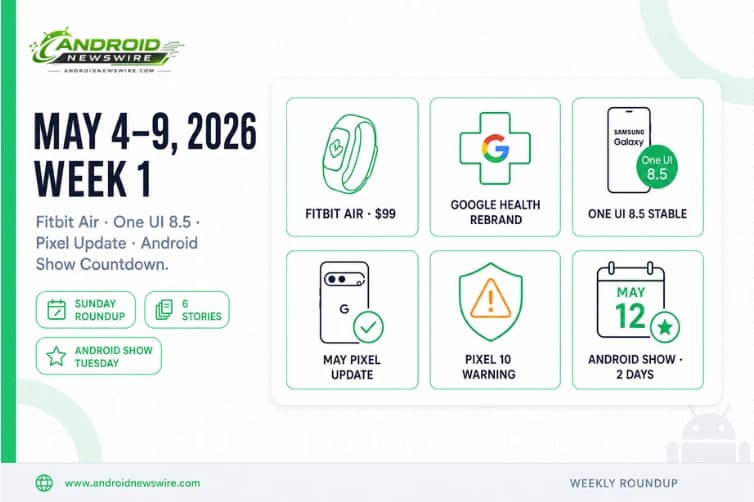
Welcome to your Sunday Android briefing. This is the week before everything changes. The Android Show | I/O Edition streams Tuesday May 12 — Google has called it the biggest year for Android yet, and every story below is the last beat of the drumroll before that reveal. Here is everything that mattered this week.
1. Fitbit Air Is Official — Google’s $99 Screenless Fitness Band Takes on Whoop
The biggest product launch of the week arrived Thursday May 7 when Google officially unveiled the Fitbit Air — a screenless fitness band priced at $99.99 that positions itself as a direct, affordable alternative to Whoop’s subscription-based recovery tracker model.
The Fitbit Air has a pill-shaped pebble made of plastic that can be easily removed from the band mechanism. Google touts “all-day focus and all-night comfort.” The sensors include 24/7 heart rate tracking, SpO2, skin temperature, and activity tracking. There’s also Bluetooth 5.0 and a vibration motor for silent Smart Wake alarms, with the unit water resistant up to 50 meters.
The Fitbit Air has 7-day battery life with quick charging that provides a day of use in 5 minutes. You can go from 0-100% in 90 minutes, with a new pill-shaped magnetic bidirectional charger that finally uses USB-C.
The Fitbit Air goes up for pre-order today at $99.99 and works on Android and iOS. Devices are expected to arrive by May 26. Purchases of the Fitbit Air include 3 months of the new Google Health Premium with the Google Health Coach. There is also a Google Fitbit Air Special Edition that comes with Steph Curry’s Special Edition Performance Loop Band at $129.99.
The cross-platform compatibility is deliberate and significant. Unlike the Pixel Watch, the Fitbit Air works on both Android and iOS. Google is clearly thinking bigger here — at $99 with no mandatory subscription and support for both major phone platforms, this has a real shot at the mainstream fitness tracking market that Whoop’s $199-per-year subscription model leaves open.
The competitive value proposition is stark. Whoop requires a paid membership before you can even use the hardware. The Fitbit Air is a flat $99.99 purchase with all core features included — the Google Health Premium subscription adds AI-powered coaching but is entirely optional. No mandatory subscription here, either — though Google is throwing in three free months of the newly rebranded Google Health Premium if you pre-order before May 26.
Pre-order now at Google Store or Amazon. Ships May 26.
2. Fitbit App Becomes Google Health — The Rebrand Is Final
Google officially unveiled the Fitbit Air alongside announcing that the Fitbit app will become the Google Health app on May 26, and users of the separate Google Fit app will also be migrated to the Google Health app later this year. “The Fitbit app is entering a new era and leveling up as the Google Health app,” Google said.
The Fitbit app is becoming the Google Health app starting May 19 following an automatic OTA update. Fitbit data will automatically carry over to Google Health, and Google Fit users will be invited to migrate their data later this year.
The more important part of this launch may actually be the software side. Google is rebranding the Fitbit app and Fitbit Premium into something called Google Health, continuing the gradual shift away from the Fitbit identity. That includes a redesigned app experience built around Google Health Coach, an AI assistant powered by Gemini. According to Google, the assistant can use sleep data, heart rate trends, activity tracking and even meal photos to generate personalised recommendations.
Google Health Premium is available with a $9.99 per month subscription — previously Fitbit Premium — which is also offered at no additional cost with a Google AI Pro or Ultra plan.
For existing Fitbit users, the transition is automatic and data-safe — no action required before May 19, when the app updates itself. For Google Fit users, the migration invitation comes later in the year. The Fitbit brand survives on the hardware side — the device is officially named “Google Fitbit Air” — but the software identity is now fully Google.
3. Samsung One UI 8.5 Stable Finally Lands — Galaxy S25 and Foldables Get It First
After four months of beta testing and ten beta builds across the Galaxy S25 series, Samsung made it official this week. Starting May 6, 2026, Samsung is releasing the stable update for eligible Galaxy devices. If you have a Galaxy S25, S25 Plus, S25 Ultra, or the new S25 Edge, you’ll get it first.
Samsung launched the stable One UI 8.5 rollout in South Korea on May 6. The Galaxy S25 series, Galaxy Z Fold 7, and Galaxy Z Flip 7 received it first. Galaxy S24 series users are in a second phase, with no fixed timeline confirmed.
The first wave includes the Galaxy S25 series, alongside the S25 FE and the newly introduced S25 Edge. Samsung has also pushed the stable build to its latest foldables, including the Galaxy Z TriFold, Z Fold 7, and Z Flip 7.
What One UI 8.5 actually delivers is substantial for a mid-cycle update. One UI 8.5 is built on Android 16 and introduces Ambient Design — a blur-based visual overhaul across the interface — alongside Perplexity-powered Bixby, Call Screening, Photo Assist, Creative Studio, and Audio Eraser for real-time background noise reduction. The Ambient Design blur aesthetic notably mirrors the Material 3 Expressive direction in Android 17 beta builds — both platforms converging on a frosted-glass, depth-layered UI language simultaneously.
The stable build ships with April 2026 patches, not May. Samsung finalized the May bulletin after the build had already been staged for release. May security patches will arrive separately. The update weighs approximately 4.5 gigabytes for foldable devices upgrading from One UI 8.0.
To check for the update: Settings → Software update → Download and install. The rollout is staged by region — Korea first, then global over the following days.
Looking ahead: The stable One UI 9 release will debut with the Galaxy Z Fold 8 and Z Flip 8 in July 2026. A wider rollout across older Galaxy flagships is expected in September or October. Samsung is already running internal testing on One UI 9 with a public beta expected in late May or early June — making this the final update cycle before the full Android 17-based One UI 9 era begins.
4. May 2026 Pixel Update — Camera and Charging Fixed, Pixel 10 Bootloader Warning
Google released the May 2026 Pixel update, likely the last Android 16 build before Android 17 arrives at Google I/O later this month. The patch covers everything from the Pixel 7a through the Pixel 10a with build number CP1A.260505.005.
The fixes this month are targeted and genuinely useful. Google fixed a camera freeze that hit when recording video while adjusting zoom on the Pixel 10. The Pixel 10 Pro and Pro XL also get fixes for a flickering white dot at the top of the display and a separate issue causing fuzzy screens, freezes, and noise lines. Wireless charging speeds were throttling between 75% and 80% battery on a wide range of devices from the Pixel 7a up through the Pixel 10 series — Google patched that too. A framework fix addresses keyboard and input UI freezing or misalignment in certain apps.
The headline concern this update is the bootloader warning that affects Pixel 10 owners specifically. The May 2026 update for Pixel 10, 10 Pro, 10 Pro XL and 10 Pro Fold devices contains a bootloader update that increments the anti-rollback version for the bootloader. This prevents the device from rolling back to previous vulnerable versions of the bootloader. After flashing the May 2026 update on these devices you won’t be able to flash and boot older Android 16 builds.
The risk: if the inactive slot still holds an older bootloader and the active slot fails to boot, the device falls back to a build that can’t run, leaving it in an unbootable state. Google recommends sideloading the full OTA after first boot to ensure both slots have a compatible bootloader. For most users taking the standard over-the-air update, none of this applies — the OTA handles both slots correctly. The warning is specifically for users who manually flash factory images. We covered the broader anti-rollback story in our dedicated article: Google’s Android Anti-Rollback Is Getting Stricter — What Developers Must Know.
One frustrating note: if you’ve been following recent Pixel coverage, the widespread battery drainage issue in Google phones remains unfixed in May’s update. The issue — which has generated nearly 600 Issue Tracker comments — is still being investigated. No fix, no timeline from Google as of this writing.
The Pixel 6, Pixel 6 Pro, Pixel 6a, Pixel 7, and Pixel 7 Pro are all not included in the May 2026 update. This continues a pattern of inconsistent update coverage for the Pixel 6 and 7 series that Google has never formally explained.
5. May 2026 Google System Updates — Gaming Gemini Goes Multilingual
May’s Google System Updates include new developer features for Utilities-related processes across Auto, PC, Phone, TV, and Wear — expanding the Maps and utility API surfaces that developers can target across form factors.
The most user-facing addition this month: you can now ask questions and share advice about the games you play in Spanish, Portuguese, Indonesian, Chinese, Japanese, and Korean. Gaming with Gemini expands from its English-only launch to six additional languages — significant for the global Android gaming audience, particularly in Southeast Asia where Indonesian is the primary language for hundreds of millions of Android users.
A warning screen appears when you sign in with a Dasher account on Android desktop devices — the first explicit reference in Google’s system update notes to Android desktop devices as a distinct platform category, consistent with the Aluminium OS direction expected to be revealed at The Android Show on Tuesday.
6. Galaxy XR Gets Critical Stability Fix — Memory Leak Patched
Galaxy XR users have been dealing with a frustrating stability issue since the April update that turned the device into a stuttering mess due to a memory leak. A new update, version I610UEU2AZD8, is rolling out and directly targets the memory leak. The patch focuses on system stability and performance improvements — the memory leak caused frame rates to dive, tracking to become unreliable, and thermals to creep up as the system struggled to compensate.
For Galaxy XR headset owners, install this update immediately. The memory leak degraded the core tracking and rendering capabilities that make a mixed-reality headset functional — this fix restores the performance the hardware was designed to deliver.
7. Android Show Countdown — 2 Days Away as You Read This
Everything above is the backdrop. The main event is Tuesday. The Android Show | I/O Edition streams May 12 at 10 AM PT — one week before Google I/O 2026 kicks off on May 19.
Google’s own teaser language this week escalated from “biggest year for Android yet” to “you won’t believe what’s next.” The teaser video showed the Android robot turning transparent — a visual that Sameer Samat, Google’s president of Android, publicly denied was a reference to Apple-style Liquid Glass, raising more questions than it answered about what the transparency actually signals.
Our read: Gemini as a transparent, ambient intelligence layer woven through the OS rather than a visible assistant interface. Aluminium OS as Google’s Android-based desktop platform going public for the first time. XR smart glasses moving from prototype preview to product announcement. Android 17’s consumer story told as a unified narrative for the first time.
We have four pieces ready to read before Tuesday. Set your alarm for 10 AM PT. We will be live on Android News Wire with every announcement as it happens.
- How to Watch — Every Timezone and Stream Link
- The Transparent Robot Teaser Mystery Explained
- Android 17: The 5 Changes Worth Getting Excited About
Developer Quick Hits
Android 17 QPR1 Beta 2 rolled out this week with additional stability refinements on top of Beta 1’s audio and terminal fixes. Pixel users are getting another dose of fixes for Google’s Android 17 QPR1 Beta 2 this week. If you are on the QPR1 Beta track, update and re-run your audio pipeline tests — particularly VoIP and direct audio output flows
EU DMA enforcement remains live with the July 2026 binding decision deadline for Google’s Android AI interoperability obligations. The public consultation window — where stakeholders can submit responses to the Commission’s proposed measures — closes May 13. Full story: EU Orders Google to Open Android to ChatGPT and Claude.
The Week in One Sentence
May 4–9 was the week Google reminded everyone that even its pre-show week has product launches worth your attention — a $99 fitness band, a brand-new health platform, Samsung’s long-awaited One UI 8.5 going stable — and then promptly told you that you “won’t believe what’s next” when Tuesday arrives.
Related on Android News Wire: