Android Week Review: June 22–27, 2026 – The Samsung Unpacked Countdown Begins
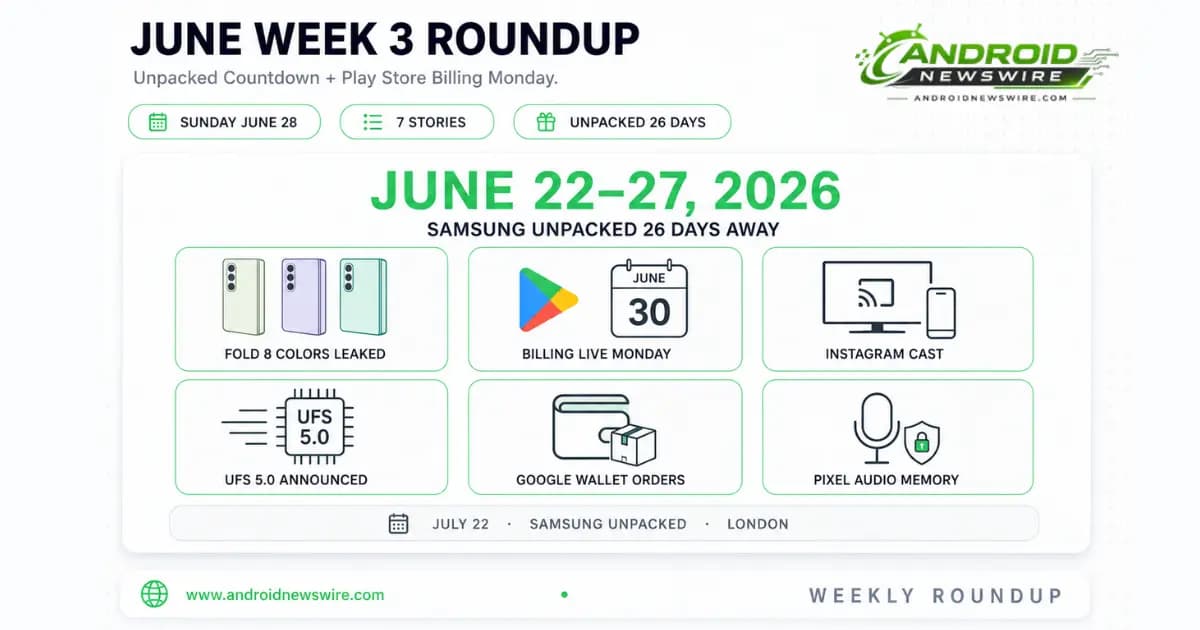
Welcome to your Sunday Android briefing for the week of June 22–27, 2026. Twenty-six days from today, Samsung takes the stage in London. The closer Unpacked gets, the faster the leaks arrive – and this week delivered the most complete picture yet of what the Galaxy Z Fold 8 lineup will look like and how much storage it will carry. Alongside the hardware preview, the week’s biggest policy story is also a matter of days away: the Play Store’s external billing change – the direct outcome of the Epic Games settlement – goes live Monday. Here is everything that mattered this week.
Story 1: Galaxy Z Fold 8, Fold 8 Ultra, and Flip 8 – Colors and Storage Confirmed in Comprehensive Leak
The most consequential Android hardware leak of the week emerged from Digital Citizen on June 24, covering all three Samsung foldables expected at Unpacked on July 22 in London. The leak is notable for its specificity: colour names, storage configurations, and model numbers for all three devices in a single release.
The Three-Model Foldable Lineup – Naming Clarified
The naming confusion that has surrounded Samsung’s 2026 foldable lineup for months is now clearer. The tall, book-style foldable – the direct successor to the Galaxy Z Fold 7, carrying model number SM-F976B – will be called the Galaxy Z Fold 8 Ultra. The shorter, wider format device carrying model number SM-F978 will simply be called the Galaxy Z Fold 8. This naming structure inverts what most coverage had been calling the “Wide” model, giving the premium tall device the Ultra designation while the new wider format carries the standard name.
Colors – Four Options Per Device, Two Exclusive Tones Each
Every device in the lineup launches with four colour options. Cream and Graphite are shared across all three, providing the neutral base options consistent with Samsung’s recent foldable palette strategy.
The Galaxy Z Fold 8 (wide format) receives two exclusive tones: Lavender and Pistachio. The pastel palette is a deliberate personality injection into what has historically been a conservative colour story for book-style foldables. Pistachio in particular – a warm, muted green – is the most distinctive colour leaked for any Samsung foldable in recent memory.
The Galaxy Z Fold 8 Ultra receives Green Shadow and Violet Shadow as its exclusive options – deeper, more premium-feeling tones appropriate for the flagship positioning of the taller device. Violet Shadow has not appeared in Samsung’s foldable lineup before.
The Galaxy Z Flip 8 rounds out with Mint and Pink alongside the shared Cream and Graphite – a palette consistent with the Flip series’ broader demographic reach compared to the Fold lineup.
Critically, the leak indicates that no colour is locked to a specific storage configuration – all four colours in each device’s lineup will be available across all storage options.
Storage – Up to 1TB for Both Fold 8 Models
The Galaxy Z Flip 8 offers 256GB and 512GB storage configurations. Both the Galaxy Z Fold 8 and the Galaxy Z Fold 8 Ultra add a 1TB option to that list – matching the Galaxy S26 Ultra’s maximum storage tier and positioning the two Fold 8 models as genuinely capable productivity hardware rather than flagship smartphones with a folding screen.
The inclusion of 1TB is particularly relevant for the Galaxy Z Fold 8’s positioning as a device that competes with compact tablets. A 1TB foldable with a large inner display and the full One UI 9 productivity suite is a materially different value proposition from a 256GB entry point.
Galaxy Watch Ultra 2 and Galaxy Watch 9
The watch side of the Unpacked lineup is also leaking this week. The first official-looking press images of the redesigned Galaxy Watch Ultra 2 appeared, alongside a major leak for the Galaxy Watch 9 covering design details and display upgrades. Both watches are expected to launch alongside the foldable phones on July 22.
Samsung has also trimmed its 2026 foldable shipment target to 5–6 million units across all three models, down from an earlier projection of 6.5 million, reflecting cautious demand expectations for the premium foldable category.
Story 2: Play Store External Billing Goes Live Monday June 30
The Play Store’s most significant commercial policy change in its history takes effect Monday. Starting June 30 in the United States, United Kingdom, and European Economic Area, developers can use their own payment systems inside their apps, link users to external websites for purchases, and pay fees that are – for most transaction types – lower than the 30% commission that has defined Android app monetisation since 2012.
The new fee structure: 10% service fee on the first $1 million in annual earnings regardless of billing method; 20% on new install transactions above $1 million using own billing; an additional 5% if Google Play Billing is used on top of the service fee. Auto-renewing subscriptions are charged at 10% at all earnings levels – the most dramatic fee reduction for subscription-based apps.
The changes are the direct result of the Epic Games settlement finalised in March 2026. Fortnite returns to Google Play globally as part of the deal. The global rollout extends to Australia in September, South Korea and Japan by December, and the rest of the world by September 2027.
For the complete fee breakdown, billing option analysis, and developer action items – full coverage in our dedicated Play Store external billing guide.
Story 3: Instagram Reels Now Play on Your TV via Google Cast
Instagram has added support for watching Reels on television screens using Google Cast. The feature is rolling out now via the Instagram app on Android – tapping the Cast icon when viewing a Reel sends the content to any Cast-compatible display including Android TV, Google TV, Chromecast, and supported smart TVs.
The practical implication: the short-form video browsing experience that Instagram has built around the Reels format is no longer confined to a phone screen. Users can Cast Reels to a living room display the same way they would cast a YouTube video, with the phone continuing as a remote for scrolling to the next clip.
For Android TV and Google TV users, Cast-based content from Instagram is distinct from a native Instagram app – the Cast session streams from the phone rather than running the app independently on the TV. The distinction matters for users who want to browse their feed from the couch: Cast requires the phone to remain in use as the playback controller.
Story 4: Google Wallet Gains Online Order Tracking in the US
Google Wallet for Android is adding online order tracking in the United States, following a homepage redesign that updated the Wallet interface earlier this month. The order tracking feature surfaces shipping status and delivery updates for purchases made through connected payment methods directly within the Wallet app – without requiring users to open individual retailer apps or email inboxes to find tracking information.
The feature is US-only at launch and works with major retailers whose order confirmation emails are accessible through Gmail. For users who have consolidated their payment and financial tracking into Google Wallet, order tracking adds a practical dimension to the app beyond payment cards and passes. The Ticketmaster partnership announced this week also expands Google Wallet’s event pass capabilities, with more detailed event information and venue-specific details now surfacing on Wallet passes for Ticketmaster events.
Story 5: Samsung Unveils UFS 5.0 Storage – Built for On-Device AI
Samsung announced UFS 5.0 storage this week – the next generation of the Universal Flash Storage standard used in flagship Android smartphones. Samsung’s UFS 5.0 claims twice the read and write speeds of UFS 4.0 alongside improved power efficiency, with the architecture specifically designed around the demands of on-device AI inference workloads.
The relevance to the broader 2026 Android platform story is direct. On-device AI features – Gemini Nano, AppFunctions inference, Contextual Suggestions, Pixel Audio Memory – all require fast, efficient storage access to keep the performance of local AI models competitive with cloud-based alternatives. Storage bandwidth is one of the practical bottlenecks in running large-language-model inference on a mobile device. UFS 5.0 addresses that bottleneck at the silicon level.
Whether UFS 5.0 appears in the Galaxy Z Fold 8 lineup at Unpacked on July 22 or is reserved for the Galaxy S27 series early next year has not been confirmed. Samsung’s typical cadence has been to introduce new storage generations in the S series before extending them to foldables – but the Fold 8’s new Ultra positioning makes it a plausible first vehicle for the technology.
Story 6: Pixel Audio Memory Feature Spotted in Development
Code analysis of a recent Pixel build has surfaced an unreleased feature called Audio Memory – described in the discovered strings as a capability that “continues to listen for important conversations” and stores audio snippets from detected interactions. The feature is dormant and non-functional in current builds, consistent with Google’s standard practice of including features in builds well before they are ready for public release.
The privacy implications of an audio-listening feature on a smartphone are significant enough that the discovery has generated substantial discussion in the Android community. Google has not commented on Audio Memory or confirmed its intended functionality. The strings suggest an opt-in model with user controls – consistent with how Google has approached similar ambient intelligence features including Contextual Suggestions and the Live Update system.
For context: the on-device AI features announced at The Android Show in May – Contextual Suggestions, Magic Cue, Gemini for Home’s Continued Conversation – all operate on ambient signals. Audio Memory, if it ships, would extend that ambient intelligence model to audio context. The privacy architecture Google uses for these features – on-device processing, opt-in activation, user-controlled data deletion – would almost certainly apply to Audio Memory as well, given Google’s established pattern. Expect more detail when Google formally acknowledges the feature, likely at a future event or in a developer blog post.
Story 7: June Platform Updates – All Already Published
Three dedicated articles from this week cover the platform update stories in full:
Samsung One UI 8.5 tracker – 44 devices updated, June maintenance release backporting Prioritize Notifications, Summarize Notifications, and File Summaries to Galaxy S25, and two of the three to Galaxy Z Fold7. Galaxy S24 receives only the security patch. Full tracker: Samsung One UI 8.5 Tracker.
June 2026 Android System Updates complete changelog – Three Play Services releases (v26.21, v26.22, v26.23) across the month, headlined by WhatsApp backup management now accessible from Android device settings for the first time. Full breakdown: June 2026 System Updates Complete Changelog.
OxygenOS 16.0.8.300 for OnePlus 12 and 13R – Dual Bluetooth audio streaming, lunar data in Weather, 2K game screenshots, Outdoor Mode app pinning, June security patch. Full article: OnePlus Dual Bluetooth Audio.
Developer Summary for the Week
Act before Monday on Play Store billing. The June 30 external billing change requires no code changes from developers to remain compliant – existing apps continue working with their current billing implementation. But developers who want to evaluate alternative billing or external link strategies should understand the new fee structure before it activates. Developers above the $1 million annual threshold who use Google Play Billing and have a large existing install base will still see a combined 30% on those existing-install transactions. The full analysis is in our Play Store billing developer guide.
Start building for Galaxy Z Fold 8 Ultra display specs. The Galaxy Z Fold 8 Ultra is reported to bring a meaningfully better inner display than the Fold 7 – with tighter pixel density and improved brightness. Apps that have already invested in Android 17’s mandatory adaptive compliance for large screens are well-positioned for Fold 8 Ultra users. Apps that have not are increasingly visible as outliers. Unpacked is July 22 – the window to ship a Fold-optimised build before the device reaches users is approximately six weeks.
Monitor Audio Memory’s development trajectory. If Pixel Audio Memory ships with user consent and on-device processing – the most likely implementation given Google’s established pattern – it creates a new ambient context signal that apps with AppFunctions integrations could benefit from. Understanding the feature’s architecture before it launches is the preparation that allows rapid integration after it does.
The Week in One Sentence
June 22–27 was the week Samsung’s Unpacked became unmistakably real – colors, storage, and watches all leaked in a single rush – while the Play Store’s most consequential policy change in its history quietly prepared to take effect Monday morning.
What to Watch Next Week
Monday June 30: Play Store external billing goes live in the US, UK, and EEA. Watch for developer responses – particularly whether major apps announce alternative billing adoption or price adjustments.
July 22 in London: Samsung Unpacked. Galaxy Z Fold 8, Galaxy Z Fold 8 Ultra, Galaxy Z Flip 8, Galaxy Watch Ultra 2, Galaxy Watch 9, Galaxy Glasses, and One UI 9 stable. Now 26 days away.
Gemini Intelligence summer rollout: The Pixel 10 series Gemini Intelligence capabilities – cross-app automation, Create My Widget, Rambler – are expected to begin arriving through Play Services and Gemini app updates. No confirmed date, but “later this summer” from Google.
Related on Android News Wire:
- Play Store External Billing June 30 – The Complete Developer Fee Guide
- Samsung One UI 8.5 Tracker: All 44 Devices, June AI Features
- June 2026 Android System Updates: Complete Changelog
- OxygenOS 16.0.8.300: Dual Bluetooth Audio on OnePlus 12 and 13R
- Android 17 Is Live: Every Feature Rolling Out to Pixel Right Now
- Android Week Review: June 16–21 – The Android 17 Launch Week