Google Play Store Opens to External Billing on June 30 – The Complete Developer Guide to the New Fee Structure
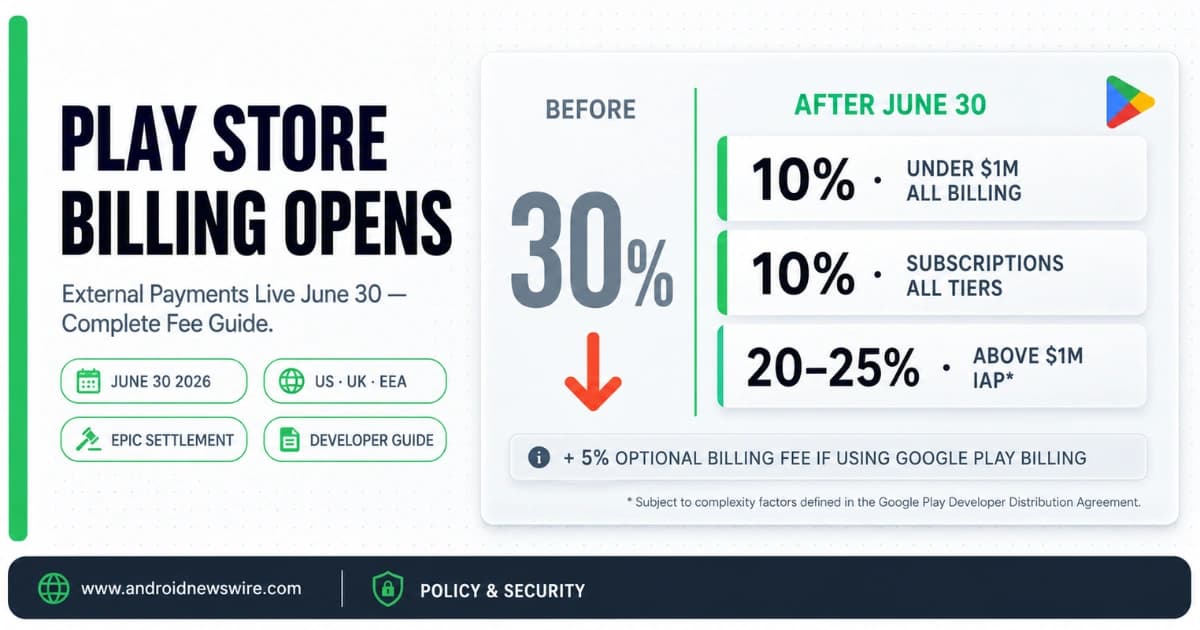
Google has confirmed that the most significant restructuring of Play Store economics in the platform’s history takes effect on June 30, 2026 – five days from now. Starting Monday, developers publishing apps in the United States, United Kingdom, and European Economic Area will be able to use their own billing systems inside their apps, link users to external websites for purchases, and pay fees that are, for most transaction types, meaningfully lower than the 30% commission that has defined Android app monetisation since 2012.
The changes are the direct, court-ordered result of Google’s settlement with Epic Games, announced March 4, 2026, which resolved a years-long antitrust dispute that began when Epic deliberately violated Google’s payment rules in 2020 to trigger a legal confrontation. The jury found Google guilty of maintaining an illegal monopoly in 2023. The June 30 implementation date is the moment that verdict becomes a material change to how every Android developer gets paid.
The fee structure is significantly more complex than the old flat 30%. Understanding it precisely before Monday matters.
Why This Is Happening: The Epic Games Settlement
The Six-Year Legal Battle
The dispute began in August 2020 when Epic Games deliberately added a cheaper external payment option to Fortnite on Android, violating Google’s terms of service in order to provoke removal and trigger litigation. Google removed Fortnite from the Play Store. Epic sued. A jury trial concluded in late 2023 with jurors agreeing that Google had maintained an illegal monopoly over Android app distribution and in-app payments.
The settlement announced March 4, 2026 resolves the dispute globally. Under its terms, Fortnite returns to the Google Play Store worldwide – confirmed by Epic CEO Tim Sweeney. Epic gains the right to operate its own Android app store. And every Android developer gains the billing freedoms and fee reductions that Epic’s legal campaign specifically targeted.
One important caveat for US developers: the US court approval of the settlement is still pending. A separate court injunction – issued during the litigation and still in effect – currently allows US developers to use alternative billing without any platform fee at all. The June 30 implementation proposes replacing that injunction with the new global framework, but the court has not yet formally approved that substitution. US developers should monitor the proceedings closely.
Why June 30 Specifically
Google announced the settlement terms in March. June 30 is the implementation date for the first wave of markets – US, UK, and EEA – set by the court timetable and regulatory approval process. The global rollout continues through 2027.
The New Fee Structure – Every Rate Explained
The old fee structure was simple: Google took 30% of every transaction, or 15% for subscriptions after the first year. The new structure is a deliberate decoupling of two separate fees that previously travelled together.
The Service Fee – What Google Charges for Platform Access
The service fee is what Google charges for the value of distributing your app through the Play Store – discovery, distribution infrastructure, fraud protection, and platform access. This fee applies to every transaction regardless of which billing method you choose.
The Billing Fee – What Google Charges for Using Its Payment Processing
The billing fee is a separate charge for using Google Play’s payment processing infrastructure specifically – tax handling, currency conversion, payment security, and transaction processing. This fee is 5% in the US, UK, and EEA, and it applies only if you choose to use Google Play Billing. If you use your own payment system or external links, you pay no billing fee.
This decoupling is the structural innovation that changes developer economics. Previously, the two components were bundled invisibly into the 30% figure. Now they are separate line items – and one of them is optional.
Complete Fee Table – Every Scenario
For Developers Earning Up to $1,000,000 Annually
| Transaction Type | Billing Method | Total Fee |
|---|---|---|
| All in-app purchases and subscriptions | Any | 10% service fee |
| All in-app purchases and subscriptions | Google Play Billing | 10% + 5% billing = 15% |
| All in-app purchases and subscriptions | Own billing / external | 10% service only = 10% |
The $1 million threshold applies to total annual earnings across all apps in your developer account, not per app.
For Developers Earning Above $1,000,000 Annually
The fee splits based on whether the transacting user’s install qualifies as new or existing relative to June 30, 2026.
New installs – users whose first install or first app update from the Play Store occurs on or after June 30, 2026.
Existing installs – users who had the app installed before June 30, 2026.
| Transaction Type | Install Type | Billing Method | Total Fee |
|---|---|---|---|
| In-app purchases (non-subscription) | New install | Own billing / external | 20% |
| In-app purchases (non-subscription) | New install | Google Play Billing | 20% + 5% = 25% |
| In-app purchases (non-subscription) | Existing install | Own billing / external | 25% |
| In-app purchases (non-subscription) | Existing install | Google Play Billing | 25% + 5% = 30% |
| Auto-renewing subscriptions | Any | Own billing / external | 10% |
| Auto-renewing subscriptions | Any | Google Play Billing | 10% + 5% = 15% |
| Link-out purchases (within 24 hrs) | New install | External | 20% |
The Critical Detail: Existing Installs Above $1M Still Reach 30%
The most important nuance in the new structure is that a developer earning above $1 million annually who continues using Google Play Billing and has a significant base of users who installed the app before June 30, 2026 will still pay a combined 30% on those existing-install transactions. The 30% figure has not been eliminated – it has been restructured so that it can be avoided by making specific choices about billing method and by growing new install share over time.
An existing-install transaction above the $1 million tier processed through Google Play Billing incurs a 25% service fee plus a 5% billing fee – the same combined 30% as before. This is the aspect of the new structure that has received the least attention in general coverage and the most scrutiny in developer forums.
The Three Billing Options – What Each Means in Practice
Option 1: Google Play Billing
The existing system, unchanged in user experience. Users see the familiar Google Play checkout flow with saved payment methods, Google One storage purchase flow, and the same transaction interface they have used for years. Developers pay the service fee plus the optional 5% billing supplement.
Choosing Google Play Billing makes sense when user familiarity and conversion optimisation outweigh the 5% premium, when your app serves a broad consumer audience for whom the Google Play checkout is a known and trusted experience, or when your subscription infrastructure is deeply integrated with the existing Play Billing API.
Option 2: Alternative Built-In Billing System
A developer-implemented payment flow inside the app – Stripe, Braintree, PayPal, or any other payment processor integrated directly. Users see a checkout experience built and controlled by the developer. No billing fee applies. The service fee applies as normal.
This option requires significant implementation work – building a compliant in-app payment UI, handling payment processing, managing failed payments and subscription renewals, implementing the receipt validation flow that Play Store requires for apps using alternative billing. For developers with an existing payments infrastructure from a web or desktop product, the lift is smaller than starting from scratch.
Option 3: External Link – Sending Users Outside the App
A link from inside the app to an external website where the purchase is completed. Users leave the app, complete payment on a web checkout, and return. No billing fee applies. The service fee applies if the purchase is completed within 24 hours of clicking the in-app link.
This is the model used by companies like Spotify and Netflix, who removed in-app purchase flows entirely to avoid Play Store fees. The June 30 changes formalise this option with defined rules – including the 24-hour attribution window – rather than leaving it in a legal grey area. For apps in subscription-heavy categories where the web checkout experience can be made as smooth as the in-app alternative, external links combined with web-based subscription management may be the most economically efficient path above the $1 million threshold.
Lower Rates Through Quality Programmes – Starting September 2026
Two additional fee tiers become available in September 2026, tied to app quality benchmarks.
Apps Experience Programme
The Apps Experience Programme incentivises developers to support Android’s platform priorities – alternate form factors including foldables and tablets, high crash-rate standards, low ANR rates, and specific features Google recommends for quality apps. Developers who qualify and participate in the Apps Experience Programme receive:
- 15% service fee on new install transactions above $1 million annually
- 20% service fee on existing install transactions above $1 million annually
- 10% service fee on auto-renewing subscriptions
These rates apply to in-app purchase transactions using any billing method. The billing fee supplement still applies if Google Play Billing is used.
Games Level Up Programme
The revamped Games Level Up Programme targets game developers specifically, with similar quality and platform support requirements. Qualifying game developers receive the same rate structure as the Apps Experience Programme – 15% on new installs, 20% on existing installs, 10% on subscriptions above the $1 million threshold.
Both programmes open for developer applications in September 2026. If your app meets the quality and form-factor support requirements – which align directly with Android 17’s mandatory adaptive compliance requirements we covered in our developer compliance guide – evaluate programme participation as a priority.
The Global Rollout Timeline
| Market | External Billing Live Date |
|---|---|
| United States, United Kingdom, European Economic Area | June 30, 2026 |
| Australia | September 30, 2026 |
| South Korea, Japan | December 31, 2026 |
| Rest of World (Canada, India, Brazil, etc.) | September 30, 2027 |
Billing rates for markets outside the US, UK, and EEA have not yet been announced. The service fee and billing fee structure confirmed for June 30 applies specifically to those three markets. Global rates will be communicated before each market’s rollout date.
What the Changes Mean for Specific App Categories
Subscription Apps – The Biggest Winners
The 10% service fee on auto-renewing subscriptions applies at all earnings levels, for all billing methods. A $9.99 per month subscription that previously cost a developer approximately $3.00 per month in Play Store fees now costs $1.00 using external billing, or $1.50 using Google Play Billing. For subscription-first apps – streaming services, news apps, fitness trackers, productivity tools – this is the most dramatic fee reduction in the new structure and the one most likely to change product economics materially.
Games Above $1M – Complexity Increases
For game developers above the $1 million annual threshold, the new structure introduces complexity without the straightforward fee reduction that smaller developers enjoy. The new/existing install split means that a game with a large established player base will see its existing players’ transactions charged at higher rates than new player transactions – creating a situation where growing new install volume becomes a commercial lever, not just a growth metric.
The Games Level Up Programme addresses this partially from September – 15% on new installs, 20% on existing. Evaluating programme eligibility before September is a priority for gaming studios.
Indie Developers and Smaller Apps – Clear Winners
Any developer earning under $1 million annually pays a flat 10% service fee regardless of billing method – plus 5% if they use Google Play Billing. The effective rate drops from 30% to 10% for own-billing/external, or 15% if keeping Google Play Billing. For most indie developers and smaller app businesses, this is straightforward and immediately positive.
Apps With Existing External Web Stores
Apps that already have web-based purchase flows – Spotify, Netflix, and comparable services – see their previously informal arrangement formalised under defined rules. The 24-hour attribution window for link-out transactions means that tracking whether a user who clicked an in-app link completes a purchase within 24 hours is now a defined compliance requirement, not just an analytics consideration.
Developer Action Items Before June 30
Immediate – Before Monday
Audit your current billing implementation. Confirm whether your app uses the Google Play Billing Library or has any existing alternative payment flows. Identify which transactions will be classified as new install versus existing install after June 30.
Review your annual earnings tier. If your app earns below $1 million annually, the change is straightforward – 10% service fee plus an optional 5% billing fee. If you earn above $1 million, the new/existing install structure requires more careful planning.
Do not make breaking changes before Monday. June 30 is when the new policy activates, not when your implementation must change. Existing apps continue working with existing billing implementations. The new options become available – they are not mandated.
Near-Term – July Through August
Evaluate alternative billing implementation. For apps above the $1 million threshold, calculate whether the 5% billing fee savings from switching to alternative billing justifies the implementation cost. For subscription apps, the 10% base rate makes this the most economically significant decision of the quarter.
Model the new/existing install split. Pull your DAU/MAU data and estimate the split between users installed before June 30 and users acquired after. This split determines your blended effective rate above the $1 million threshold and informs whether switching billing methods changes your economics materially.
September 2026 – Quality Programmes Open
Apply for Apps Experience or Games Level Up Programme. If your app or game meets the quality and form-factor requirements – strong Android 17 large-screen support, low crash rates, compliance with Google’s recommended features – apply immediately when programmes open in September. The fee reductions for qualifying apps are meaningful above the $1 million threshold.
The Fortnite Return – A Symbol, Not Just a Legal Outcome
As part of the settlement, Fortnite returns to the Google Play Store worldwide. The return is confirmed by Epic CEO Tim Sweeney and represents the formal resolution of the relationship between Epic and Google that has been adversarial since 2020. Fortnite’s return is both a practical commercial development and a signal: the legal battle that reshaped Android’s app distribution economics is concluded, and the platform it leaves behind is structurally more open than the one the dispute began in.
Related on Android News Wire:
- Google Play Policy Changes 2026: Billing Flexibility and Lower Fees Announced
- Google and Epic Games Settlement: Play Store Commissions Drop to 20%
- Android 17 Makes Adaptive Layouts Mandatory – Developer Compliance Guide
- Google Play Store Overhaul 2026: New Fees, Billing and App Stores Explained
- Google’s Sideloading Restrictions: Why Indie Developers Are Worried