
Android Week Review: June 8–13, 2026 — Patch Week Collides With Feature Season
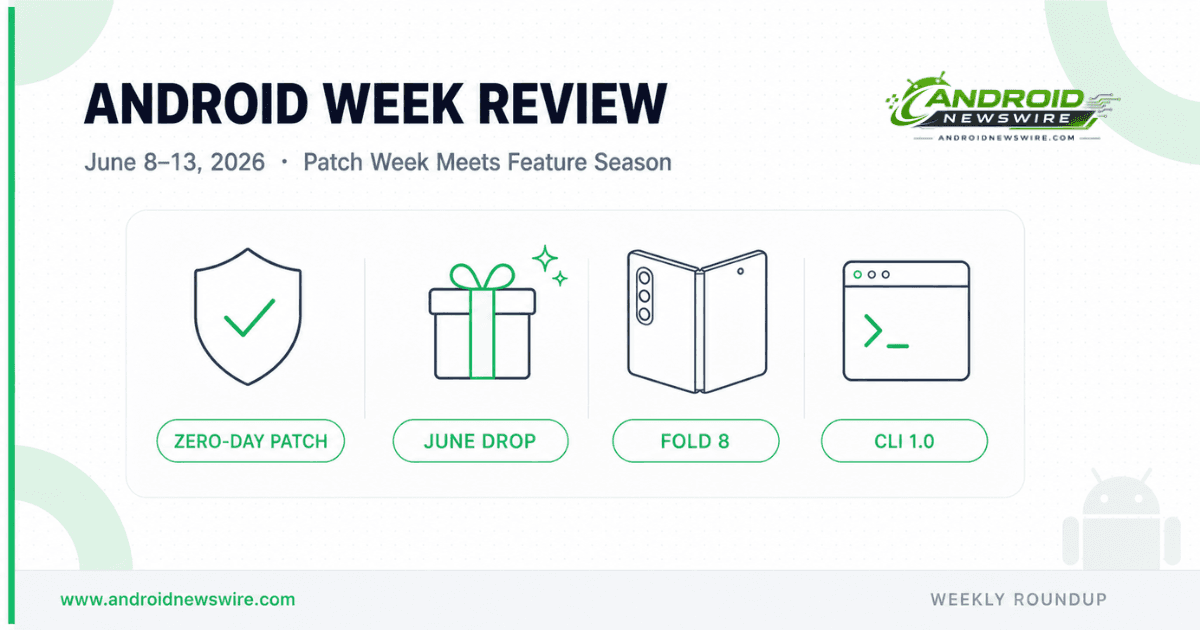
If May 2026 belonged to Google I/O, the second week of June belonged to the unglamorous work that follows: patching, polishing, and positioning. A security bulletin with an actively exploited zero-day shared the week with the consumer-friendly June Android Drop, Google trimmed its beta programme while Samsung certified three foldables for July, and developers received the most significant tooling drop since I/O. The thread connecting it all — platform maturity is now measured in how fast fixes and features reach real devices, a theme that has defined the entire Android 17 release cycle.
1. The June Security Patch: 124 Fixes and an Exploited Zero-Day
The week opened under the shadow of the June 2026 Android security bulletin — one of the largest of the year, addressing 124 vulnerabilities across Android 14, 15, 16, and 16 QPR2.
The Zero-Day at the Centre
The bulletin’s most urgent entry is a privilege-escalation flaw already being exploited in targeted attacks, alongside a critical Android Framework vulnerability allowing remote privilege escalation with no user interaction. Pixel devices received the patch in the first wave, and the complete analysis is in the June 2026 security patch breakdown.
The Adoption Problem
By Friday, June 12, 2026, install rates indicated most eligible users still had not applied the update — a recurring gap between patch availability and patch adoption that the platform’s silent-update mechanisms have yet to close. Samsung’s parallel June release resolved a further 45 vulnerabilities across One UI and Exynos components and reached a growing roster of Galaxy devices through the week.
2. June Android Drop Reaches Phones in Volume
Announced June 2, 2026, the June Android Drop hit broad rollout this week — the most consumer-visible feature wave of the quarter.
Fake Call Detection
Phone by Google gained fake call detection, using encrypted RCS verification to flag calls spoofing a trusted contact’s number. It is the most practical anti-scam feature Google has shipped since the AI call-screening work covered in Android’s 2026 security and privacy overhaul.
Digital Wardrobe, Circle to Search, and Quick Share
Google Photos began rolling out Digital Wardrobe, cataloguing clothing from your library into a virtual closet with mix-and-match try-on. Circle to Search’s multi-object outfit identification expanded to all compatible Android 14+ phones. Quick Share’s AirDrop interoperability reached the Galaxy S25 and S24 series plus recent Z-series foldables, with Oppo, OnePlus, Vivo, Xiaomi, and Honor devices confirmed for later in 2026. Gboard collected new Emoji Kitchen combinations, and the Personal Safety app extended lock-screen medical info, emergency contacts, and car crash detection to children under 13. Full feature detail is in the June 2026 Feature Drop coverage.
3. Android 17 QPR1 Beta 4: Eight Fixes, One Quiet Goodbye
Google shipped Android 17 QPR1 Beta 4 on June 10, 2026 — build CP31.260522.006 — carrying eight targeted bug fixes covering the invisible external-display mouse pointer, Private Space Settings crashes, 5x zoom video jitter, Back Tap failures, broken Wireless ADB, disappearing widgets, and an OpenGL ES regression.
The Pixel 6 Question
The changelog’s silent omission spoke loudest: Pixel 6 and Pixel 6 Pro were removed from the QPR1 beta programme without notice, while the Pixel 6a remains. Whether this signals an early end to the Pixel 6’s feature-update track or merely a beta-programme trim is the open question heading into next week — the full picture is in the QPR1 Beta 4 report. QPR1 stable remains on course for September 2026.
4. Samsung Certifies the Z Fold 8 Trio
On June 11, 2026, the Galaxy Z Flip 8, Galaxy Z Fold 8, and Galaxy Z Fold 8 Ultra cleared regulatory certifications — the final procedural step before the July 22, 2026 Unpacked event in London.
What the Filings Confirm
Three foldables, all powered by the Snapdragon 8 Elite Gen 5 for Galaxy, with the Fold 8 Ultra carrying a 5,000mAh battery and 45W charging. All launch on Android 17 with One UI 9 — the first non-Pixel devices to ship the platform, exactly on the timeline laid out in every phone getting Android 17. The Z Fold 8 also headlines the Gemini Intelligence qualification list from launch, alongside the Pixel 10 and Galaxy S26 series.
One UI 9 Beta Momentum
The One UI 9 beta, running since May 11, 2026 for the Galaxy S26 lineup across six countries, expanded to additional mid-range Galaxy models this week, keeping stable S26 availability on track for the third quarter.
5. Developer Tooling: Android CLI 1.0 and Compose 1.11
The week’s developer story was the maturation of agent-era tooling.
Android CLI Goes Stable
Android CLI reached 1.0 with programmatic version lookup, command-line Journeys test execution, and a studio bridge that lets external agents drive Android Studio directly — opening projects, triggering builds, and reading inspection results.
Compose 1.11 and Studio Quail
Jetpack Compose 1.11 delivered first-party Grid and FlexBox layout primitives, trackpad support with matching test APIs, and built-in focus rings for accessible keyboard navigation. Android Studio’s Quail train shipped Quail 1 Patch 1 to stable and pushed Quail 2 through Canaries 5–7, headlined by a LeakCanary profiler task that brings leak-trace analysis into the IDE. The adoption path is mapped in the developer tools deep dive.
6. Android Auto 17 Beta Widens With Gemini
Android Auto 17’s beta expanded through the week, bringing Gemini voice assistance built on Gemini 3.5 Flash to more drivers, alongside previews of customisable home-screen widgets, parked video playback, and Immersive Navigation with 3D Google Maps. DoorDash remains the first confirmed third-party Gemini integration, with the stable trajectory covered in the Android Auto 17.0 update guide.
7. The Road Ahead: Pixel 11 and the Hardware Summer
Background leak activity kept the Pixel 11’s profile sharpening: Tensor G6 on TSMC’s 2nm node with a seven-core CPU led by an ARM C1-Ultra at 4.11 GHz, a MediaTek M90 modem, Titan M3 security, and the Pixel Glow RGB array replacing the camera-bar thermometer on Pro models. Pricing chatter points to $799 for the Pixel 11, rising to $1,199 for the Pro XL, ahead of the August 2026 announcement window detailed in the Pixel 11 leak roundup.
Developer Summary
Four actions for the coming sprint. Re-verify permission-sensitive code paths against the June patch’s Framework fixes. Upgrade CI to Android CLI 1.0 and replace version-parsing scripts with programmatic lookup. Branch-test Compose 1.11, auditing custom focus visuals and grid implementations. And validate adaptive layouts against large-screen profiles before the Z Fold 8 ships Android 17 to a mass audience in July — the adaptive API surface from the Android 17 developer guide is now weeks from its biggest deployment.
What Comes Next
The week of June 15, 2026 should bring continued June Drop expansion, Samsung’s pre-Unpacked teaser campaign, early Gemini Intelligence qualification messaging ahead of the summer rollout, and — if the cadence holds — movement on Android 17 stable for the first non-Pixel OEMs. The Developer Verification timeline also creeps closer: Advanced Flow sideloading goes live in August 2026, so the steps in the Advanced Flow sideloading explainer are worth reviewing now.
The Week in One Sentence
A 124-fix zero-day patch, a feature-rich June Drop, a trimmed beta programme, three certified foldables, and stable agent-era tooling made June 8–13, 2026 the week Android’s release machine showed both its speed and its blind spots.
Before Monday, take two minutes: install the June patch via Settings → System → Software update, and enable fake call detection under Phone → Settings → Caller ID & spam.