Your Sunday Android Briefing: May 18–23, 2026 — The Week Google I/O Changed Everything
Welcome to your Sunday Android briefing for what was, without question, the most consequential week in Android’s 2026 calendar. Google I/O 2026 ran Tuesday through Wednesday. The keynote delivered on its promise. The developer sessions filled in the technical details. And the post-I/O week dropped several additional stories that complete the picture of where Android is headed for the rest of the year.
We have published six dedicated articles this week covering the biggest individual stories. This roundup covers everything that connects them — plus the stories that did not get their own standalone treatment but are essential context heading into what promises to be an equally packed summer.
The I/O 2026 Recap: What This Week Actually Delivered
Before the individual stories, the headline take: Google I/O 2026 delivered on its ambition. At the Android Show 2026, Google introduced Gemini Intelligence, proactive new AI features on Android, launched Gemini in Chrome with auto browse, introduced Googlebook as a new category of laptops designed for Gemini Intelligence, revealed Android Auto upgrades, showcased new Android 17 features including an optimised Instagram experience with advanced editing tools and Adobe Premiere, and introduced Pause Point as a new wellbeing feature.
Along with Googlebooks, Gemini Intelligence is coming to devices running Wear OS, Android Auto, Android XR, and Android itself. These features will first appear on the latest Samsung Galaxy and Google Pixel phones, with Google starting to deploy them this summer.
The full I/O story on Android News Wire this week:
- Gemini Intelligence: Android Becomes an Intelligence System — AppFunctions API, Create My Widget, Rambler, cross-app automation
- Wear OS 7 Announced — Wear Widgets, 10% better battery, Live Updates, Gemini on wrist
- Android XR Glasses Confirmed for 2026 — XREAL Project Aura and Google/Samsung intelligent eyewear
- I/O 2026 Android Roundup — QPR1 Beta 3, iOS switching, Quick Share × AirDrop, Ask Play, Gemini 3.5 Flash
What follows are the additional stories that did not get dedicated articles this week but are essential reading before Monday.
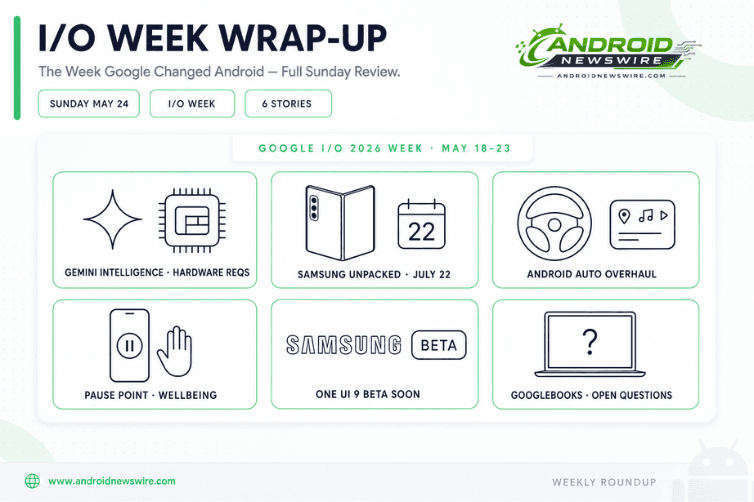
1. Gemini Intelligence Hardware Requirements — A Surprise Limitation
The most debated post-I/O story has not been a new announcement — it has been a footnote. Gemini Intelligence requires a device with 12GB of RAM and a “qualified SoC flagship chip,” and it must receive five Android OS updates and support AI Core and Gemini Nano v3 or higher. That means even devices as recent as the Pixel 9 series and the base Samsung Galaxy Z Fold 7 might not qualify.
For now, the only Samsung phones that support Gemini Nano v3 are the Galaxy S26, Galaxy S26 Plus, and the Galaxy S26 Ultra. The only Google phones with Gemini Nano v3 are the Pixel 10, Pixel 10 Pro, Pixel 10 Pro XL, and the Pixel 10 Pro Fold.
This is the detail that changes how Gemini Intelligence lands in the real world. The cross-app task automation, the Create My Widget tool, the AI Personal Autofill — these are not features that update to your existing Pixel 9 or Galaxy Z Fold 7 this summer. They are features for devices that shipped in 2026 with Gemini Nano v3 hardware on board.
The positive framing: Gemini Intelligence defines a capability tier that creates real differentiation between 2025 and 2026 flagship hardware. The critical framing: the installed base of qualifying devices in summer 2026 is relatively small — the Galaxy S26 series and the Pixel 10 series. Every device that launched before those, regardless of how recent, is effectively on the Gemini Intelligence waiting list until the hardware catches up.
2. Samsung Galaxy Z Fold 8 Unpacked Confirmed for July 22
Samsung’s Unpacked event for the Galaxy Z Fold 8 and Z Flip 8 is reportedly happening on July 22. Samsung is reportedly planning to launch its Galaxy Glasses later this year alongside the Galaxy Z Fold 8 and Z Flip 8, which would make them the first devices to ship with Android XR out of the box.
July 22 is the most significant Samsung hardware date on the 2026 calendar. The Galaxy Z Fold 8 and Z Flip 8 arrive as the first Samsung devices confirmed for One UI 9 and — per the Seoul Economic Daily report — the first Samsung devices to receive Gemini Intelligence commercially. The Galaxy Glasses alongside them would make July 22 Samsung’s biggest single hardware announcement since the Galaxy S26 launch in March.
For context on what 45W charging and the full Galaxy Z Fold 8 spec expectations look like — including the previously confirmed upgrade from the Z Fold 7’s 25W charging — see our March 2026 Week 4 roundup where those hardware details first surfaced.
3. Android Auto Gets Its Biggest Overhaul in Years
Android Auto is getting a much needed makeover with customisable widgets on the home screen, support for video playback, and more.
Google Maps for Android Auto is going 3D with new Immersive Navigation that can better instruct users with directions.
Android Auto’s overhaul covers four distinct areas. Customisable home screen widgets — replacing the fixed grid that has defined Android Auto’s interface for years — mean drivers can arrange their most-used functions around their driving habits rather than accepting Google’s default layout. Video playback support brings passenger entertainment to the front-seat display, a capability that Android Auto has conspicuously lacked compared to Apple CarPlay with its sidecar display mode.
Immersive 3D Google Maps navigation is the feature most likely to drive upgrade motivation among existing Android Auto users. The shift from the flat 2D navigation overlay to a fully rendered 3D environment — with better contextual lane guidance, more clearly rendered upcoming manoeuvres, and a navigational experience that feels architecturally similar to what Google Maps has offered on phones since the Google Earth integration — is a qualitative improvement in daily driving usefulness.
Dolby Atmos audio support in Android Auto rounds out what is genuinely the most comprehensive update to Google’s in-car platform since its original launch. Gemini Intelligence is coming to Android Auto, with features that can use context from your messages, email, and calendar to help with replies or voice-driven tasks. The Gemini context-awareness in Android Auto — understanding what is on your calendar when you ask for navigation, surfacing relevant message summaries while driving — is the AI layer that elevates the feature list from spec upgrades to a genuinely different car experience.
4. Pause Point — Android 17’s Wellbeing Feature for the Doomscrolling Era
Reclaim your time with Pause Point. This new wellbeing feature helps stop doomscrolling so you can use your phone with more intent.
Pause Point is Android 17’s answer to a problem that every previous al Wellbeing feature has approached but not solved: not just telling you how much time you have spent on your phone, but actively interrupting the scrolling loop before it extends further than you intended.
The feature, confirmed for Android 17’s stable June launch, detects extended passive scrolling sessions in social apps and surfaces a gentle intervention — a moment of pause rather than a hard block — that creates space for a conscious decision about whether to continue. The distinction from screen time limits is important: Pause Point is not a governor that cuts off access, it is a mindfulness prompt that gives you back the decision you handed to the algorithm.
For developers building social, content, or media apps: Pause Point interacts with your app at the system level rather than requiring any in-app implementation. It is worth understanding how it surfaces to users of your app — not as a developer compliance requirement, but as a feature that shapes how your most engaged users experience your app going forward.
5. One UI 9 Beta — Coming Within Weeks
One UI 9 is expected to launch on Samsung’s new foldables, with the Android 17-based update now available in beta. A public beta is expected in late May or early June.
One UI 9 is Samsung’s Android 17-based update — the natural successor to One UI 8.5 that brought Android 16 to the Galaxy S25 series and foldables earlier this month. Built on Android 17, One UI 9 carries the full Material 3 Expressive visual overhaul, native App Lock, Desktop Mode improvements, and the Wear OS 7 companion experience for Galaxy Watch 8 devices.
The public beta arriving in late May or early June — within the next two weeks — follows Samsung’s pattern of launching a beta program before the associated hardware event. With Galaxy Z Fold 8 Unpacked confirmed for July 22, a June beta that coincides with Android 17’s stable release gives Samsung’s testing programme approximately six weeks before the foldable launch. Galaxy S25 owners and Galaxy Z Fold 7/Flip 7 owners will be the first eligible for the One UI 9 beta. Watch for Samsung’s official beta programme announcement in the coming days.
6. Googlebooks: What We Still Don’t Know
Google absolutely stirred some attention when it revealed its Googlebook during last week’s Android Show, but it was a no-show at the Google I/O 2026 keynote. While these premium laptops are fundamentally tied to Gemini Intelligence, we were hopeful to learn more about them, especially what its hardware partners intend to do with their versions.
Google may have revealed a bunch of details about Googlebooks, including the fact that they will be running on an Android-based operating system, but there’s still a bunch we don’t know — like a name, because so far we’ve just been calling it Googlebook OS. Rumours suggested that the name AluminiumOS could be on the cards, but that might just have been a codename.
The Googlebook story remains the largest open chapter from I/O week. Google confirmed the product, named the hardware partners (Acer, ASUS, Dell, HP, Lenovo), demonstrated Magic Pointer, and showed Create My Widget running on a laptop display. What it has not confirmed: the operating system’s official name, pricing for any model, a specific launch date, how existing ChromeOS apps and the ChromeOS user base transition, and what the developer SDK for Googlebook-specific features looks like. All of these are questions that need answers before Googlebooks ship.
Google I/O’s on-demand session library — available at io.google as of May 21 — includes a Googlebooks developer session that goes deeper than the keynote. If you are building for or evaluating Googlebooks as a development target, the on-demand session is where the technical detail lives.
7. Android 17 Stable — What the Final Timeline Looks Like
Google did not announce a specific date for Android 17 stable at I/O — it maintained the “June 2026” target without committing to a calendar day. Based on Google’s pattern of releasing stable alongside or shortly after I/O — Android 16 shipped June 10, 2025 — the most probable window for Android 17 stable is the second or third week of June 2026.
Android 17 QPR1 Beta 3 was released this week with background blur expanding to more parts of the user interface. With QPR1 Beta 3 already live, the QPR1 Beta cycle is advancing rapidly toward stable alongside the base Android 17 release. The convergence of both timelines in June will be the most compressed Android release month in the platform’s history.
For developers: if you have not yet run your app against Android 17 QPR1 Beta 3, do it this weekend. The June stable launch is approximately three weeks away. Any breaking behaviour discovered now has repair time. Any breaking behaviour discovered after stable ships becomes a user-facing regression.
The Developer Summary for This Week
Five things every Android developer should act on coming out of I/O week:
Apply for AppFunctions Early Access. The programme is open. Early-access developers are the ones who ship Gemini Intelligence integrations at launch rather than chasing the first wave after stable. Apply at the Android developer portal.
Apply for the Android XR Developer Catalyst Programme. XREAL Project Aura launches globally before end of 2026. The Catalyst Programme provides early hardware access for developers building XR experiences. Apply now — hardware kits are limited.
Download the Wear OS 7 Canary Emulator. Available from today in Android Studio’s SDK Manager. Run your existing Wear OS app against the new system image to identify Tile-to-Widget migration requirements before the stable rollout.
Test against Android 17 QPR1 Beta 3. Three weeks to stable. Background blur expansion adds a new visual system context. Run your UI against the updated emulator and verify your overlays, permission dialogs, and system-adjacent UI all look correct.
Watch the I/O on-demand sessions. All 85+ sessions are live at io.google as of May 21. Prioritise: Adaptive Everywhere, AppFunctions integration walkthrough, Wear OS 7 developer session, Android XR SDK Developer Preview 4, and the three agentic coding sessions.
The Week in One Sentence
The week of May 18–23, 2026 was the week Google stopped talking about what Android would become and started showing what it already is — an intelligence system with a developer API, a wearable platform in its most capable form yet, glasses that you can actually buy before the year ends, and a summer hardware calendar that runs straight from Android 17 stable in June through Samsung Unpacked on July 22 to Pixel 11 in August or October.